
Free WHS Inspection (Hardware Store) Template
Download our Free WHS Inspection (Hardware Store) Template to identify and control risks like manual handling, falling objects, and forklift traffic.
Free WHS Inspection (Hardware Store) Template
DOCX • 128 KB + PDF
Updated Oct 2026
No signup required
Purpose of the Free WHS Inspection (Hardware Store) Template
Managing workplace health and safety in a busy hardware store requires a systematic approach. Our Free WHS Inspection (Hardware Store) Template provides a structured starting point for identifying hazards unique to the retail hardware environment, from customer aisles to the back-of-house warehouse.
This Inspection template helps you proactively manage risks before they lead to incidents, injuries, or property damage.
Hardware stores contain a diverse range of hazards, including:
- Manual Handling: Lifting and moving heavy or awkward items like bags of concrete, timber, and paint tins.
- Slips, Trips & Falls: Spills from liquids, dust from building materials, and clutter in aisles or storage areas.
- Falling Objects: Unstable stacking on high shelves or pallet racking.
- Plant & Equipment: Use of forklifts, pallet jacks, paint tinting machines, and timber cutting saws.
- Hazardous Chemicals: Storage and handling of paints, solvents, pesticides, and pool chemicals.
Using this template to conduct regular inspections helps a Person Conducting a Business or Undertaking (PCBU) demonstrate due diligence and maintain a record of safety management activities. It forms a critical component of broader WHS management systems, providing tangible evidence of your commitment to a safe workplace for employees and customers alike.
Video walkthrough
How to use the Free WHS Inspection (Hardware Store) Template
This resource is provided as a fully editable DOCX file, with a PDF version also available for easy printing. To use it, simply download the file and open it in your preferred word processor.
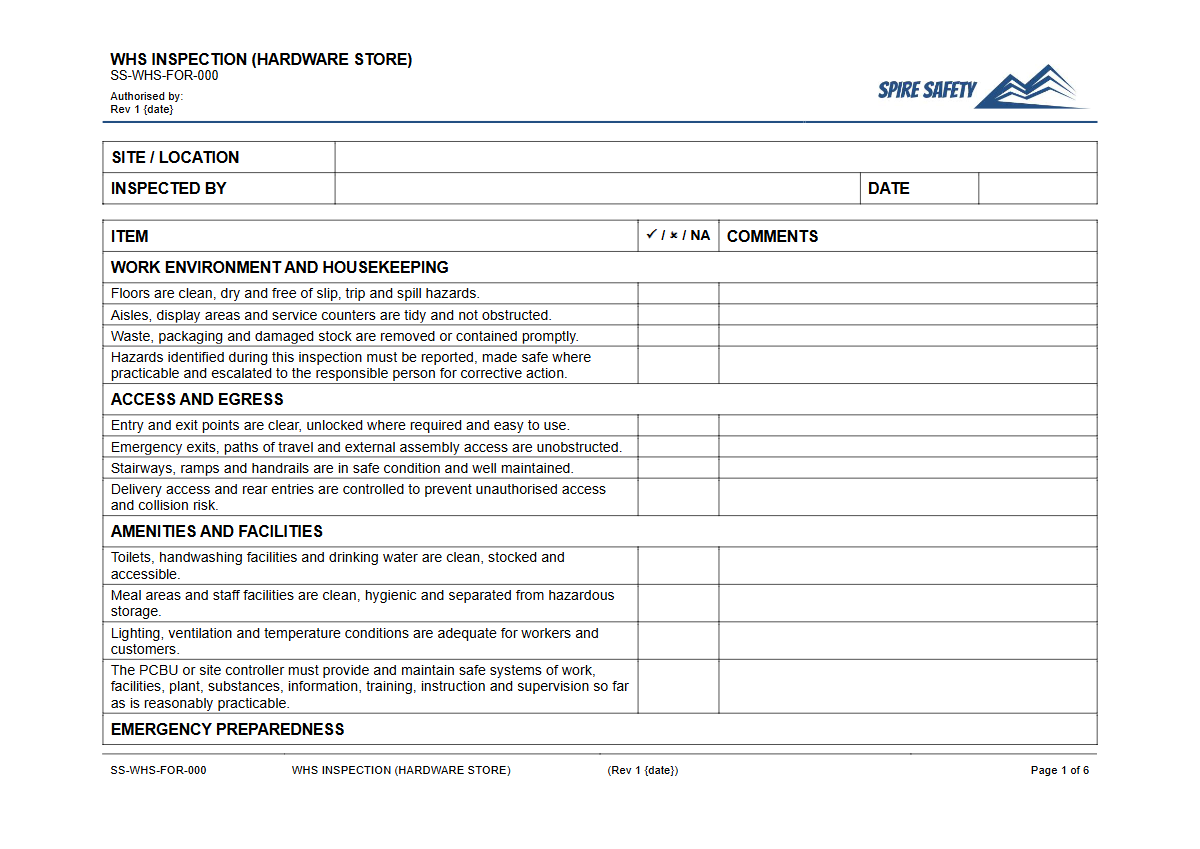
The checklist is organised by common areas within a hardware store, such as the main shop floor, warehouse, timber yard, and staff amenities.
You can then walk through the relevant areas of your workplace, checking off items and making notes on any hazards or non-conformances you identify. For each issue, there is space to assign a corrective action, nominate a responsible person, and set a due date to ensure timely resolution.
Important: This template is a guide based on general Australian WHS principles and must be adapted to your specific site. We strongly recommend that you customise this document to address the unique layout, equipment, and work processes of your hardware store. You might need to add sections for a garden centre, specific machinery like a key cutting station, or review the safety of any lifting equipment with a dedicated electric hoist pre-start checklist.
When to use this Inspection
Regular and consistent safety inspections are key to maintaining a safe environment. The ideal frequency will depend on the risk level and nature of different areas within your store. Consider implementing a schedule such as:
- Daily: Quick visual checks of public aisles, entryways, and high-traffic areas for immediate trip hazards or spills.
- Weekly: A more thorough walk-through of the entire store, including storage areas and staff facilities.
- Monthly: A detailed, in-depth inspection covering all items on the checklist, including a review of previous corrective actions.
Inspections should also be conducted after an incident, following the introduction of new equipment or shelving, or after a significant change to the store layout. For comprehensive reviews, you might engage a professional for a WHS compliance auditing service.
Who should use it
This inspection template is designed for use by anyone with responsibility for health and safety in a hardware retail setting. This includes:
- Store Managers and Assistant Managers
- Department Supervisors (e.g., Warehouse, Garden, Trade Desk)
- Health and Safety Representatives (HSRs)
- WHS Committee Members
- Business Owners
Effective inspections involve consultation. It is best practice to involve workers from the areas being inspected, as they have first-hand knowledge of the work processes and associated hazards.
This collaborative approach fosters a stronger safety culture and leads to more practical and effective solutions. For specific areas like delivery docks, consulting with staff on procedures for vehicle entry, which might be controlled by a boom gate, can be invaluable; you could even use a specific boom gate pre-start checklist for this asset.
Similarly, if your store sells ride-on equipment, having a specific lawn tractor pre-start checklist helps manage risks associated with demonstrations or pre-delivery checks. You can find these and more in our free WHS resources library.
Common mistakes
Common mistakes to avoid
- Using a generic checklist that doesn't address hardware-specific hazards like pallet racking or forklift operations.
- Failing to document and track corrective actions, leaving identified hazards unresolved.
- Not involving team members from different departments (e.g., warehouse, garden) in the inspection process.
- Conducting inspections at the same time and day, missing issues that only occur during peak hours or shift changes.
Legal references
Legal considerations
The following legal requirements may be relevant to this type of work.
- Work Health and Safety Act (Harmonised) — Provides the primary duties for protecting workers and other people from work health and safety risks.
- Work Health and Safety Regulations (Harmonised) — Sets out requirements supporting the management of workplace hazards and risks.
The following codes may be relevant to this type of work.
- Managing WHS Risks Code of Practice — Provides practical guidance on identifying hazards, assessing risks and applying effective controls.
- Work Health and Safety Consultation, Cooperation and Coordination Code of Practice — Provides practical guidance on consulting workers and coordinating with other duty holders.
- Managing the Work Environment and Facilities Code of Practice — Provides practical guidance on safe work environments, workplace facilities and related controls.
Did you know
Manual Handling Risks
In Australian retail, hazardous manual tasks are a leading cause of serious workers' compensation claims. A hardware store presents numerous risks, from lifting bags of cement to moving bulky flat-pack furniture.
Slips, Trips & Falls
Slips, trips, and falls are the second most common cause of injury in the retail sector, often resulting from spills, uneven surfaces, or poor housekeeping in aisles and storage areas.
FAQ
Frequently asked questions
01What are the main WHS risks in a hardware store?
02How often should we inspect our hardware store for safety issues?
03Can I use this template if my store has a garden centre or timber yard?
04Does using this template make my hardware store WHS-aligned?
Share this resource
Free WHS Inspection (Hardware Store) Template
Browse Categories
How To Use It
- 1Download and open in Word or PDF.
- 2Replace the placeholders with your business details.
- 3Get it reviewed by a WHS specialist before rollout.
Need it customised?
Our WHS consultants can adapt this template to your site, run a gap analysis, or audit what you already have in place.
Book a Free Consultation WHS consulting servicesor call 1300 156 382