
Free WHS Inspection (Hospital) Template
Download our free WHS Inspection Template for hospitals.
Free WHS Inspection (Hospital) Template
DOCX • 128 KB + PDF
Updated Oct 2026
No signup required
Purpose of the Free WHS Inspection (Hospital) Template
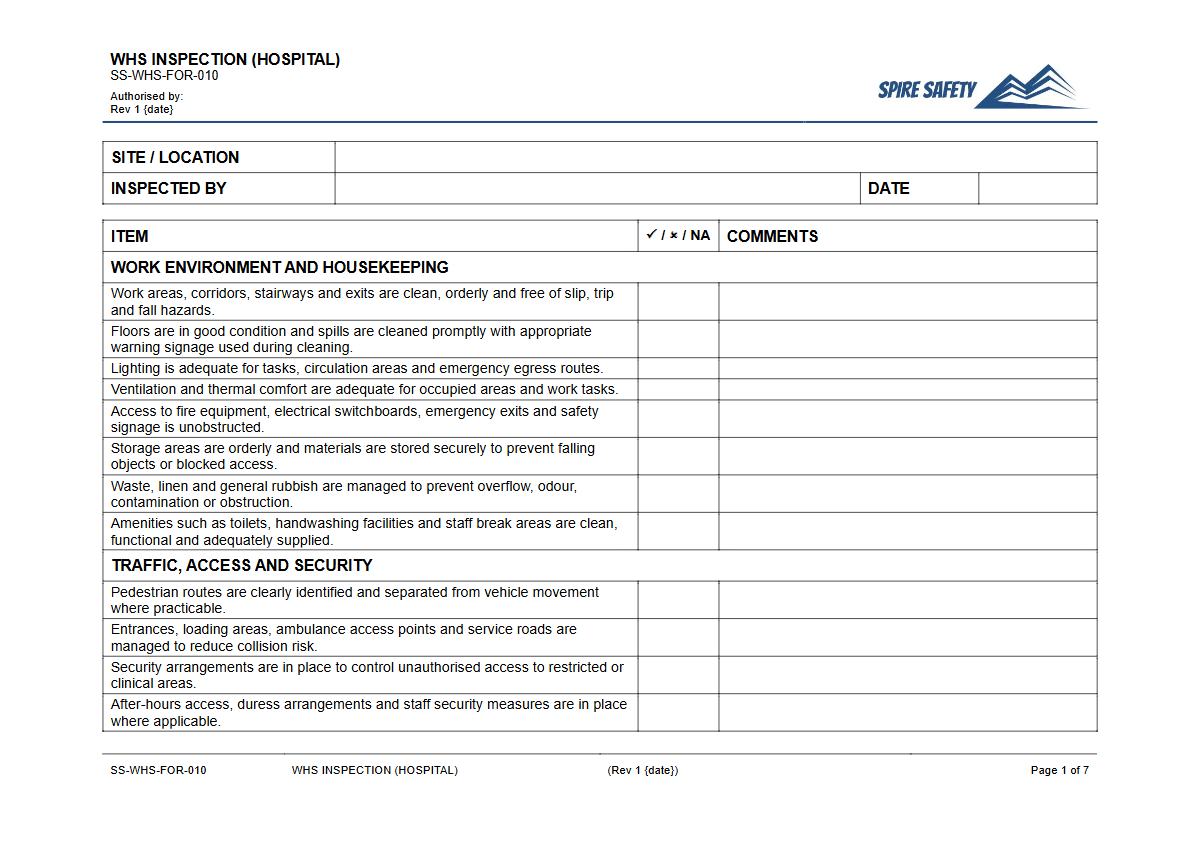
Hospitals and healthcare facilities present a unique and complex range of work health and safety risks. Our Free WHS Inspection (Hospital) Template provides a structured starting point for systematically identifying and controlling these hazards.
Regular, documented inspections are a cornerstone of any effective safety management approach, demonstrating due diligence and a proactive commitment to the wellbeing of staff, patients, and visitors. This template is designed to formalise the process of workplace safety checks, covering diverse areas from patient rooms and clinical areas to kitchens and administrative offices.
Using this template helps your organisation move beyond ad-hoc checks towards a scheduled, consistent process. It prompts users to look for common and specific hazards, including slips, trips, and falls, manual handling risks, electrical equipment safety, chemical storage, infection control measures, and fire safety. Integrating regular inspections into your broader safety framework is a key activity for maintaining a safe workplace and forms an essential part of robust WHS management systems.
Video walkthrough
How to use the Free WHS Inspection (Hospital) Template
This resource is available as a fully editable DOCX file and a ready-to-print PDF. The checklist is structured to cover general physical environment hazards, but it must be adapted to reflect the specific risks within your facility.
For example, an inspection of a surgical ward will have different priorities than one for an outpatient clinic or a loading dock. It is crucial to review and modify the checklist to suit the areas being inspected.
For detailed checks on specific plant, you should use dedicated checklists in conjunction with this general inspection. For instance, while this template covers general equipment safety, a more thorough check would use a specific tool like our Free Pre-Start Checklist (Patient Hoist) Template to verify the operational safety of high-risk patient handling equipment before use.
Customisation is essential
This document is a template, not a finished product. We provide it as a starting point, and you must customise it to address the specific hazards and operational context of your hospital or healthcare facility.
This includes adding, removing, or modifying checklist items to ensure they are relevant and comprehensive for each department or area being inspected.
When to use it
The frequency of WHS inspections should be determined by a risk assessment. High-risk areas, such as emergency departments, operating theatres, or kitchens, may require more frequent inspections (e.g., weekly or even daily for some items) than lower-risk administrative areas (e.g., monthly or quarterly).
We recommend establishing a schedule to ensure consistency and thorough coverage across the entire facility.
In addition to routine scheduled inspections, this template should be used following an incident or near-miss, when new equipment is introduced, when work processes change, or when concerns are raised by staff. These situational inspections help identify causal factors and verify the effectiveness of new control measures. While regular inspections are operational checks, they can also provide valuable data for more formal, periodic WHS compliance auditing.
Who should use it
This inspection template is designed for use by a range of personnel responsible for health and safety. This includes:
- WHS Managers and Safety Officers
- Facility and Operations Managers
- Department Heads and Unit Managers
- Health and Safety Representatives (HSRs)
- Members of the WHS Committee
Engaging frontline workers in the inspection process is highly beneficial, as they have direct, practical knowledge of the work environment and its associated hazards. Consultation is a key principle of Australian WHS legislation, and involving staff in safety inspections helps foster a positive safety culture.
For specific tasks, such as maintenance of external areas, you might use additional resources like a Free Pre-Start Checklist (Lawn Tractor) Template to ensure equipment is safe before operation.
After completing the inspection, findings should be documented, and corrective actions must be assigned, tracked, and verified. This template includes sections for recording these details, creating a clear action plan and an auditable record.
For more granular checks, such as those in maintenance or engineering departments, a specific checklist like the Free Pre-Start Checklist (Electric Hoist) Template can supplement this general workplace inspection. If your organisation requires expert guidance in developing a comprehensive inspection program, consider our tailored WHS consulting services.
Common mistakes
Common mistakes to avoid
- Using a generic checklist without customising it for specific hospital departments or risks.
- Failing to document and follow up on corrective actions for identified hazards.
- Conducting inspections inconsistently without a formal schedule.
- Not involving frontline staff who have firsthand knowledge of workplace risks.
Legal references
Legal considerations
The following legal requirements may be relevant to this type of work.
- Work Health and Safety Act (Harmonised) — Provides the primary duties for protecting workers and other people from work health and safety risks.
- Work Health and Safety Regulations (Harmonised) — Sets out requirements supporting the management of workplace hazards and risks.
The following codes may be relevant to this type of work.
- Managing WHS Risks Code of Practice — Provides practical guidance on identifying hazards, assessing risks and applying effective controls.
- Work Health and Safety Consultation, Cooperation and Coordination Code of Practice — Provides practical guidance on consulting workers and coordinating with other duty holders.
- Managing the Work Environment and Facilities Code of Practice — Provides practical guidance on safe work environments, workplace facilities and related controls.
Did you know
Slips, Trips & Falls
According to Safe Work Australia, slips, trips, and falls are the second most common cause of serious workers' compensation claims in the Healthcare and Social Assistance industry.
Manual Handling Risks
Body stressing, which includes injuries from hazardous manual tasks like lifting patients, is the leading cause of serious injury claims in Australian healthcare settings.
FAQ
Frequently asked questions
01What is the difference between a WHS inspection and an audit?
02How often should WHS inspections be conducted in a hospital?
03What are common hazards to look for in a hospital WHS inspection?
04Can this template be used for aged care facilities?
Share this resource
Free WHS Inspection (Hospital) Template
Browse Categories
How To Use It
- 1Download and open in Word or PDF.
- 2Replace the placeholders with your business details.
- 3Get it reviewed by a WHS specialist before rollout.
Need it customised?
Our WHS consultants can adapt this template to your site, run a gap analysis, or audit what you already have in place.
Book a Free Consultation WHS consulting servicesor call 1300 156 382