
Free WHS Inspection (Imaging Centre) Template
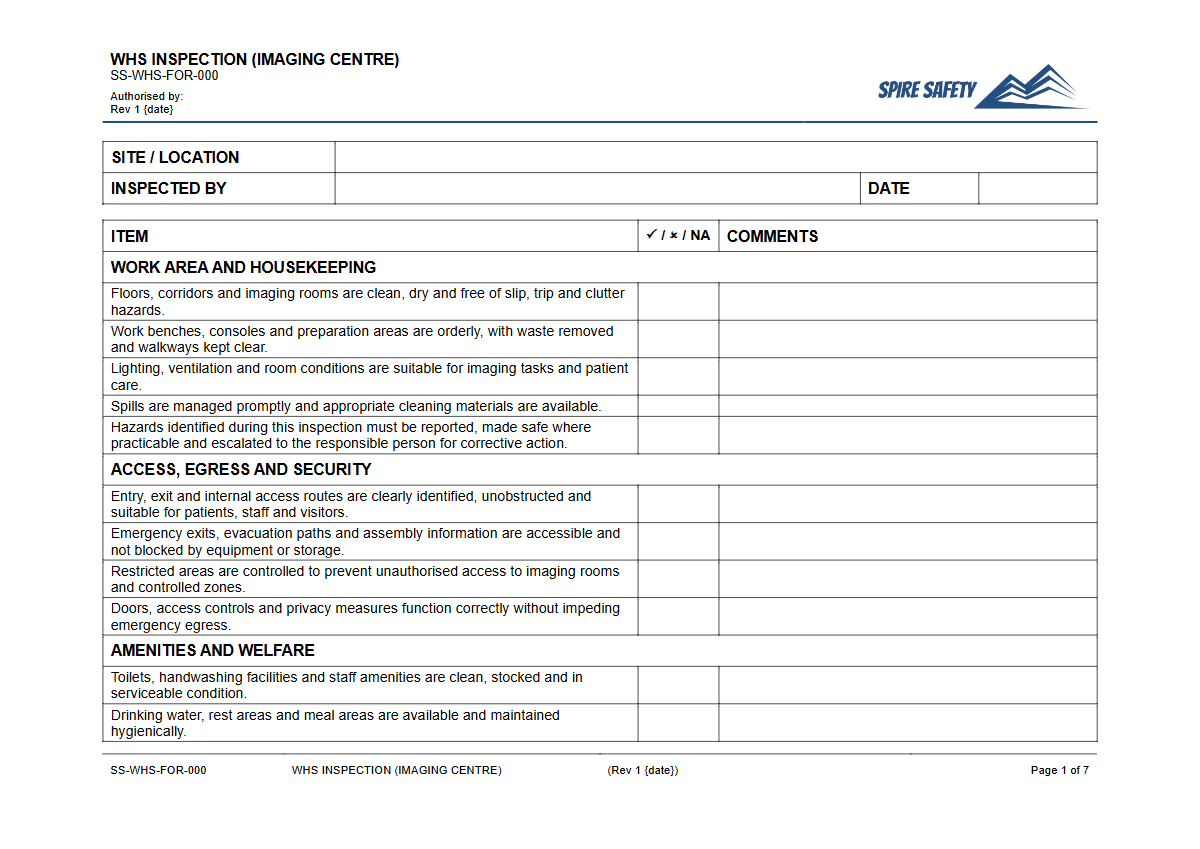
Download our Free WHS Inspection (Imaging Centre) Template to formalise safety checks for MRI, CT, X-ray, and ultrasound environments.
Free WHS Inspection (Imaging Centre) Template
DOCX • 128 KB + PDF
Updated Oct 2026
No signup required
Purpose of the Free WHS Inspection (Imaging Centre) Template
Imaging centres present a unique combination of workplace hazards, from powerful magnetic fields and ionising radiation to patient handling and electrical risks. A systematic inspection process is crucial for identifying and controlling these risks before they lead to an incident.
This Free WHS Inspection (Imaging Centre) Template provides a structured starting point for your organisation to develop a robust inspection program tailored to diagnostic imaging environments. Regular inspections help ensure equipment is functioning correctly, safety protocols are being followed, and the physical environment is free from hazards.
Using a formal checklist helps you proactively manage health and safety obligations. It prompts a thorough review of critical areas, including radiation safety measures, magnetic field controls (for MRI suites), electrical equipment safety, and manual handling risks associated with patient care.
Properly managing patient mobility is a key part of this; our Free Pre-Start Checklist (Patient Hoist) Template can assist with the daily checks of specific lifting equipment.
Video walkthrough
How to use the Free WHS Inspection (Imaging Centre) Template
This resource is available as a fully editable DOCX file and a print-ready PDF. The DOCX version is designed to be adapted to your specific operational needs.
A generic checklist cannot cover the unique layout, equipment models, and procedures of every facility. It is essential that you add, remove, and modify checklist items to create a document that accurately reflects your workplace.
Important: This document is a template, not a finished product. We strongly recommend you customise every section to reflect the specific equipment, layouts, and procedures of your facility.
Effective safety management involves integrating these checks into your broader operational framework. A well-designed inspection is a key component of comprehensive WHS management systems, providing valuable data for risk assessments and continuous improvement.
Key Inspection Areas
Your customised checklist should cover several critical domains specific to an imaging environment:
- Radiation Safety: Verifying shielding integrity, correct use of personal protective equipment (PPE) like lead aprons, functioning warning lights and signage, and adherence to ALARA (As Low As Reasonably Achievable) principles.
- Equipment Integrity: Checking the physical condition of MRI, CT, X-ray, and ultrasound machines. This includes inspecting cables for damage, ensuring emergency stops are functional, and verifying that routine maintenance and calibration are up to date.
- Patient and Staff Safety: Assessing manual handling risks, ensuring clear and unobstructed patient pathways, checking the condition of patient beds and chairs, and verifying infection control measures.
- Environment and Ancillary Equipment: Inspecting for slip, trip, and fall hazards, ensuring adequate lighting and ventilation, and checking the safety of supporting equipment. Even simple items require checks; you might formalise this with a specific tool like a pre-start checklist for a bottle warmer used in paediatric settings.
- Emergency Preparedness: Confirming that fire extinguishers are accessible and serviced, emergency exits are clear, and staff are familiar with procedures for events like an MRI quench or power failure.
When to use it
The frequency of inspections should be determined by a risk assessment. High-risk areas or equipment may require daily or weekly checks, while a full facility inspection might be conducted monthly or quarterly.
This template is ideal for scheduling these regular, proactive walkthroughs. It should also be used following any significant change, such as the installation of new imaging equipment, a change in layout, or after a safety incident or near-miss to identify contributing factors.
Routine checks of specific plant and equipment are an essential part of this process. For example, if your centre uses lifting devices for maintenance or other tasks, a resource like our Free Pre-Start Checklist (Electric Hoist) Template can supplement your broader inspection regime.
Who should use it
This inspection should be carried out by a competent person with a thorough understanding of the hazards present in an imaging centre. This could be a Clinic Manager, Lead Radiographer, a dedicated WHS Officer, or a member of the health and safety committee.
To ensure objectivity and rigour, it can be beneficial to have inspections conducted by someone not directly responsible for the area being inspected. The findings must then be formally reported to management for action.
Documented inspections are a practical way to demonstrate due diligence and a commitment to safety. They provide tangible evidence of your hazard identification and risk control efforts.
For an independent assessment of your safety processes against legislative requirements, consider engaging professional WHS compliance auditing services. Exploring our free WHS resources library can also provide additional tools to support your safety management program.
Common mistakes
Common mistakes to avoid
- Failing to customise the template for specific imaging modalities (e.g., using a generic checklist for an MRI suite).
- Conducting 'pencil-whip' inspections without physically verifying the condition of equipment and safety controls.
- Not assigning clear responsibility or deadlines for the corrective actions identified during the inspection.
- Neglecting to review and update the inspection checklist after an incident or when new equipment is introduced.
Legal references
Legal considerations
The following legal requirements may be relevant to this type of work.
- Work Health and Safety Act (Harmonised) — Provides the primary duties for protecting workers and other people from work health and safety risks.
- Work Health and Safety Regulations (Harmonised) — Sets out requirements supporting the management of workplace hazards and risks.
The following codes may be relevant to this type of work.
- Managing WHS Risks Code of Practice — Provides practical guidance on identifying hazards, assessing risks and applying effective controls.
- Work Health and Safety Consultation, Cooperation and Coordination Code of Practice — Provides practical guidance on consulting workers and coordinating with other duty holders.
- Managing the Work Environment and Facilities Code of Practice — Provides practical guidance on safe work environments, workplace facilities and related controls.
Did you know
MRI Safety Zones
Most hospitals use a four-zone system to control access around MRI scanners. This system progressively restricts access to manage the immense risks from the machine's powerful magnetic field, which is always on.
The ALARA Principle
ALARA, or "As Low As Reasonably Achievable," is the guiding principle of radiation safety. It means every reasonable effort must be made to keep radiation exposure to both staff and patients as far below regulatory dose limits as possible.
FAQ
Frequently asked questions
01What is the difference between a pre-start check and a general WHS inspection?
02How often should an imaging centre be formally inspected?
03Are digital inspection forms better than paper ones?
04Who is responsible for acting on the findings of an inspection?
Share this resource
Free WHS Inspection (Imaging Centre) Template
Browse Categories
How To Use It
- 1Download and open in Word or PDF.
- 2Replace the placeholders with your business details.
- 3Get it reviewed by a WHS specialist before rollout.
Need it customised?
Our WHS consultants can adapt this template to your site, run a gap analysis, or audit what you already have in place.
Book a Free Consultation WHS consulting servicesor call 1300 156 382