
Free WHS Inspection (Landscaping Depot) Template
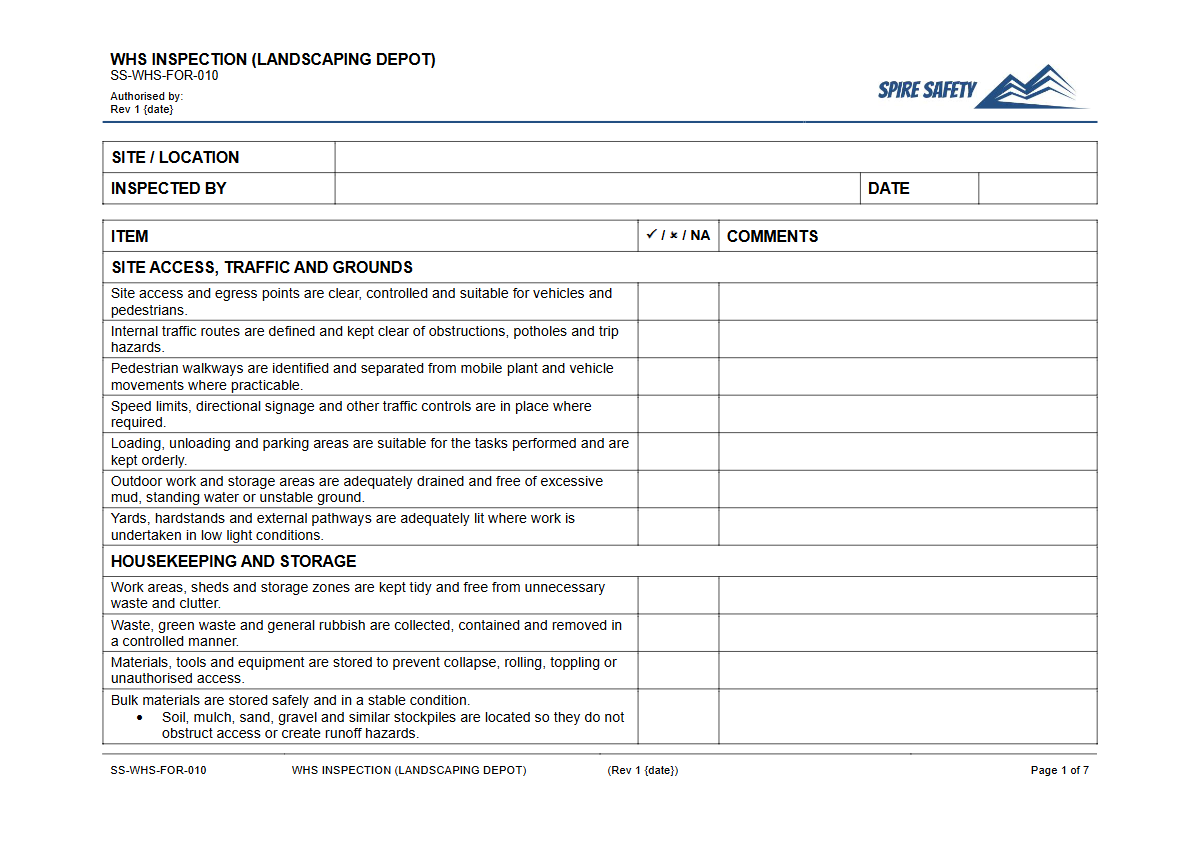
Download our Free WHS Inspection (Landscaping Depot) Template to formalise safety checks. This DOCX & PDF helps identify hazards specific to landscaping yards.
Free WHS Inspection (Landscaping Depot) Template
DOCX • 128 KB + PDF
Updated Oct 2026
No signup required
Purpose of the Free WHS Inspection (Landscaping Depot) Template
A landscaping depot is a dynamic environment with a unique combination of hazards, from moving vehicles and heavy equipment to chemical storage and manual tasks. This Free WHS Inspection (Landscaping Depot) Template provides a structured starting point for systematically identifying these hazards and assessing control measures.
Regular inspections are a fundamental part of proactive safety management, helping your organisation meet its duty of care by maintaining a safe workplace. Using this template helps formalise the process, ensuring that key areas are not overlooked and that a consistent record of safety checks is maintained over time.
This depot-level inspection is designed to provide a broad overview of the site's general condition. It complements, but does not replace, the need for detailed checks on specific machinery.
For example, before operating equipment, workers should still complete a pre-start checklist for a lawn tractor to verify its operational safety. The goal of this broader inspection is to identify systemic issues like poor traffic management, inadequate storage, or deteriorating infrastructure before they lead to an incident.
Video walkthrough
How to use the Free WHS Inspection (Landscaping Depot) Template
This template is provided as a fully editable DOCX file and a ready-to-use PDF. To get the most value from it, you should download the DOCX version and adapt it to the specific layout, equipment, and processes of your landscaping depot.
A generic checklist can miss site-specific hazards.
Follow these general steps:
- Customise: Walk through your depot and add, remove, or modify checklist items to reflect your actual environment. Consider areas like chemical storage sheds, vehicle wash-down bays, workshop areas, staff amenities, and loading zones.
- Schedule: Determine an appropriate frequency for inspections (e.g., weekly, fortnightly, or monthly) based on the level of activity and risk at your site.
- Conduct the Inspection: Walk the site methodically, using the checklist to guide your observations. Note any non-conformances, hazards, or areas for improvement. Take photos where necessary to provide clear evidence.
- Document and Act: Record your findings clearly. For each issue identified, assign a responsible person and a realistic deadline for corrective action. Tracking these actions through to completion is the most critical step.
Important Note: This document is a template only. We are not WHS consultants, and this template does not constitute legal or safety advice.
You must customise this document to suit the specific hazards, risks, and operational needs of your workplace. Its effectiveness is entirely dependent on its correct customisation and implementation.
This structured approach to inspections is a core component of effective WHS management systems, providing valuable data for risk assessment and continuous improvement. It ensures that safety is not just a policy on paper but a practiced reality.
The process also supports a positive safety culture by visibly demonstrating the organisation's commitment to worker wellbeing.
When to use this Inspection Template
This template is designed for regular, planned inspections of your entire landscaping depot. The ideal frequency depends on factors like the size of your operation, the nature of the work, and your site's risk profile.
A busy depot with high vehicle and pedestrian traffic might require weekly inspections, while a smaller, quieter site could be inspected monthly.
In addition to routine checks, this inspection should be conducted:
- After an incident or near-miss to identify contributing environmental factors.
- Following significant changes to the depot layout, equipment, or work processes.
- Before seasonal peaks in activity (e.g., spring or summer) to ensure the site is prepared for increased workloads.
The documented results of these inspections provide essential evidence for any subsequent WHS compliance auditing activities, showing a history of proactive hazard identification and risk management.
Who should use this Inspection Template
The inspection can be carried out by various personnel, depending on your organisation's structure and resources. This may include:
- Site Supervisors or Depot Managers: They have direct oversight of daily operations and are well-positioned to identify and rectify issues quickly.
- Health and Safety Representatives (HSRs): As elected worker representatives, HSRs can use this template to conduct inspections and consult with management on safety matters.
- WHS Committee Members: Inspections can be a scheduled activity for the safety committee, allowing for a collaborative review of the workplace.
- Business Owners or Senior Managers: Conducting inspections demonstrates leadership commitment to safety.
For organisations seeking an independent assessment, engaging external WHS consulting support can provide a fresh perspective and expert insights. No matter who performs the inspection, they should be familiar with the depot's operations and have a basic understanding of WHS principles.
Explore our complete library of free WHS resources for more tools to support your safety program.
Common mistakes
Common mistakes to avoid
- Failing to customise the template for the specific layout and equipment of your depot.
- Overlooking 'minor' housekeeping issues that can lead to major incidents like slips or fires.
- Not documenting corrective actions and failing to assign responsibility for fixing hazards.
- Completing the checklist as a 'tick and flick' exercise without genuine observation or follow-up.
Legal references
Legal considerations
The following legal requirements may be relevant to this type of work.
- Work Health and Safety Act (Harmonised) — Provides the primary duties for protecting workers and other people from work health and safety risks.
- Work Health and Safety Regulations (Harmonised) — Sets out requirements supporting the management of workplace hazards and risks.
The following codes may be relevant to this type of work.
- Managing WHS Risks Code of Practice — Provides practical guidance on identifying hazards, assessing risks and applying effective controls.
- Work Health and Safety Consultation, Cooperation and Coordination Code of Practice — Provides practical guidance on consulting workers and coordinating with other duty holders.
- Managing the Work Environment and Facilities Code of Practice — Provides practical guidance on safe work environments, workplace facilities and related controls.
Did you know
Slips, Trips and Falls
According to Safe Work Australia, slips, trips and falls are a leading cause of serious injury in Australian workplaces, making housekeeping and clear access ways in a depot critically important.
Manual Handling Risks
The agriculture, forestry and fishing industry, which includes many landscaping activities, has one of the highest rates of serious claims for injuries caused by lifting, pushing, or pulling objects.
FAQ
Frequently asked questions
01What are common hazards in a landscaping depot?
02How often should a landscaping depot be inspected?
03Who is responsible for fixing issues found during an inspection?
04Can this template be used for a temporary worksite or just the main depot?
Share this resource
Free WHS Inspection (Landscaping Depot) Template
Browse Categories
How To Use It
- 1Download and open in Word or PDF.
- 2Replace the placeholders with your business details.
- 3Get it reviewed by a WHS specialist before rollout.
Need it customised?
Our WHS consultants can adapt this template to your site, run a gap analysis, or audit what you already have in place.
Book a Free Consultation WHS consulting servicesor call 1300 156 382