
Free WHS Inspection (Loading Dock) Template
Download our Free WHS Inspection (Loading Dock) Template (DOCX & PDF) to formalise safety checks and manage risks in your workplace. Get your free template.
Free WHS Inspection (Loading Dock) Template
DOCX • 127 KB + PDF
Updated Oct 2026
No signup required
Purpose of the Free WHS Inspection (Loading Dock) Template
Loading docks are high-traffic, high-risk environments where workers, vehicles, and plant interact under pressure. A systematic inspection process is essential for identifying hazards and preventing incidents.
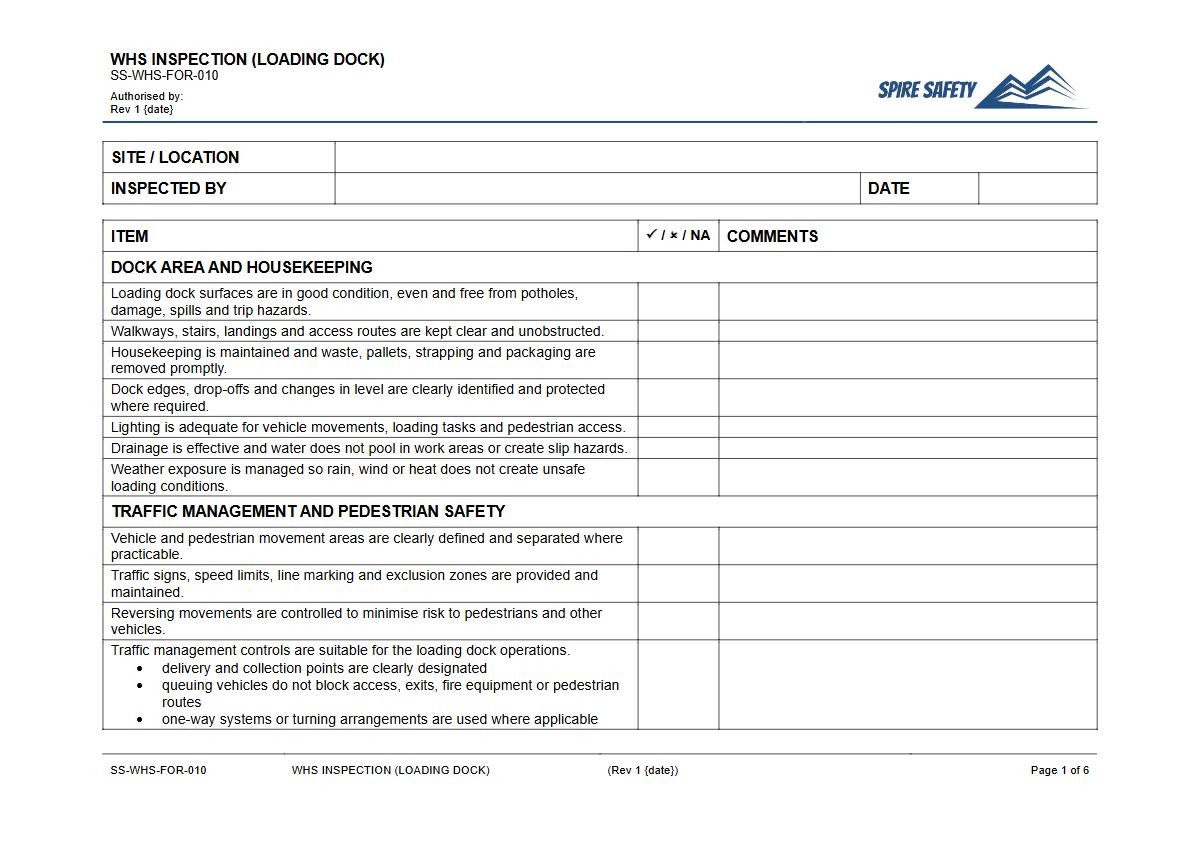
This Free WHS Inspection (Loading Dock) Template provides a structured framework for conducting thorough safety assessments of your loading dock areas. It helps your organisation proactively manage risks by documenting checks for traffic flow, equipment condition, structural integrity, and general housekeeping.
Formalising this process is a key part of effective WHS management systems, ensuring that safety checks are performed consistently and that corrective actions are tracked to completion.
Video walkthrough
How to use the Free WHS Inspection (Loading Dock) Template
This template is designed as a comprehensive starting point for your periodic loading dock safety walks. To use it effectively, the nominated inspector should systematically walk through the area and assess each item listed.
The checklist covers critical components such as vehicle restraints, signage, lighting, emergency procedures, and the condition of physical structures. For more frequent, equipment-specific checks, consider using our Free Pre-Start Checklist (Dock Leveller) Template to supplement this broader inspection.
You can use the checklist to assign a status (e.g., 'Satisfactory', 'Action Required') to each point and make detailed notes on any identified deficiencies. A dedicated section for outlining corrective actions, assigning responsibility, and setting due dates ensures that hazards are addressed in a timely manner.
While this template is based on Australian WHS principles, it is a generic document. You must customise it to reflect the specific hazards, equipment, and operating procedures of your workplace.
We can assist in tailoring this document to your unique operational needs.
What this Inspection Template covers:
- Traffic Management (e.g., speed limits, pedestrian exclusion zones, signage)
- Dock Area and Access (e.g., dock edges, bumpers, lighting, weather protection)
- Dock Equipment (e.g., levellers, ramps, plates, doors, restraints)
- Housekeeping and Environment (e.g., slip/trip hazards, waste management, ventilation)
- Emergency Preparedness (e.g., first aid kits, fire extinguishers, emergency stops)
- Worker Behaviour and Procedures (e.g., use of PPE, adherence to safe work procedures)
The condition of portable equipment is also a critical factor in loading dock safety. In addition to fixed assets, ensure that items like mobile ramps and plates are regularly checked.
You can formalise these checks using our Free Pre-Start Checklist (Dock Plate) Template before each use.
When to use it
This detailed inspection template is best used for periodic safety assessments, such as on a weekly or monthly basis, depending on the intensity of activity in your loading dock. The frequency should be determined by your risk assessment.
It should also be used after any incident or near-miss, after the introduction of new equipment or procedures, or whenever a new hazard is identified. Regular inspections form a crucial evidence trail, demonstrating proactive safety management, which is often reviewed during a formal WHS compliance auditing process.
Who should use it
This template is designed for use by competent personnel with a strong understanding of loading dock operations and WHS principles. This may include Warehouse Managers, Site Supervisors, Logistics Coordinators, Health and Safety Representatives (HSRs), or members of the safety committee.
The person conducting the inspection must have the authority and knowledge to accurately identify hazards and recommend appropriate control measures. Involving workers who operate in the area can also provide valuable insights into day-to-day operational risks.
To explore more specific resources, browse our full free WHS resources library for checklists and templates covering a wide range of plant and equipment.
Common mistakes
Common mistakes to avoid
- Failing to inspect vehicle restraints or chocks, leading to trailer creep or premature departure.
- Overlooking the condition of the dock leveller, ramp, or plate, which can lead to structural failure.
- Ignoring poor lighting, which can obscure hazards and contribute to operator error.
- Not enforcing pedestrian exclusion zones, allowing workers to walk into the path of moving vehicles.
Legal references
Legal considerations
The following legal requirements may be relevant to this type of work.
- Work Health and Safety Act (Harmonised) — Provides the primary duties for protecting workers and other people from work health and safety risks.
- Work Health and Safety Regulations (Harmonised) — Sets out requirements supporting the management of workplace hazards and risks.
The following codes may be relevant to this type of work.
- Managing WHS Risks Code of Practice — Provides practical guidance on identifying hazards, assessing risks and applying effective controls.
- Work Health and Safety Consultation, Cooperation and Coordination Code of Practice — Provides practical guidance on consulting workers and coordinating with other duty holders.
- Managing the Work Environment and Facilities Code of Practice — Provides practical guidance on safe work environments, workplace facilities and related controls.
Did you know
A Significant Drop
According to Safe Work Australia, falls from height are a leading cause of workplace fatalities. The standard height of a loading dock (around 1.2 metres) is high enough to cause serious injury or death if a person or forklift falls from the edge.
Carbon Monoxide Risk
Internal combustion forklifts operating in poorly ventilated loading docks can cause a build-up of toxic carbon monoxide. This highlights the importance of checking ventilation systems as part of any thorough dock inspection.
FAQ
Frequently asked questions
01What is the biggest hazard in a loading dock?
02How often should a loading dock be inspected in Australia?
03What is a 'drive-off' incident at a loading dock?
04Why is housekeeping important in a loading dock inspection?
Share this resource
Free WHS Inspection (Loading Dock) Template
Browse Categories
How To Use It
- 1Download and open in Word or PDF.
- 2Replace the placeholders with your business details.
- 3Get it reviewed by a WHS specialist before rollout.
Need it customised?
Our WHS consultants can adapt this template to your site, run a gap analysis, or audit what you already have in place.
Book a Free Consultation WHS consulting servicesor call 1300 156 382