
Free WHS Inspection (Lumber Mill) Template
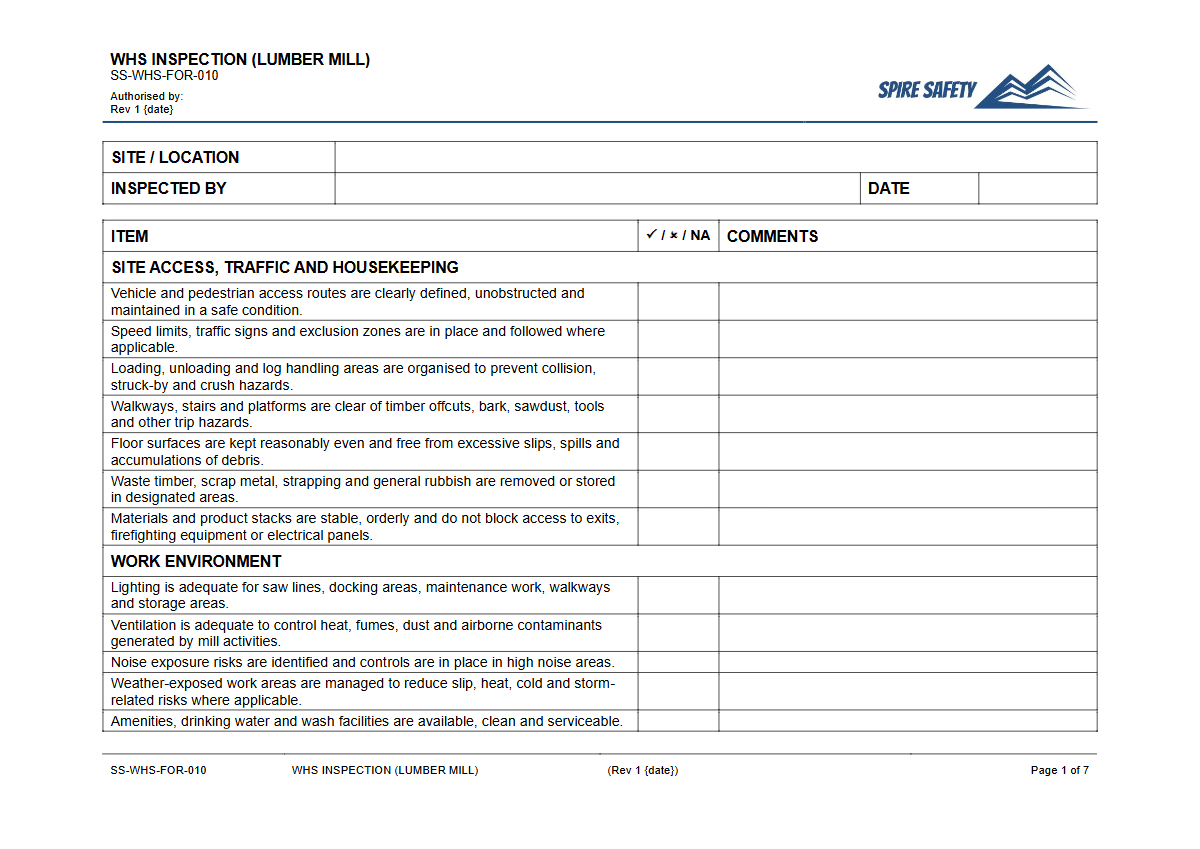
Download our free WHS Inspection (Lumber Mill) Template to identify hazards and control risks in your timber processing operations. A structured starting point.
Free WHS Inspection (Lumber Mill) Template
DOCX • 128 KB + PDF
Updated Oct 2026
No signup required
Purpose of the Free WHS Inspection (Lumber Mill) Template
Lumber and timber mills are high-risk environments with significant WHS hazards. This free WHS Inspection (Lumber Mill) Template provides a structured starting point for systematically identifying and controlling these risks.
It guides users through key areas of a lumber mill operation, from machinery and equipment safety to noise, dust, and traffic management. Using a formal inspection checklist helps create a documented record of safety performance, assists in meeting your duties under WHS legislation, and promotes a safer workplace for everyone on site.
A thorough inspection process is a critical component of proactive safety management. It moves your organisation beyond simply reacting to incidents and towards preventing them.
By regularly assessing your site against established criteria, you can identify unsafe conditions or at-risk behaviours before they lead to injury. This process forms the foundation of robust WHS management systems, demonstrating a clear commitment to continuous improvement and worker wellbeing.
The template prompts checks on debarkers, head saws, resaws, chippers, stacking equipment, and associated mobile plant.
Video walkthrough
How to use the Free WHS Inspection (Lumber Mill) Template
This Inspection template is provided in both DOCX and PDF formats for your convenience. The DOCX version is fully editable, allowing you to tailor it to the specific machinery, processes, and layout of your facility.
It is essential that you customise this document to reflect your unique operational risks.
To effectively use the template, follow these steps:
- Customise the Checklist: Review each section and item. Add, remove, or modify checks to align with your specific equipment (e.g., brand and model of saws), site layout, and known hazards. For example, your checks for lifting equipment should be as detailed as those found in a specific pre-start checklist for an electric hoist.
- Schedule Inspections: Determine an appropriate frequency for inspections based on risk. This may be weekly, monthly, or quarterly.
- Assign Responsibility: Designate trained and competent personnel, such as supervisors or WHS representatives, to conduct the inspections.
- Conduct the Inspection: Walk through the site and systematically complete the checklist, noting any non-conformances, hazards, or areas for improvement. Take photos where necessary.
- Document and Action Findings: Record all findings clearly. For each identified issue, assign a corrective action, a person responsible, and a due date. Track all actions to ensure they are completed.
Site-specific hazards like vehicle interaction points and security are also critical. Ensure your inspection covers access control points and traffic flow.
You might find that a dedicated checklist, such as a boom gate pre-start checklist, is useful for these specific assets to supplement your main site inspection.
When to use it
Regular, scheduled workplace inspections are a cornerstone of good WHS practice. This template should be used as part of your routine safety program at intervals determined by a risk assessment.
Additionally, it is valuable to conduct an inspection after any significant change in the workplace, such as the installation of new machinery, a change in workflow, or following an incident or near miss. These ad-hoc inspections help ensure that new risks are not introduced and that contributing factors to an incident have been effectively controlled. Regular use of this template can also prepare your organisation for formal WHS compliance auditing.
Who should use it
This template is designed for use by individuals with responsibilities for workplace health and safety in a lumber mill environment. This includes:
- Work Health and Safety (WHS) Managers and Officers
- Site Supervisors and Line Managers
- Health and Safety Representatives (HSRs)
- Maintenance Managers
- Business owners or Persons Conducting a Business or Undertaking (PCBUs)
While a designated person should lead the inspection, involving workers who operate the machinery and work in the inspected areas is highly recommended. Their firsthand knowledge is invaluable for identifying subtle or intermittent hazards that a manager might otherwise miss.
The principles of hazard identification are transferable across similar processing industries, as seen in resources like our Feed Mill Pre-Start Checklist. For more tailored advice, our WHS consulting services can provide expert guidance specific to your operations. If you're looking for other checklists and forms, you can browse our complete free WHS resources library.
Common mistakes
Common mistakes to avoid
- Using a generic checklist without customising it for the mill's specific machinery and layout.
- Failing to properly document and track corrective actions for identified hazards, leaving risks uncontrolled.
- Conducting inspections without involving the workers who operate the equipment daily.
- Ignoring 'minor' issues or near misses that could be indicators of a more serious underlying problem.
Legal references
Legal considerations
The following legal requirements may be relevant to this type of work.
- Work Health and Safety Act (Harmonised) — Provides the primary duties for protecting workers and other people from work health and safety risks.
- Work Health and Safety Regulations (Harmonised) — Sets out requirements supporting the management of workplace hazards and risks.
The following codes may be relevant to this type of work.
- Managing WHS Risks Code of Practice — Provides practical guidance on identifying hazards, assessing risks and applying effective controls.
- Work Health and Safety Consultation, Cooperation and Coordination Code of Practice — Provides practical guidance on consulting workers and coordinating with other duty holders.
- Managing the Work Environment and Facilities Code of Practice — Provides practical guidance on safe work environments, workplace facilities and related controls.
Did you know
A Noisy Environment
Noise levels in sawmills can easily exceed 100 decibels (dB), well above the 85 dB exposure standard where hearing protection becomes mandatory. Prolonged exposure without protection can cause permanent hearing loss.
Wood Dust Risks
Besides being a respiratory hazard that can cause asthma and other lung conditions, fine wood dust is also highly combustible. If it accumulates and is mixed with air in the right concentration, it can be ignited, causing a dangerous explosion.
FAQ
Frequently asked questions
01What are the biggest WHS hazards in a lumber mill?
02How often should lumber mill machinery be inspected?
03Is this template enough for WHS compliance?
04Who is responsible for safety in a lumber mill?
Share this resource
Free WHS Inspection (Lumber Mill) Template
Browse Categories
How To Use It
- 1Download and open in Word or PDF.
- 2Replace the placeholders with your business details.
- 3Get it reviewed by a WHS specialist before rollout.
Need it customised?
Our WHS consultants can adapt this template to your site, run a gap analysis, or audit what you already have in place.
Book a Free Consultation WHS consulting servicesor call 1300 156 382