
Free WHS Inspection (Marina Workshop) Template
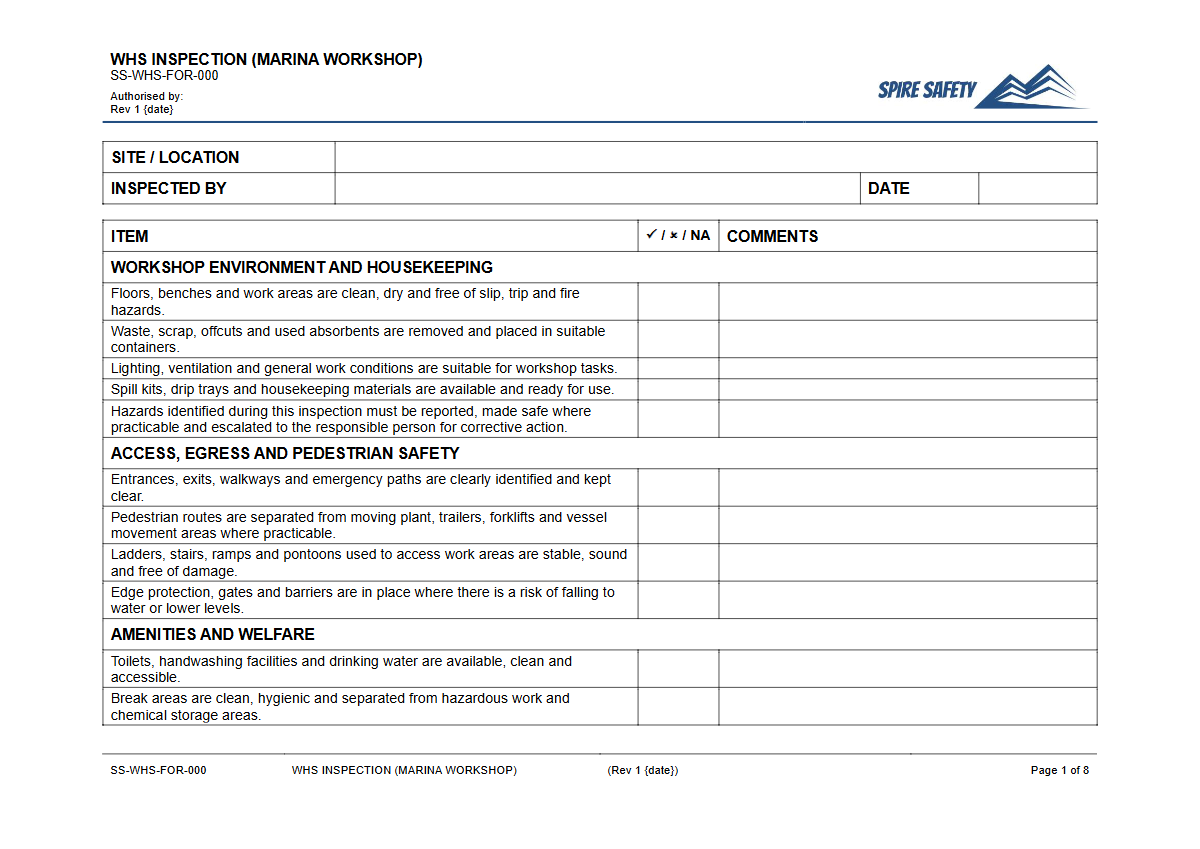
Formalise safety checks with our Free WHS Inspection (Marina Workshop) Template. This structured DOCX & PDF helps identify and manage marine-specific hazards.
Free WHS Inspection (Marina Workshop) Template
DOCX • 129 KB + PDF
Updated Oct 2026
No signup required
Purpose of the Free WHS Inspection (Marina Workshop) Template
Managing work health and safety in a marina workshop requires a systematic approach to identifying the unique hazards present. This environment combines risks from vehicle and vessel maintenance, water proximity, chemical handling, and heavy lifting.
Our Free WHS Inspection (Marina Workshop) Template provides a structured starting point for your organisation to conduct thorough safety inspections. It helps formalise the process of identifying potential hazards, assessing risks, and verifying that control measures are in place and effective.
The template prompts you to examine key areas such as the condition of tools and equipment, electrical safety (especially near water), chemical storage and handling, slip and trip hazards on pontoons and hardstands, and traffic management for both vehicles and pedestrians. By using this Inspection template, you can create a documented record of your safety diligence, which is a cornerstone of effective risk management. For daily checks on specific high-risk plant, consider using it alongside equipment-specific checklists like our Free Pre-Start Checklist (Boat Lift) Template.
Video walkthrough
How to use the Free WHS Inspection (Marina Workshop) Template
This template is provided in both DOCX and PDF formats for your convenience. The DOCX version is fully editable, allowing you to tailor it precisely to your workplace.
The first step is to download the document and review its contents against the specific conditions, equipment, and procedures used in your marina workshop. It is essential to customise this document to reflect your unique operational risks.
Walk through your workshop with the draft template and add, remove, or modify checklist items. For example, you might need to add sections for specific welding bays, fibreglass repair areas, or battery charging stations.
Involve your workers and Health and Safety Representatives (HSRs) in this customisation process; their direct experience is invaluable for identifying practical hazards and effective controls. Once finalised, this inspection form becomes an integral part of your robust WHS management system.
Important: This is a template, not a finished document. We have no knowledge of your specific workplace, equipment, or processes.
You MUST adapt this document to your own business and operational needs in consultation with your team and any relevant safety specialists.
When to use this Inspection resource
Regular, scheduled inspections are key to proactively managing safety. The frequency of using this Inspection template should be determined by a risk assessment, but a common schedule is monthly or quarterly.
More frequent inspections may be necessary for high-risk areas or during periods of increased activity, such as the lead-up to the boating season.
Beyond routine checks, this inspection should also be conducted:
- After an incident, accident, or near-miss occurs to identify contributing factors.
- When new equipment, such as an engine hoist or diagnostic tool, is introduced. For specific items, you might also use a targeted resource like the Free Pre-Start Checklist (Electric Hoist) Template.
- Following changes to workshop layout, work procedures, or chemicals used.
- As part of preparation for external audits. Regular internal inspections help ensure you are prepared for more formal WHS compliance auditing.
Who should use this Inspection resource
This template is designed for use by individuals with responsibility for workplace health and safety. This typically includes:
- Workshop Managers or Supervisors
- WHS/HSE Managers and Officers
- Health and Safety Representatives (HSRs)
- Members of the WHS Committee
- Business Owners or Persons Conducting a Business or Undertaking (PCBUs)
While a manager or safety professional often leads the inspection, it's best practice to involve workers from the areas being inspected. Their hands-on knowledge helps ensure the inspection is practical and relevant. For organisations without dedicated safety personnel, engaging in specialist WHS consulting can provide the expertise needed to effectively implement inspection programs. You can also explore our entire free WHS resources library for other useful templates.
Common mistakes
Common mistakes to avoid
- Failing to customise the template to the specific layout and equipment of their workshop.
- Not involving workers who perform the tasks in the inspection process.
- Completing the checklist but failing to create and track corrective actions for identified hazards.
- Only inspecting reactively when something goes wrong, instead of on a regular, proactive schedule.
Legal references
Legal considerations
The following legal requirements may be relevant to this type of work.
- Work Health and Safety Act (Harmonised) — Provides the primary duties for protecting workers and other people from work health and safety risks.
- Work Health and Safety Regulations (Harmonised) — Sets out requirements supporting the management of workplace hazards and risks.
The following codes may be relevant to this type of work.
- Managing WHS Risks Code of Practice — Provides practical guidance on identifying hazards, assessing risks and applying effective controls.
- Work Health and Safety Consultation, Cooperation and Coordination Code of Practice — Provides practical guidance on consulting workers and coordinating with other duty holders.
- Managing the Work Environment and Facilities Code of Practice — Provides practical guidance on safe work environments, workplace facilities and related controls.
Did you know
Slips, Trips, and Falls
Slips, trips, and falls are a leading cause of injury in workshops. In marine environments, wet or oily floors, stray ropes, hoses, and changing deck levels are major contributing factors.
Chemical Safety
Many common marina workshop chemicals, such as resins, solvents, paints, and antifouling agents, can be hazardous. Effective ventilation and correct personal protective equipment (PPE) are critical to managing exposure risks.
FAQ
Frequently asked questions
01What's the difference between a pre-start check and a workshop inspection?
02How often should I inspect my marina workshop?
03Is this template suitable for all Australian states and territories?
04Can I use this template for other types of workshops?
Share this resource
Free WHS Inspection (Marina Workshop) Template
Browse Categories
How To Use It
- 1Download and open in Word or PDF.
- 2Replace the placeholders with your business details.
- 3Get it reviewed by a WHS specialist before rollout.
Need it customised?
Our WHS consultants can adapt this template to your site, run a gap analysis, or audit what you already have in place.
Book a Free Consultation WHS consulting servicesor call 1300 156 382