
Free WHS Inspection (Medical Centre) Template
Download our free WHS Inspection (Medical Centre) Template. A structured starting point to identify hazards in clinical and administrative areas. Get yours now.
Free WHS Inspection (Medical Centre) Template
DOCX • 128 KB + PDF
Updated Oct 2026
No signup required
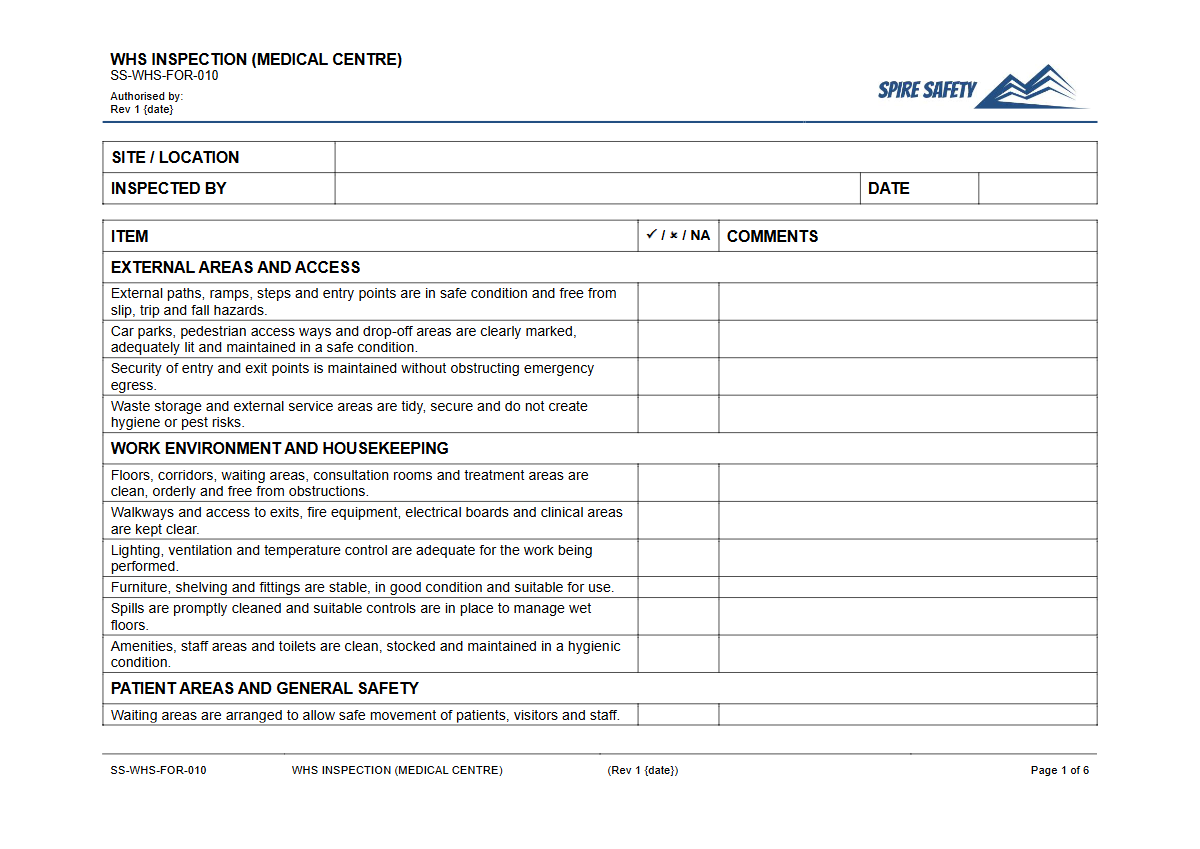
Purpose of the Free WHS Inspection (Medical Centre) Template
Medical centres face a unique combination of workplace hazards, from clinical risks like needlestick injuries and biological exposures to general risks like slips, trips, and psychosocial stress. This Free WHS Inspection (Medical Centre) Template provides a structured starting point for systematically identifying, assessing, and controlling these hazards.
Regular, thorough inspections are a cornerstone of proactive safety management, helping you protect your staff, patients, and visitors while meeting your work health and safety duties.
Using a standardised checklist helps ensure that inspections are consistent and comprehensive, covering everything from consultation rooms and treatment areas to reception and staff facilities. It formalises the process of hazard identification, moving beyond ad-hoc observations to a documented system.
Integrating such procedures is a key part of developing robust WHS management systems that embed safety into your practice's daily operations.
Video walkthrough
How to use the Free WHS Inspection (Medical Centre) Template
This document serves as a foundation for developing a checklist specific to your facility. Start by downloading the template and walking through your practice to identify areas and tasks that need to be included.
The checklist covers common areas like waiting rooms, administrative zones, consulting rooms, and storage areas. Pay special attention to specific equipment and processes unique to your services. For certain high-risk equipment, you may need more detailed daily checks, such as our Free Pre-Start Checklist (Patient Hoist) Template.
Customising Your Inspection Checklist
It is essential that you customise this template to reflect the specific environment and risks of your medical centre. We have provided a comprehensive starting point, but you must adapt it to your own workplace. Walk through your premises and consider hazards in:
- Reception and Waiting Areas: Trip hazards (mats, cables), seating stability, infection control measures.
- Consulting and Treatment Rooms: Sharps disposal, clinical waste management, ergonomics of workstations, electrical equipment safety, and privacy screens.
- Sterilisation Areas: Use of autoclaves, chemical handling, ventilation, and PPE availability.
- Staff Amenities: Kitchen safety, clear emergency exits, and general housekeeping.
- Storage Areas: Safe storage of medical supplies, files, and chemicals. This includes specialised equipment like refrigerators and freezers, which may require their own checks, similar to our Free Pre-Start Checklist (Freezer) Template.
When to use it
Workplace inspections should be conducted on a regular, scheduled basis. The frequency will depend on the level of risk and the nature of the work, but a quarterly inspection is a common starting point for a medical practice. In addition to your regular schedule, inspections should also be carried out:
- After an incident, accident, or near miss occurs.
- When new equipment, substances, or procedures are introduced.
- When there are changes to the layout of the practice.
- If concerns are raised by staff or patients.
The findings from these inspections can provide valuable data for higher-level reviews, such as periodic WHS compliance auditing, to verify that your safety systems are effective and that controls are working as intended.
Who should use it
The inspection should be conducted by a person or team with a good understanding of WHS principles and the practice's operations. This is often a Practice Manager, a designated WHS Officer, or a Health and Safety Representative (HSR).
It is highly beneficial to involve a team that includes both clinical and administrative staff. Frontline workers have intimate knowledge of their tasks and work areas and can often spot hazards that management might overlook.
Involving different people also helps build a stronger safety culture across the organisation. By giving staff responsibility for checking their own areas, you encourage ownership of safety.
This applies to all areas, including administrative zones where simple equipment can still pose a risk if not maintained, making a checklist like the Free Pre-Start Checklist (Envelope Sealer) Template useful for office machinery.
Once completed, the inspection report should be reviewed by management, and an action plan should be developed to address any identified hazards. The results should be communicated to all staff. For more tools to support your safety processes, browse our complete free WHS resources library.
Common mistakes
Common mistakes to avoid
- Using a generic checklist without customising it for the practice's specific rooms, equipment, and procedures.
- Failing to assign responsibility and deadlines for corrective actions identified during the inspection.
- Conducting the inspection with only one person instead of involving a team of clinical and administrative staff.
- Forgetting to inspect non-clinical areas like car parks, staff rooms, and administrative offices.
Legal references
Legal considerations
The following legal requirements may be relevant to this type of work.
- Work Health and Safety Act (Harmonised) — Provides the primary duties for protecting workers and other people from work health and safety risks.
- Work Health and Safety Regulations (Harmonised) — Sets out requirements supporting the management of workplace hazards and risks.
The following codes may be relevant to this type of work.
- Managing WHS Risks Code of Practice — Provides practical guidance on identifying hazards, assessing risks and applying effective controls.
- Work Health and Safety Consultation, Cooperation and Coordination Code of Practice — Provides practical guidance on consulting workers and coordinating with other duty holders.
- Managing the Work Environment and Facilities Code of Practice — Provides practical guidance on safe work environments, workplace facilities and related controls.
Did you know
Healthcare Hazards
The healthcare and social assistance industry is one of Australia's largest, but it also records one of the highest rates of serious workers' compensation claims, with body stressing and slips, trips or falls being major causes.
FAQ
Frequently asked questions
01What specific hazards should an inspection in a medical centre cover?
02How often should we conduct a WHS inspection in our medical practice?
03Is this template suitable for a dental clinic or allied health practice?
04What happens after we find a hazard during an inspection?
Share this resource
Free WHS Inspection (Medical Centre) Template
Browse Categories
How To Use It
- 1Download and open in Word or PDF.
- 2Replace the placeholders with your business details.
- 3Get it reviewed by a WHS specialist before rollout.
Need it customised?
Our WHS consultants can adapt this template to your site, run a gap analysis, or audit what you already have in place.
Book a Free Consultation WHS consulting servicesor call 1300 156 382