
Free WHS Inspection (Motor Workshop) Template
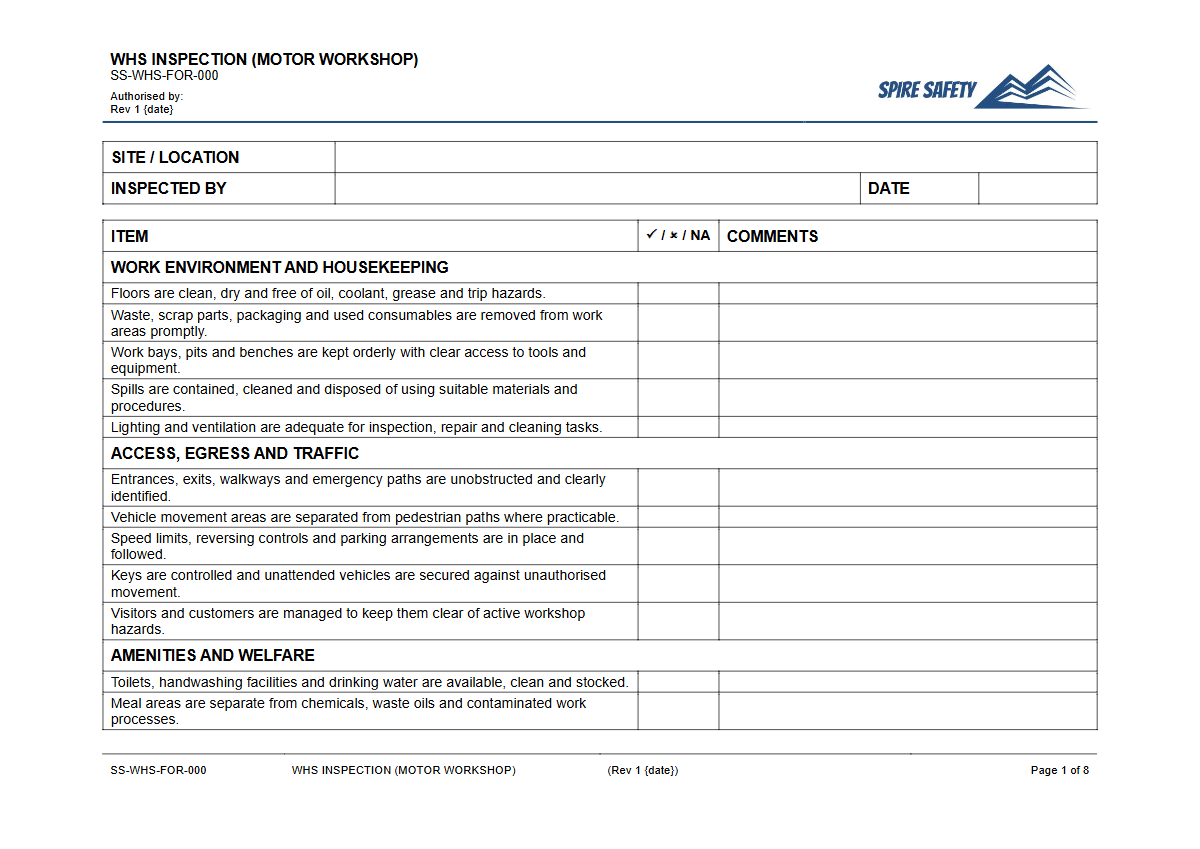
Download our free WHS Inspection Template for motor workshops. A structured DOCX and PDF to help you formalise safety checks and manage hazards.
Free WHS Inspection (Motor Workshop) Template
DOCX • 129 KB + PDF
Updated Oct 2026
No signup required
Purpose of the Free WHS Inspection (Motor Workshop) Template
A motor workshop is a high-risk environment with a unique combination of hazards, including moving vehicles, hazardous substances, heavy lifting, high-pressure equipment, and noise. This Free WHS Inspection (Motor Workshop) Template provides a structured starting point for systematically identifying these hazards before they can cause injury or illness.
Regular, documented inspections are a cornerstone of proactive safety management, helping your business meet its duty of care and maintain a safe working environment.
By using a formal template, you can standardise your inspection process, ensuring that key risk areas are consistently reviewed. This includes everything from the condition of hand tools and the safe operation of vehicle hoists to housekeeping and chemical storage. For specific plant, this general inspection should be supplemented with daily checks, like those detailed in our electric hoist pre-start checklist.
Ultimately, a routine inspection program helps embed safety into your workshop's daily operations. It moves safety from a reactive task to a proactive process, demonstrating a commitment to worker wellbeing and forming a critical part of your overall WHS management systems.
Video walkthrough
How to use the Free WHS Inspection (Motor Workshop) Template
Using this template effectively involves more than just filling in the blanks. It's a multi-step process designed to drive real safety improvements.
Start by downloading the template in your preferred format (DOCX or PDF). Next, walk through your workshop and adapt the checklist to your specific site.
Add, remove, or modify items to reflect the actual plant, equipment, and processes your team uses. Consider all areas, including service bays, parts storage, offices, and site access points, which may have specific controls like those covered in a boom gate pre-start checklist.
The inspection should cover all areas of the workshop, from the main service bays to storage areas and staff facilities. For example, even kitchen equipment requires safety checks, which can be managed with a simple freezer pre-start checklist. Once customised, establish a schedule for inspections, assign responsibilities to competent personnel, and ensure they are trained on how to conduct the inspection thoroughly.
Document all findings, assign corrective actions with deadlines, and track them to completion. These records are vital for demonstrating due diligence.
Customising the Inspection Template
Important: This is a template that provides a starting point. It must be customised to address the specific equipment, chemicals, processes, and risks present in your motor workshop.
We recommend a consultation process with your workers to ensure all site-specific hazards are covered.
When to use it
Workplace inspections should be conducted at regular, planned intervals to ensure ongoing safety. The frequency depends on the level of risk.
High-risk areas or activities might require weekly or fortnightly inspections, while lower-risk areas like offices could be inspected monthly or quarterly.
In addition to scheduled inspections, this template should be used in response to specific events, such as:
- After a workplace incident or near miss.
- When new machinery, equipment, or hazardous substances are introduced.
- When work procedures or the workshop layout changes.
- Following concerns raised by workers or a Health and Safety Representative (HSR).
These planned inspections are a key verification activity. Their effectiveness can be periodically confirmed through more in-depth processes like formal WHS compliance auditing to ensure your safety systems are performing as intended.
Who should use it
A successful inspection program involves a team effort. While a single person may lead the inspection, input should be sought from various roles within the business.
- Workshop Managers and Supervisors: They are typically responsible for ensuring inspections are scheduled, completed, and that all identified corrective actions are implemented and closed out in a timely manner.
- Health and Safety Representatives (HSRs): HSRs have specific powers under WHS law to inspect the workplace and should be involved in the process. They bring a worker-focused perspective and can help champion safety initiatives.
- Workers and Mechanics: The people doing the job every day have invaluable, first-hand knowledge of the risks. Involving them in inspections ensures the process is practical and effective, and increases their engagement in safety.
The person conducting the inspection must be competent, meaning they have the knowledge and experience to identify the hazards specific to a motor workshop. This template is one of many tools available in our free WHS resources library to help support your safety processes.
Common mistakes
Common mistakes to avoid
- Using a generic checklist without customising it for the specific plant, chemicals, and tasks in your workshop.
- Failing to create and track formal corrective actions to fix identified problems.
- Not training the person conducting the inspection on how to identify hazards effectively.
- Treating the inspection as a 'tick and flick' exercise rather than a genuine opportunity to improve safety.
Legal references
Legal considerations
The following legal requirements may be relevant to this type of work.
- Work Health and Safety Act (Harmonised) — Provides the primary duties for protecting workers and other people from work health and safety risks.
- Work Health and Safety Regulations (Harmonised) — Sets out requirements supporting the management of workplace hazards and risks.
The following codes may be relevant to this type of work.
- Managing WHS Risks Code of Practice — Provides practical guidance on identifying hazards, assessing risks and applying effective controls.
- Work Health and Safety Consultation, Cooperation and Coordination Code of Practice — Provides practical guidance on consulting workers and coordinating with other duty holders.
- Managing the Work Environment and Facilities Code of Practice — Provides practical guidance on safe work environments, workplace facilities and related controls.
Did you know
Vehicle Hoist Risks
According to Safe Work Australia, vehicle hoists are a leading cause of death and serious injury in the vehicle repair industry. Common incidents involve hoist collapse, vehicles falling, and operators being crushed.
Hierarchy of Controls
When you find a hazard, you must try to control the risk. The most effective control is elimination, followed by substitution, isolation, engineering controls, administrative controls, and finally, personal protective equipment (PPE).
FAQ
Frequently asked questions
01What is the difference between a WHS inspection and a pre-start check?
02How often should a motor workshop be inspected for WHS?
03Who is responsible for conducting WHS inspections in a workshop?
04What happens after a hazard is identified during an inspection?
Share this resource
Free WHS Inspection (Motor Workshop) Template
Browse Categories
How To Use It
- 1Download and open in Word or PDF.
- 2Replace the placeholders with your business details.
- 3Get it reviewed by a WHS specialist before rollout.
Need it customised?
Our WHS consultants can adapt this template to your site, run a gap analysis, or audit what you already have in place.
Book a Free Consultation WHS consulting servicesor call 1300 156 382