
Free WHS Inspection (Packing Facility) Template
Formalise safety checks in your packing facility with our free WHS Inspection Template. A structured starting point for identifying hazards.
Free WHS Inspection (Packing Facility) Template
DOCX • 128 KB + PDF
Updated Oct 2026
No signup required
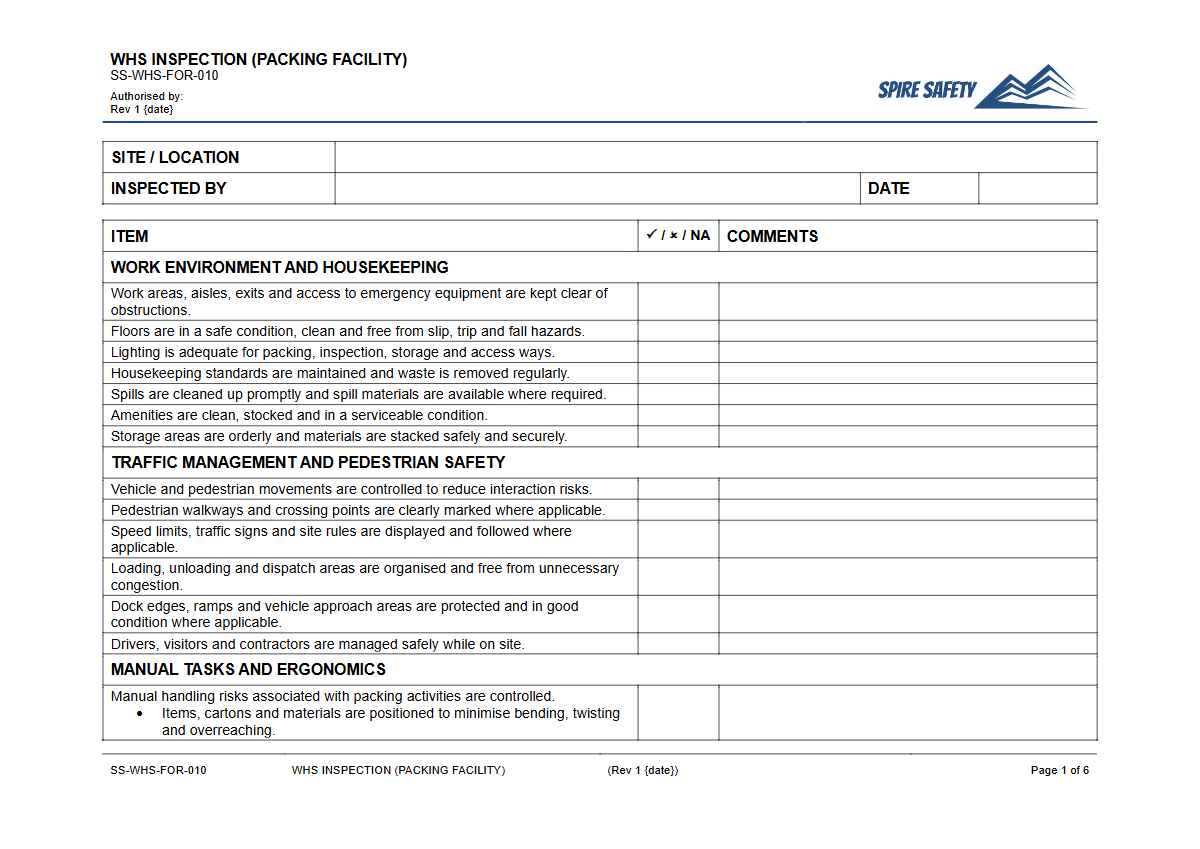
Purpose of the Free WHS Inspection (Packing Facility) Template
A packing facility is a dynamic environment with numerous health and safety risks, from moving machinery to repetitive manual tasks. This Free WHS Inspection (Packing Facility) Template provides a structured starting point for systematically identifying, assessing, and controlling these hazards.
Using this checklist helps your organisation demonstrate a proactive approach to safety, meet its duty of care, and prevent workplace incidents before they occur. It is designed to be a key component within broader WHS management systems, facilitating regular reviews and continuous improvement.
Video walkthrough
Key Areas to Inspect in a Packing Facility
A thorough inspection should cover all aspects of the packing environment. Our template prompts you to consider several key areas, which you should adapt to your specific operations.
Machinery and Equipment
This includes all plant used in packing processes, such as conveyor belts, wrapping machines, palletisers, and forklifts. Checks should confirm that guarding is in place and effective, emergency stops are functional and accessible, and that regular maintenance is being performed. For some items, it's beneficial to use a specific daily checklist, such as our Free Pre-Start Checklist (Envelope Sealer) Template.
Hazardous Manual Tasks
Packing often involves significant manual handling. Assess tasks involving lifting, carrying, pushing, and pulling boxes or products.
Look for ergonomic risks like awkward postures, repetitive movements, and excessive force. Consider whether mechanical aids could be introduced or if workflows can be redesigned to reduce strain on workers.
Traffic Management
The interaction between pedestrians and vehicles (like forklifts or delivery trucks) is a major source of risk. Your inspection should review the layout of the facility, ensuring clear, designated walkways are maintained, crossings are visible, and exclusion zones are respected. Effective traffic management may also involve controlling site entry points, a process which can be supported with tools like a boom gate checklist.
Work Environment and Housekeeping
General environmental conditions are crucial for safety. Check for slip, trip, and fall hazards from spills, debris, or poorly managed cables.
Assess the adequacy of lighting and ventilation, particularly around machinery or chemical storage. Regular checks on environmental equipment like industrial refrigerators or freezers are also critical; our Free Pre-Start Checklist (Freezer) Template can assist with this.
How to use the Free WHS Inspection (Packing Facility) Template
This document is provided as a fully editable DOCX file and a print-ready PDF. To get the most value, it should be used as a practical tool for on-the-floor safety assessments, not just a paperwork exercise.
Walk through the facility, observe tasks as they are performed, and engage with workers about their safety concerns. Record your findings directly onto the checklist, noting any non-conformances or areas for improvement.
Assign clear corrective actions with deadlines and responsible persons to ensure issues are resolved. The completed records can serve as valuable evidence during a formal WHS compliance auditing process.
Important: This resource is a template, not a finished document. We have provided a structured starting point aligned with Australian WHS principles, but you must customise it for your specific workplace.
You need to add, remove, or modify sections to reflect the unique equipment, layout, materials, and processes present in your packing facility.
When to Conduct an Inspection
Regular, scheduled inspections are key to maintaining a safe workplace. We recommend conducting a full facility inspection on a monthly or quarterly basis, depending on the scale and risk profile of your operations.
Additionally, an inspection should be carried out whenever there is a significant change, such as the introduction of new machinery, a change in workflow, or after an incident or near-miss. These formal inspections supplement, but do not replace, the need for daily pre-start checks for machinery like electric hoists.
Who Should Conduct the Inspection
Inspections can be led by a WHS Manager, a Supervisor, or a dedicated safety officer. However, the most effective inspections involve a team.
This should include Health and Safety Representatives (HSRs) and workers who operate the equipment and perform the tasks being assessed. Their firsthand knowledge is invaluable for identifying subtle or intermittent hazards that a manager might otherwise miss.
The findings should be reviewed and discussed by the site's WHS committee to ensure follow-up and organisation-wide learning.
This inspection template is one of many tools available to help you build a safer workplace. You can find more templates, checklists, and guides in our comprehensive free WHS resources library.
Common mistakes
Common mistakes to avoid
- Failing to customise the template for specific site machinery and processes.
- Conducting the inspection as a 'tick-and-flick' exercise without meaningful observation.
- Not involving workers who perform the tasks in the inspection process.
- Neglecting to assign and track corrective actions to address identified hazards.
Legal references
Legal considerations
The following legal requirements may be relevant to this type of work.
- Work Health and Safety Act (Harmonised) — Provides the primary duties for protecting workers and other people from work health and safety risks.
- Work Health and Safety Regulations (Harmonised) — Sets out requirements supporting the management of workplace hazards and risks.
The following codes may be relevant to this type of work.
- Managing WHS Risks Code of Practice — Provides practical guidance on identifying hazards, assessing risks and applying effective controls.
- Work Health and Safety Consultation, Cooperation and Coordination Code of Practice — Provides practical guidance on consulting workers and coordinating with other duty holders.
- Managing the Work Environment and Facilities Code of Practice — Provides practical guidance on safe work environments, workplace facilities and related controls.
Did you know
Manual Handling Risks
According to Safe Work Australia, manual handling injuries account for a significant portion of serious workers' compensation claims in the transport, postal, and warehousing industry.
Forklift Dangers
Being hit by a moving object is one of the most common causes of forklift-related fatalities. Effective traffic management and pedestrian exclusion zones are critical controls.
FAQ
Frequently asked questions
01What should be included in a packing facility inspection?
02How often should WHS inspections be conducted in a packing facility?
03Is this template suitable for a food packing facility?
04Who is responsible for conducting WHS inspections?
Share this resource
Free WHS Inspection (Packing Facility) Template
Browse Categories
How To Use It
- 1Download and open in Word or PDF.
- 2Replace the placeholders with your business details.
- 3Get it reviewed by a WHS specialist before rollout.
Need it customised?
Our WHS consultants can adapt this template to your site, run a gap analysis, or audit what you already have in place.
Book a Free Consultation WHS consulting servicesor call 1300 156 382