
Free WHS Inspection (Pharmacy) Template
Proactively manage safety in your pharmacy with our free WHS inspection template. A structured checklist to identify hazards and control risks. Download now.
Free WHS Inspection (Pharmacy) Template
DOCX • 127 KB + PDF
Updated Oct 2026
No signup required
Purpose of the Free WHS Inspection (Pharmacy) Template
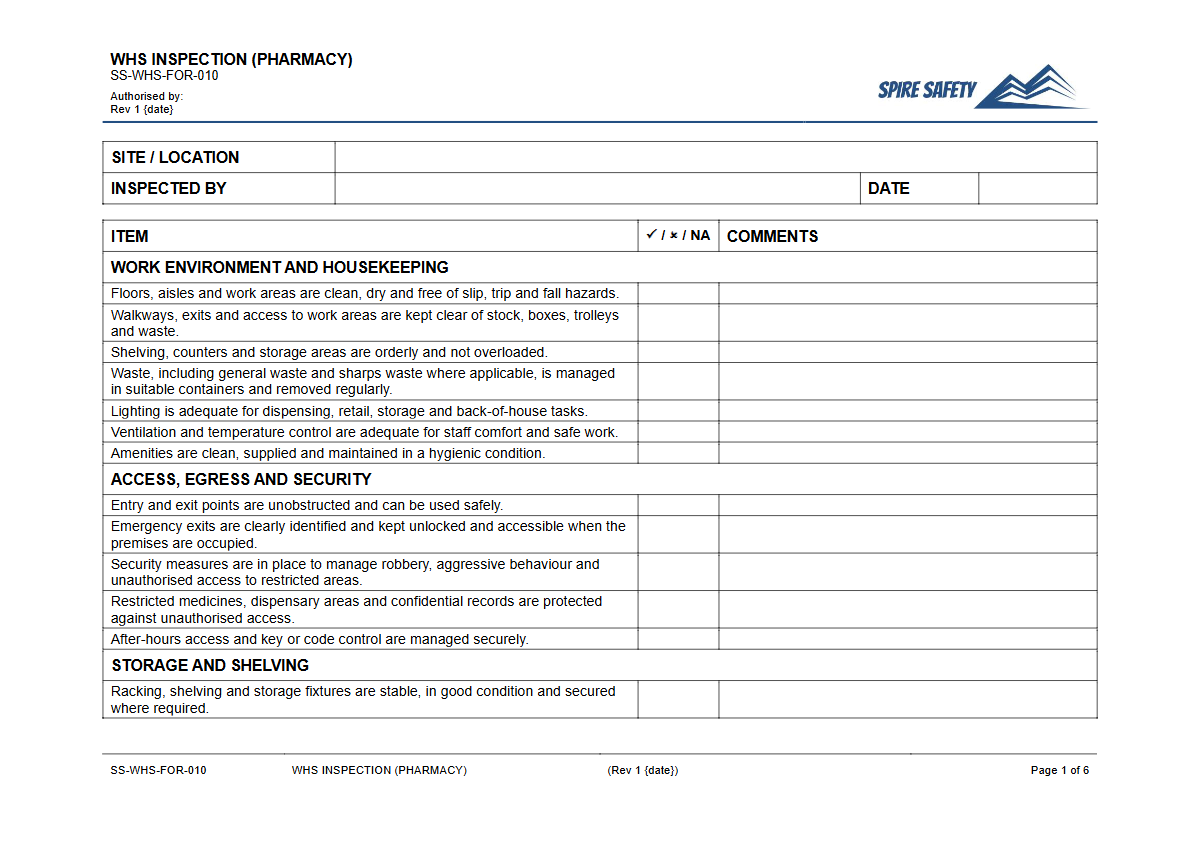
This Free WHS Inspection (Pharmacy) Template provides a structured starting point for systematically identifying and controlling hazards within a community or hospital pharmacy setting. Regular, documented inspections are a cornerstone of effective safety management, helping to prevent injuries and demonstrate due diligence.
By using this template, pharmacy managers can formalise their safety walk-throughs, ensuring key areas are consistently checked and any identified issues are recorded for action. The goal is to move beyond reactive incident response towards a proactive safety culture.
A thorough inspection helps address common pharmacy risks, including slips, trips, and falls from cluttered floors; ergonomic strains from poorly arranged dispensaries; manual handling injuries from lifting stock; and risks associated with hazardous substances. Formalising this process is a key activity when implementing a formal WHS management system. The checklist prompts a review of general work areas, dispensing stations, stock rooms, staff amenities, and emergency preparedness, ensuring a comprehensive overview of the physical environment and work practices.
Video walkthrough
How to use the Free WHS Inspection (Pharmacy) Template
This template is available for download in both DOCX and PDF formats. The DOCX version is fully editable, allowing you to tailor the checklist to the unique layout, equipment, and procedures of your pharmacy.
This customisation is essential for ensuring the inspection is relevant and effective. The PDF version is suitable for immediate printing and use if the existing sections are a close match for your needs.
To get started, add your pharmacy’s details and the inspection date. Walk through each area listed, methodically checking the items.
Use the 'OK', 'Action Required', or 'N/A' columns to record the status of each point. For any item marked 'Action Required', provide a clear description of the hazard or non-conformance in the comments section.
This detail is vital for assigning and tracking corrective actions. The final section of the document is an Action Plan, where you can summarise all required actions, assign responsibility to a specific person, and set a due date for completion.
Important: This resource is a general template designed to be a starting point. We cannot be responsible for its application as-is.
You must customise it to reflect the specific hazards, equipment, workflow, and legal obligations relevant to your individual pharmacy operation. This may include adding checks for specific machinery, such as using our freezer pre-start checklist for vaccine or medication refrigerators.
When to use it
Regularity is key to an effective inspection program. We recommend conducting and documenting a comprehensive pharmacy inspection on a scheduled basis, such as monthly or quarterly.
The frequency should be determined by your risk assessment; higher-risk environments may require more frequent checks. Beyond routine scheduling, this inspection template should also be used in specific circumstances, such as after a workplace incident or near miss, before an external audit or accreditation visit, when significant changes are made to the workplace layout or workflow, or upon the introduction of new equipment or hazardous substances.
Integrating these inspections into your calendar and overall safety plan ensures they are not overlooked. The findings can provide valuable data for your WHS committee meetings and inform decisions about safety improvements. For businesses seeking a more rigorous evaluation, the data gathered can be a valuable input for a professional WHS compliance audit.
Who should use it
This inspection template is designed for use by anyone with responsibility for health and safety in a pharmacy. This typically includes the Pharmacy Owner (as the PCBU), the Pharmacist in Charge (PIC), or a designated WHS Manager or Health and Safety Representative (HSR).
To achieve the best results, the inspection process should be collaborative. Involving pharmacy assistants, dispensary technicians, and other staff who work in the areas being inspected can provide valuable insights, as they often have firsthand knowledge of hazards and workflow challenges.
For pharmacies co-located with or providing services to medical or aged care facilities, safety processes may need to cover a broader range of equipment. In such cases, other specific checks, like a patient hoist pre-start checklist, might also become relevant to your overall safety program.
Empowering team members to participate in safety checks fosters a stronger safety culture and shared sense of responsibility. You can find more templates for various industries and tasks in our complete free WHS resources library to build out your safety toolkit.
Common mistakes
Common mistakes to avoid
- Forgetting to check and test emergency equipment like fire extinguishers, first aid kits, and eyewash stations.
- Ignoring trip hazards in storage areas and walkways, such as boxes, electrical leads, and uneven flooring.
- Failing to review and update Safety Data Sheets (SDS) for all hazardous chemicals and medicines stored on-site.
- Not involving pharmacy assistants and other staff in the inspection process, thereby missing valuable on-the-ground insights.
Legal references
Legal considerations
The following legal requirements may be relevant to this type of work.
- Work Health and Safety Act (Harmonised) — Provides the primary duties for protecting workers and other people from work health and safety risks.
- Work Health and Safety Regulations (Harmonised) — Sets out requirements supporting the management of workplace hazards and risks.
The following codes may be relevant to this type of work.
- Managing WHS Risks Code of Practice — Provides practical guidance on identifying hazards, assessing risks and applying effective controls.
- Work Health and Safety Consultation, Cooperation and Coordination Code of Practice — Provides practical guidance on consulting workers and coordinating with other duty holders.
- Managing the Work Environment and Facilities Code of Practice — Provides practical guidance on safe work environments, workplace facilities and related controls.
Did you know
Ergonomic Risk
Pharmacists can walk several kilometres per day within the dispensary alone. Poorly designed workflows and prolonged standing are significant ergonomic risks that can lead to musculoskeletal disorders.
Sharps Injuries
While less common than in other clinical settings, sharps injuries from needles (e.g., during vaccination services or from customer-returned items) are a serious biohazard risk in pharmacies that must be managed.
FAQ
Frequently asked questions
01What are the most common hazards in a pharmacy?
02How often should I conduct a WHS inspection in my pharmacy?
03Is this pharmacy inspection template compliant with Australian WHS laws?
04Who is responsible for WHS in a pharmacy?
Share this resource
Free WHS Inspection (Pharmacy) Template
Browse Categories
How To Use It
- 1Download and open in Word or PDF.
- 2Replace the placeholders with your business details.
- 3Get it reviewed by a WHS specialist before rollout.
Need it customised?
Our WHS consultants can adapt this template to your site, run a gap analysis, or audit what you already have in place.
Book a Free Consultation WHS consulting servicesor call 1300 156 382