
Free WHS Inspection (Port Facility) Template
Formalise safety checks in high-risk maritime environments with our WHS Inspection Template for Port Facilities. A structured starting point. Download now.
Free WHS Inspection (Port Facility) Template
DOCX • 129 KB + PDF
Updated Oct 2026
No signup required
Purpose of the Free WHS Inspection (Port Facility) Template
Port facilities are dynamic and high-risk work environments, combining heavy machinery, complex logistics, vehicle movement, and interaction with vessels. Managing Work Health and Safety (WHS) in this setting requires a systematic approach to identifying and controlling hazards.
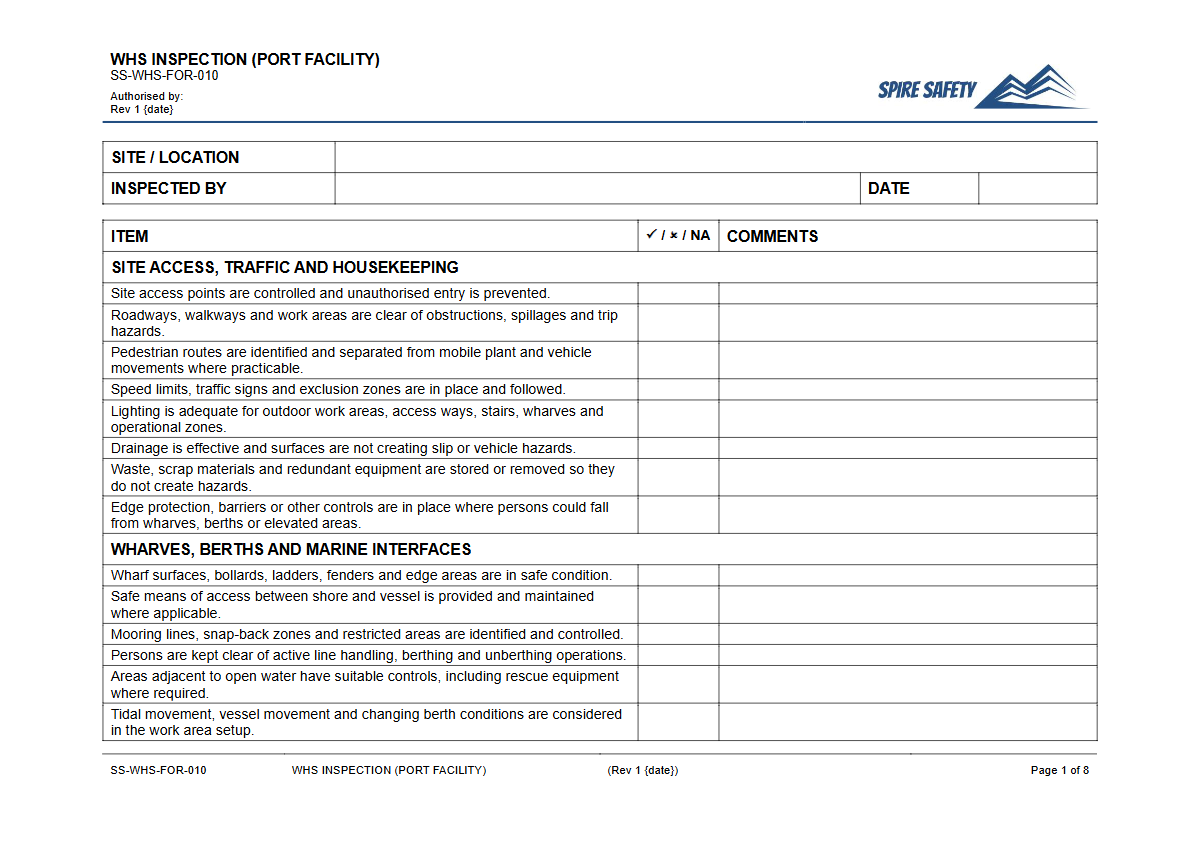
This Free WHS Inspection (Port Facility) Template provides a structured starting point for organisations to formalise their safety inspection processes.
Regular inspections are a fundamental part of proactive safety management. By using a comprehensive checklist, you can methodically assess key areas of your operation—from quayside activities and container handling to traffic management and worker amenities.
This template is designed to help you document findings, assign corrective actions, and maintain a consistent record of your safety assurance activities, aligning with Australian WHS best practices.
Video walkthrough
How to use the Free WHS Inspection (Port Facility) Template
This resource is available in both DOCX and PDF formats for your convenience. The DOCX file is fully editable, allowing you to tailor the content to the specific hazards and operational realities of your port, terminal, or wharf.
The PDF version is ready for immediate printing and use for more general applications.
To get the most value from this template, follow these steps:
- Download the DOCX version.
- Review each section and item, adding, removing, or modifying them to reflect your site-specific equipment, procedures, and risks. For example, you might add detailed checks for specific lifting gear, such as a dedicated pre-start checklist for an electric hoist.
- Engage with workers and supervisors during the customisation process to ensure the checklist is practical and relevant to their daily tasks.
- Integrate the finalised inspection checklist into your organisation's broader safety management system.
Important: This template is a guide only. Every workplace is unique.
You must customise this document to address the specific hazards and legal requirements applicable to your business and its operations. We are not responsible for any compliance issues that arise from the use of this template.
Key Areas Covered in the Inspection Template
A thorough port facility inspection goes beyond checking a few pieces of equipment. This template prompts a review of various operational zones and safety systems. Key areas include:
- Traffic Management: Signage, line marking, separation of pedestrians and vehicles, and speed limits.
- Plant and Equipment: Condition of cranes, forklifts, reach stackers, and other mobile plant.
- Quayside and Wharf Areas: Fall protection (e.g., barriers, handrails), mooring equipment, and housekeeping.
- Hazardous Substances: Correct storage, handling, labelling, and availability of Safety Data Sheets (SDS).
- Emergency Preparedness: Accessibility of fire extinguishers, first aid kits, spill kits, and clear emergency exit routes.
- Worker Amenities and Facilities: Condition of lunchrooms, toilets, and provision of clean drinking water.
A documented inspection provides essential data for a more formal audit process. Regular internal checks can make a periodic external WHS compliance audit a much smoother and more effective process.
When to Conduct an Inspection
The frequency of inspections should be determined by a risk assessment. High-risk areas or activities may require daily or weekly checks, while a full facility-wide inspection might be scheduled monthly or quarterly.
A good practice is to establish a schedule that includes different types of inspections, such as daily pre-start checks on critical equipment like access control points, which can be formalised with a pre-start checklist for a boom gate. Inspections should also be conducted after an incident, following significant changes to the work environment, or when new plant or procedures are introduced.
Who Should Use This Inspection Template
This template is designed for individuals responsible for overseeing and implementing safety protocols in a maritime or port environment. This includes:
- WHS Managers and Safety Officers
- Port and Terminal Supervisors
- Operations Managers
- PCBUs (Persons Conducting a Business or Undertaking)
- Safety and Training Coordinators
It serves as a practical tool for those on the ground and provides valuable information for management teams looking to improve their overall WHS management systems. For more tools to support your safety framework, explore our complete free WHS resources library.
Common mistakes
Common mistakes to avoid
- Using a generic checklist without customising it for specific terminal operations (e.g., container vs. bulk liquid).
- Failing to document and track corrective actions for identified hazards through to completion.
- Only inspecting physical equipment while neglecting work processes, traffic management plans, or worker behaviour.
- Conducting inspections without involving the workers and health and safety representatives (HSRs) who perform the tasks daily.
Legal references
Legal considerations
The following legal requirements may be relevant to this type of work.
- Work Health and Safety Act (Harmonised) — Provides the primary duties for protecting workers and other people from work health and safety risks.
- Work Health and Safety Regulations (Harmonised) — Sets out requirements supporting the management of workplace hazards and risks.
The following codes may be relevant to this type of work.
- Managing WHS Risks Code of Practice — Provides practical guidance on identifying hazards, assessing risks and applying effective controls.
- Work Health and Safety Consultation, Cooperation and Coordination Code of Practice — Provides practical guidance on consulting workers and coordinating with other duty holders.
- Managing the Work Environment and Facilities Code of Practice — Provides practical guidance on safe work environments, workplace facilities and related controls.
Did you know
High-Risk Industry
Safe Work Australia identifies the Transport, Postal & Warehousing industry, which includes port operations, as one of the highest-risk industries for serious workplace injuries and fatalities.
Global Standards
Many Australian ports align their safety practices with international standards from the IMO (International Maritime Organization) and ILO (International Labour Organization) to ensure safety consistency for global shipping partners.
FAQ
Frequently asked questions
01What specific hazards does a port facility inspection cover?
02How often should we conduct a full WHS inspection of our port facility?
03Is this template suitable for all types of port facilities?
04Can this inspection template replace a formal safety audit?
Share this resource
Free WHS Inspection (Port Facility) Template
Browse Categories
How To Use It
- 1Download and open in Word or PDF.
- 2Replace the placeholders with your business details.
- 3Get it reviewed by a WHS specialist before rollout.
Need it customised?
Our WHS consultants can adapt this template to your site, run a gap analysis, or audit what you already have in place.
Book a Free Consultation WHS consulting servicesor call 1300 156 382