
Free WHS Inspection (Printing Plant) Template
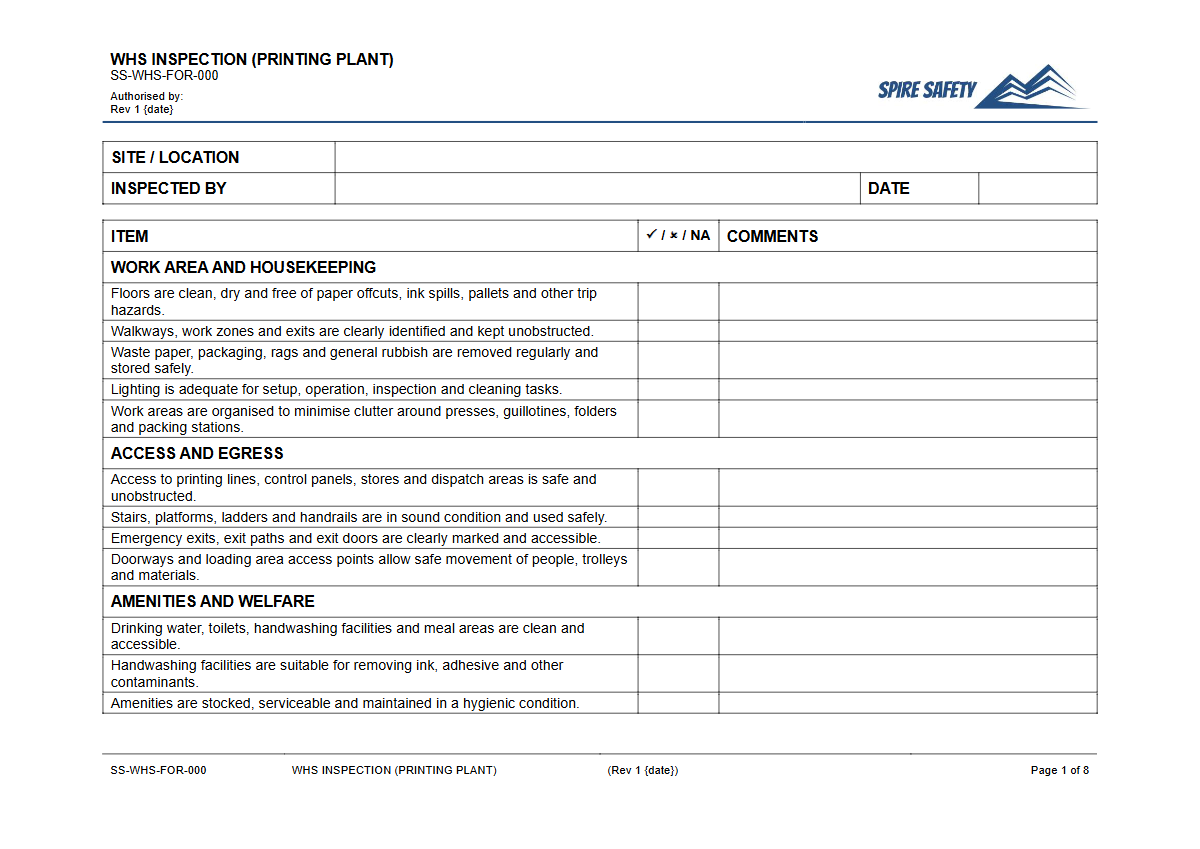
Download our Free WHS Inspection (Printing Plant) Template to identify and manage hazards in your printing operations.
Free WHS Inspection (Printing Plant) Template
DOCX • 129 KB + PDF
Updated Oct 2026
No signup required
Purpose of the Free WHS Inspection (Printing Plant) Template
The primary purpose of this Free WHS Inspection (Printing Plant) Template is to provide a comprehensive checklist for assessing potential hazards. Printing facilities contain a unique mix of risks, including moving parts on presses, chemical exposure from inks and solvents, noise, and manual handling tasks.
Using this template helps organisations formalise their inspection process, ensuring that key safety elements are not overlooked. It aids in demonstrating due to diligence and forms a crucial part of a proactive safety management system.
Regular inspections help prevent incidents, reduce downtime, and foster a stronger safety culture among employees. Properly managing these risks is a core component of effective WHS management systems.
Video walkthrough
How to use the Free WHS Inspection (Printing Plant) Template
To effectively use the Free WHS Inspection (Printing Plant) Template, download the DOCX file and adapt it to the specific machinery, chemicals, and processes in your workplace. The template is aligned with Australian WHS principles but is a starting point, not a universal solution.
Note: It is essential that you customise this document to reflect the unique hazards and control measures relevant to your specific site, equipment, and operational procedures. We cannot guarantee its suitability for your specific circumstances.
Walk through the printing floor with the checklist, methodically examining each item. Document any identified hazards, non-conformances, or areas for improvement.
For each issue, note the required corrective action, assign responsibility to a specific person, and set a realistic completion date. For issues like chemical spills, your team's response should be guided by specific training, which can be reinforced using resources like our Spill Prevention and Response Toolbox Talk Template.
Customisation should involve adding or removing checklist items based on your plant's specific equipment. For example, if your facility includes finishing equipment like binding machines or guillotines, ensure specific checks for these are included. You may also have ancillary equipment like an envelope sealer, which would require its own checks, similar to those found in a Free Pre-Start Checklist (Envelope Sealer) Template.
When to use it
Workplace safety inspections should be conducted on a regular, scheduled basis. The frequency depends on the level of risk and the nature of the work.
For a dynamic environment like a printing plant, it is advisable to conduct these comprehensive inspections at least quarterly. They should also be performed whenever there is a significant change in the workplace, such as the introduction of new printing presses or finishing equipment, a change in chemical suppliers, or following an incident or near miss.
These planned inspections are different from daily pre-start checks but are equally important for maintaining a safe system of work.
Who should use it
This inspection template is designed for use by individuals with responsibility for workplace health and safety. This typically includes site managers, production supervisors, WHS officers, and members of the Health and Safety Committee (HSC).
To be effective, the person conducting the inspection should be familiar with printing operations and have received training in hazard identification and risk assessment. Involving workers who operate the machinery can also provide valuable insights, as they have direct experience with the equipment and processes.
For an independent evaluation of your safety processes, consider engaging external experts for a WHS compliance auditing service.
By integrating this inspection template into your regular safety procedures, you create a documented record of your commitment to WHS. It helps ensure hazards are not just identified but also controlled in a timely manner.
This systematic approach is fundamental to preventing workplace injuries and illnesses in the printing industry. For more tools to support your safety program, explore our complete free WHS resources library.
Common mistakes
Common mistakes to avoid
- Overlooking chemical safety, including inadequate storage and missing Safety Data Sheets (SDS).
- Failing to ensure all machine guarding is in place and effective, especially after maintenance.
- Neglecting ergonomic risks associated with repetitive tasks and manual handling of paper and plates.
- Allowing poor housekeeping, leading to accumulations of paper dust, spills, and trip hazards.
Legal references
Legal considerations
The following legal requirements may be relevant to this type of work.
- Work Health and Safety Act (Harmonised) — Provides the primary duties for protecting workers and other people from work health and safety risks.
- Work Health and Safety Regulations (Harmonised) — Sets out requirements supporting the management of workplace hazards and risks.
The following codes may be relevant to this type of work.
- Managing WHS Risks Code of Practice — Provides practical guidance on identifying hazards, assessing risks and applying effective controls.
- Work Health and Safety Consultation, Cooperation and Coordination Code of Practice — Provides practical guidance on consulting workers and coordinating with other duty holders.
- Managing the Work Environment and Facilities Code of Practice — Provides practical guidance on safe work environments, workplace facilities and related controls.
Did you know
Noise Hazard
Older offset printing presses can operate at noise levels exceeding 85 decibels (dB), the exposure standard for noise in Australia. Without proper hearing protection and controls, this can lead to permanent hearing damage over time.
Chemicals in the Air
Volatile Organic Compounds (VOCs) released from inks, coatings, and cleaning solvents can be a significant inhalation hazard in printing facilities. Effective ventilation is a critical control measure to keep airborne concentrations below workplace exposure standards.
FAQ
Frequently asked questions
01What are the most common hazards in a printing plant?
02How often should printing equipment be inspected?
03Who is responsible for conducting safety inspections in a printing facility?
04Can this template be used for digital printing as well as offset printing?
Share this resource
Free WHS Inspection (Printing Plant) Template
Browse Categories
How To Use It
- 1Download and open in Word or PDF.
- 2Replace the placeholders with your business details.
- 3Get it reviewed by a WHS specialist before rollout.
Need it customised?
Our WHS consultants can adapt this template to your site, run a gap analysis, or audit what you already have in place.
Book a Free Consultation WHS consulting servicesor call 1300 156 382