
Free WHS Inspection (Prison) Template
Download our free WHS Inspection Template for prisons. A structured starting point for identifying hazards in correctional facilities. Get your DOCX & PDF now.
Free WHS Inspection (Prison) Template
DOCX • 129 KB + PDF
Updated Oct 2026
No signup required
Purpose of the Free WHS Inspection (Prison) Template
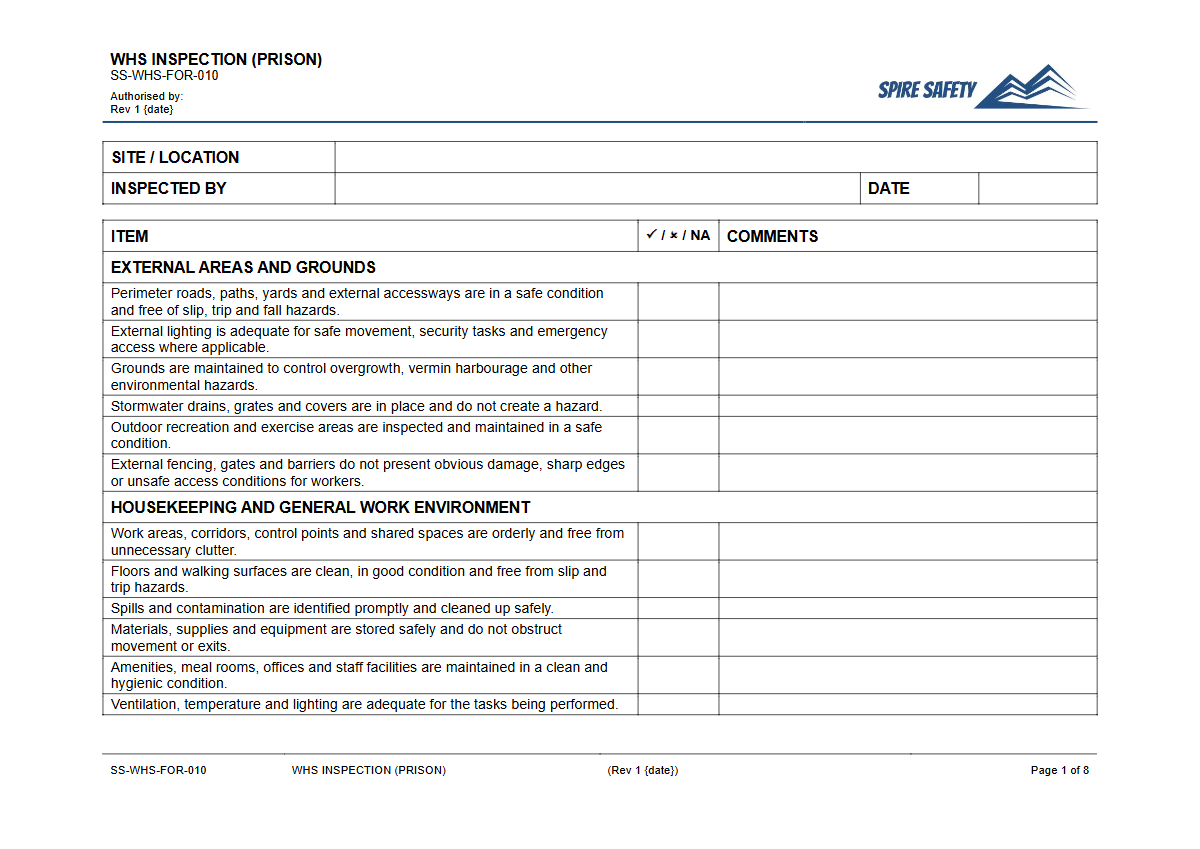
Correctional facilities present a unique and complex set of work health and safety challenges. This Free WHS Inspection (Prison) Template provides a structured starting point for identifying, assessing, and controlling hazards specific to this high-risk environment.
Regular inspections are fundamental to a proactive safety culture, helping to protect staff, contractors, and visitors from harm. A thorough inspection process helps a Person Conducting a Business or Undertaking (PCBU) meet their primary duty of care.
The template is designed to prompt a comprehensive review of various areas within a prison, including cell blocks, administrative offices, workshops, kitchens, medical facilities, and visitor areas. It covers physical hazards such as slips, trips, and falls; security system integrity; hazardous manual tasks; and the condition of plant and equipment.
It also provides a framework for considering psychosocial hazards like workplace violence and aggression, which are significant risks in this sector. Proactive inspections are a key component of robust WHS management systems, demonstrating a commitment to continuous improvement.
How to use the Free WHS Inspection (Prison) Template
Using this template effectively involves a few key steps. First, download the document in your preferred format (DOCX or PDF).
The DOCX version is fully editable, allowing for extensive customisation to suit the specific layout, activities, and risks of your facility. It is crucial to adapt the checklist to your unique operational context.
Next, schedule and conduct the inspection. This should be done by a competent person, such as a WHS officer or facility manager, who is familiar with the environment and its associated hazards.
The inspection should be methodical, covering all areas and items listed. Document all findings clearly, noting any non-conformances or areas for improvement.
Use photos where appropriate to provide context. Finally, ensure all identified hazards are risk-assessed and that corrective actions are assigned, tracked, and verified upon completion.
For large facilities with extensive grounds, you may need specific checks like a Pre-Start Checklist (Lawn Tractor) Template for maintenance equipment.
Note: This document provides a general framework. We have created it as a starting point, and it must be customised to address the specific hazards and operational needs of your workplace before use.
Video walkthrough
When to conduct a Prison Inspection
The frequency of WHS inspections in a correctional facility should be determined by a risk assessment. However, a regular schedule is essential.
It is best practice to conduct comprehensive site-wide inspections at least quarterly. In addition, inspections should be triggered by specific events, including after a safety incident or near miss, following a report of a new hazard, or when changes are made to the facility, work processes, or equipment.
Regular, scheduled reviews form the basis of an effective safety program and are a core activity within any WHS compliance auditing schedule.
Who should use this Inspection Template
This template is designed for use by individuals with responsibilities for health and safety within a correctional services environment. This includes:
- Facility Managers and Operations Managers
- Work Health and Safety (WHS) Officers and Advisors
- Health and Safety Representatives (HSRs)
- Department Heads (e.g., Head of Security, Workshop Supervisor)
- Senior Leadership and PCBUs
Engaging a mix of personnel in the inspection process can provide a more comprehensive overview of the risks present. For instance, a workshop supervisor will have specific insights into machinery safety, while a security officer will be focused on entry control points and duress systems.
Formalising daily checks on specific security equipment, for example using a Pre-Start Checklist for Boom Gates, can supplement these broader inspections.
The findings from these inspections should be communicated to all relevant parties, including the Health and Safety Committee, to ensure transparency and promote a collective approach to risk management. Reviewing these documents systematically helps build a safer work environment.
The commercial kitchen is another area requiring diligent checks; our Free Pre-Start Checklist (Freezer) Template can be adapted for this purpose. You can find more specific tools like this in our complete free WHS resources library.
Common mistakes
Common mistakes to avoid
- Failing to customise the template for specific zones like medical wings, kitchens, or industrial workshops.
- Conducting the inspection as a paperwork exercise without genuine observation and engagement with staff.
- Neglecting to create and track corrective actions for identified hazards, leaving risks unmanaged.
- Focusing only on physical hazards while overlooking significant psychosocial risks like stress, fatigue, and violence.
Legal references
Legal considerations
The following legal requirements may be relevant to this type of work.
- Work Health and Safety Act (Harmonised) — Provides the primary duties for protecting workers and other people from work health and safety risks.
- Work Health and Safety Regulations (Harmonised) — Sets out requirements supporting the management of workplace hazards and risks.
The following codes may be relevant to this type of work.
- Managing WHS Risks Code of Practice — Provides practical guidance on identifying hazards, assessing risks and applying effective controls.
- Work Health and Safety Consultation, Cooperation and Coordination Code of Practice — Provides practical guidance on consulting workers and coordinating with other duty holders.
- Managing the Work Environment and Facilities Code of Practice — Provides practical guidance on safe work environments, workplace facilities and related controls.
Did you know
Psychosocial Risks
Correctional officers report high levels of work-related stress, with exposure to violence, aggression, and trauma being primary contributing factors. Managing these psychosocial risks is as critical as managing physical hazards.
A Controlled Environment
While prisons are highly controlled, this does not eliminate common workplace hazards. Slips, trips, and falls remain one of the most frequent causes of injury, often due to spills, poorly maintained flooring, or clutter.
FAQ
Frequently asked questions
01What are the key WHS hazards in a prison environment?
02How often should prison facilities be inspected for WHS?
03Who is responsible for WHS in a correctional facility?
04Can this inspection template be used for youth detention centres?
Share this resource
Free WHS Inspection (Prison) Template
Browse Categories
How To Use It
- 1Download and open in Word or PDF.
- 2Replace the placeholders with your business details.
- 3Get it reviewed by a WHS specialist before rollout.
Need it customised?
Our WHS consultants can adapt this template to your site, run a gap analysis, or audit what you already have in place.
Book a Free Consultation WHS consulting servicesor call 1300 156 382