
Free WHS Inspection (Pump Workshop) Template
Streamline your safety processes with our Free WHS Inspection (Pump Workshop) Template. A structured starting point for identifying and managing risks.
Free WHS Inspection (Pump Workshop) Template
DOCX • 128 KB + PDF
Updated Oct 2026
No signup required
Purpose of the Free WHS Inspection (Pump Workshop) Template
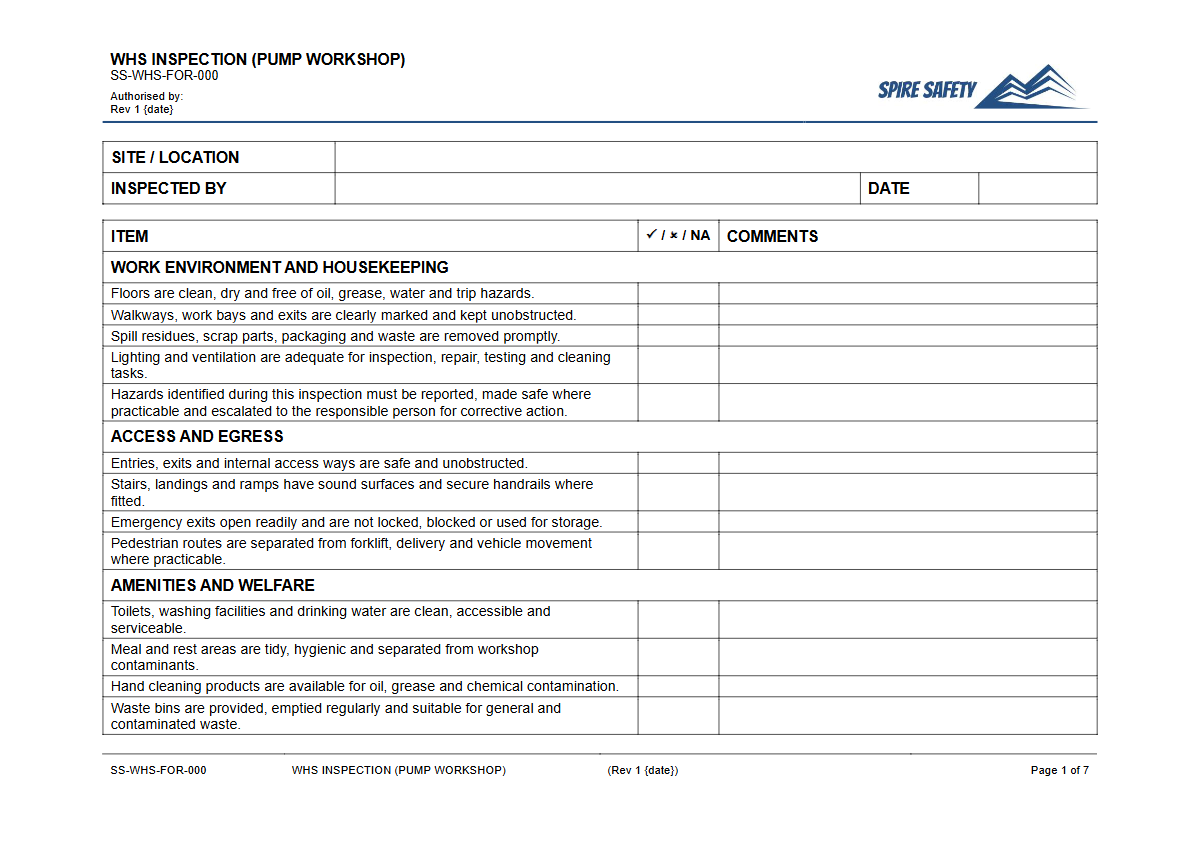
This Free WHS Inspection (Pump Workshop) Template provides a structured starting point for systematically identifying and controlling hazards in environments where industrial, commercial, or specialised pumps are serviced, repaired, or tested. Pump workshops contain a unique combination of risks, including high-pressure hydraulic and pneumatic systems, rotating machinery, electrical hazards, and exposure to oils, fuels, and chemicals.
Using a formal inspection checklist helps organisations proactively manage these risks rather than reacting to incidents.
Regular, documented inspections are a cornerstone of effective safety management. They demonstrate due diligence in meeting WHS obligations and create a safer environment for technicians and other personnel.
This process is a key component of building and maintaining robust WHS management systems that protect your people and your business.
Video walkthrough
How to use the Free WHS Inspection (Pump Workshop) Template
This template is designed for ease of use. Simply download the DOCX file and adapt it to the specific context of your workshop.
The checklist covers common areas like general housekeeping, machinery guarding, electrical safety, fluid and pressure systems, hazardous substances, and emergency equipment.
It is essential to tailor this document to your operational needs. Add, remove, or modify checklist items to reflect the specific types of pumps you service (e.g., centrifugal, diaphragm, submersible, concrete pumps), the equipment in your workshop (e.g., lathes, grinders, lifting equipment), and your established work procedures.
For process-specific documents, you might also require documents like our Boom Pump SOP (Safe Operating Procedure) Template to detail the steps for safe operation.
Please note: This document provides a general framework. We strongly recommend you customise it to ensure all specific equipment, tasks, and hazards present in your workplace are covered.
When to conduct a Workshop Inspection
Formal workshop inspections should be conducted at regular, planned intervals. The frequency will depend on factors like the intensity of work, the age of the equipment, and your organisation's risk profile.
A common schedule is monthly or quarterly. In addition to these routine checks, an inspection should also be performed:
- After the installation of new plant or equipment.
- Following a significant change in workshop layout or work processes.
- After a workplace incident, accident, or near miss.
- As part of an annual safety management system review.
These scheduled inspections are more comprehensive than daily checks. For routine equipment-specific checks before use, our Free Pre-Start Checklist (Cooling Pump) Template offers a more focused approach for operators.
Who should use this Inspection template
This template is designed for use by personnel with responsibility for workshop safety and operations. This typically includes:
- Workshop Managers or Supervisors
- Work Health and Safety (WHS) Representatives or Committee Members
- Lead Technicians or Maintenance Planners
- In-house or external WHS Advisors
The person conducting the inspection must be competent to do so. This means they should have a thorough understanding of the workshop's operations, be familiar with the equipment, and have the knowledge to identify potential hazards. Ensuring staff are trained and competent is a key safety duty, which can be formalised using tools such as our Verification of Competency (Concrete Pump (Stationary)) Template.
Beyond the Checklist: Taking Action
Completing the checklist is only the first step. The primary value of an inspection lies in the follow-up.
Every identified hazard or non-conformance must be documented, assessed, and assigned a corrective action. A clear process for tracking these actions through to completion is critical.
The findings from these inspections can serve as valuable input for higher-level reviews and formal WHS compliance auditing to verify the overall effectiveness of your safety systems.
By systematically inspecting, correcting, and reviewing, you create a continuous cycle of improvement that drives down risk. Explore our complete free WHS resources library for more tools to support your safety management efforts.
Common mistakes
Common mistakes to avoid
- Using a generic checklist without customising it for the specific equipment and risks in the workshop.
- Failing to document and track corrective actions, leaving identified hazards unresolved.
- Focusing only on the pumps and machinery while ignoring environmental hazards like poor lighting, trip hazards, or inadequate ventilation.
- Treating the inspection as a 'tick and flick' exercise instead of a genuine opportunity to identify risks.
Legal references
Legal considerations
The following legal requirements may be relevant to this type of work.
- Work Health and Safety Act (Harmonised) — Provides the primary duties for protecting workers and other people from work health and safety risks.
- Work Health and Safety Regulations (Harmonised) — Sets out requirements supporting the management of workplace hazards and risks.
The following codes may be relevant to this type of work.
- Managing WHS Risks Code of Practice — Provides practical guidance on identifying hazards, assessing risks and applying effective controls.
- Work Health and Safety Consultation, Cooperation and Coordination Code of Practice — Provides practical guidance on consulting workers and coordinating with other duty holders.
- Managing the Work Environment and Facilities Code of Practice — Provides practical guidance on safe work environments, workplace facilities and related controls.
Did you know
Hydraulic Fluid Injection
A pinhole leak in a high-pressure hydraulic hose can release fluid at a speed over 180 m/s. This can easily penetrate skin and cause severe, limb-threatening injuries that require immediate specialist medical attention.
Maintenance-Related Incidents
A significant percentage of workplace incidents involving machinery occur during maintenance, cleaning, or repair activities, often because the equipment was not properly isolated from its energy sources (locked out).
FAQ
Frequently asked questions
01What's the difference between a pre-start check and a workshop inspection?
02How often should a pump workshop be inspected?
03What are the most common hazards in a pump workshop?
04Can this template be used for mobile pump maintenance units?
Share this resource
Free WHS Inspection (Pump Workshop) Template
Browse Categories
How To Use It
- 1Download and open in Word or PDF.
- 2Replace the placeholders with your business details.
- 3Get it reviewed by a WHS specialist before rollout.
Need it customised?
Our WHS consultants can adapt this template to your site, run a gap analysis, or audit what you already have in place.
Book a Free Consultation WHS consulting servicesor call 1300 156 382