
Free WHS Inspection (Recycling Depot) Template
Download our Free WHS Inspection (Recycling Depot) Template. A structured starting point for identifying hazards and improving safety in your facility.
Free WHS Inspection (Recycling Depot) Template
DOCX • 129 KB + PDF
Updated Oct 2026
No signup required
Purpose of the Free WHS Inspection (Recycling Depot) Template
Recycling depots are dynamic environments with a unique combination of hazards. From heavy mobile plant and powerful processing machinery to manual handling and exposure to hazardous substances, maintaining a safe workplace requires constant vigilance.
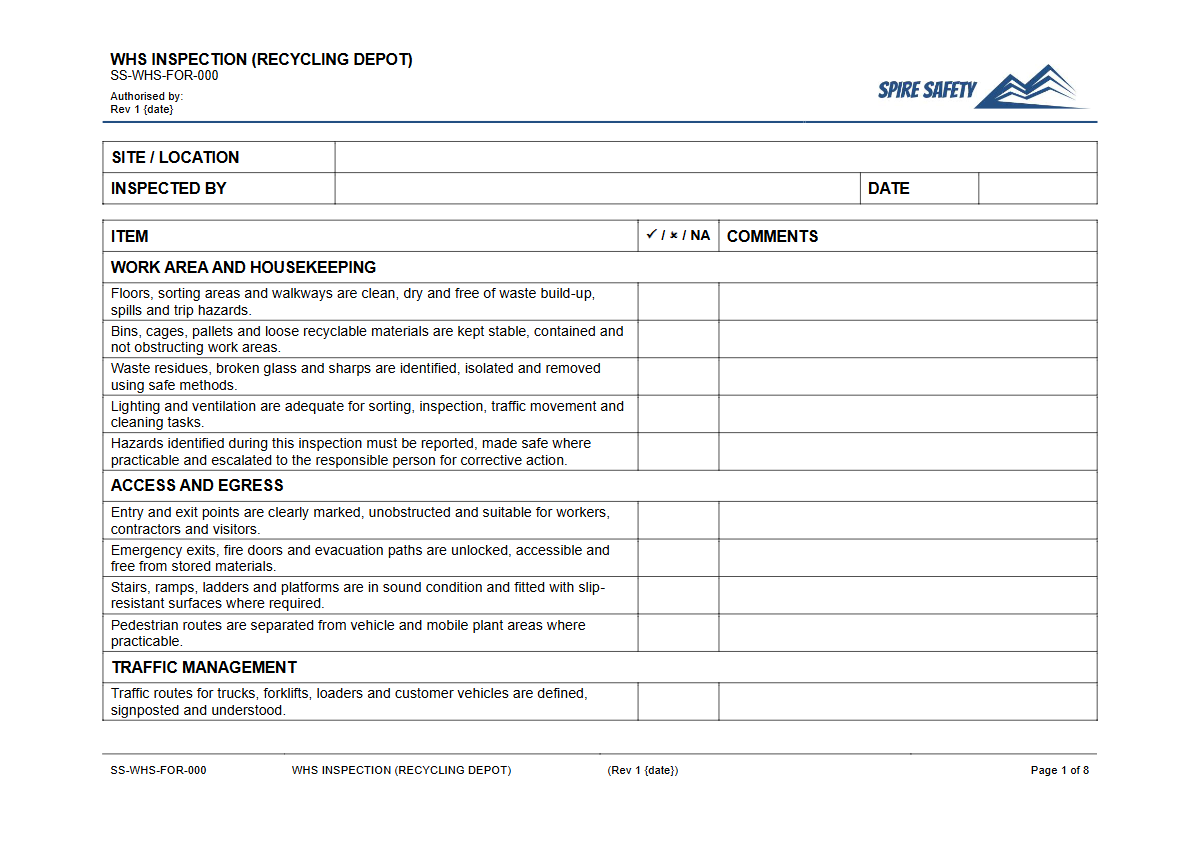
This Free WHS Inspection (Recycling Depot) Template provides a structured starting point for proactively identifying, assessing, and controlling risks within your facility.
A systematic inspection process helps your organisation move beyond reactive incident response. By regularly examining your work areas, equipment, and procedures, you can uncover latent conditions and unsafe behaviours before they lead to injury or illness.
This template is designed to guide inspectors through key areas of concern in a typical recycling depot, including traffic management, machine guarding, emergency procedures, and worker amenities. Formalising your inspections demonstrates a commitment to WHS and provides valuable data for continuous improvement.
Key Hazards Covered
- Mobile Plant & Vehicles: Checks for forklifts, loaders, and haul trucks, including traffic management plans and pedestrian segregation.
- Plant & Machinery: Focuses on guarding, lock-out/tag-out procedures, and operational safety for equipment like balers, conveyors, and shredders.
- Hazardous Manual Tasks: Prompts to assess risks from lifting, carrying, and sorting materials.
- Hazardous Substances: Includes checks for storage, labelling, and handling of potentially hazardous waste materials.
- General Environment: Covers slip, trip, and fall hazards, lighting, ventilation, noise levels, and housekeeping standards.
Video walkthrough
How to Use the Free WHS Inspection (Recycling Depot) Template
Using this template effectively involves more than just ticking boxes. It should be a key component of your overall safety framework.
For a holistic approach, these inspections should feed into your broader WHS management systems, providing crucial performance data.
Follow these steps for best results:
- Download and Customise: Download the template in your preferred format (DOCX or PDF). It’s vital to remember that this template is a starting point. We've designed it to be comprehensive, but you must customise it to reflect the specific equipment, processes, and risks at your facility. Add or remove items to make it relevant to your site.
- Schedule the Inspection: Determine an appropriate frequency for your inspections (e.g., monthly or quarterly) and assign responsibility.
- Conduct the Inspection: The assigned inspector(s) should walk through the site, observing work practices and the physical environment, using the checklist to document findings. Engage with workers during the inspection to gain valuable insights.
- Document Findings: Clearly record all observations, both positive and negative. Use photos to support your findings where appropriate. Note any immediate actions taken to control serious risks.
- Develop an Action Plan: For any identified hazards or non-conformances, create a corrective action plan that specifies the required action, the person responsible, and a deadline for completion. Track these actions to ensure they are closed out effectively.
When to Conduct a Recycling Depot Inspection
Regular, scheduled inspections are fundamental, but they should also be conducted in response to specific triggers. This ensures your safety management remains responsive and proactive. Consider conducting a full site inspection:
- On a regular schedule (e.g., monthly or quarterly) as part of your standard WHS program.
- After any significant incident, accident, or near-miss to identify underlying causes.
- Before commissioning new plant or equipment, such as a new baler or conveyor system.
- When introducing new processes or substances to the site.
- If legislative requirements change or new industry guidance is published.
- As part of a periodic WHS compliance auditing program to verify that controls are in place and effective.
Regular equipment checks are also crucial. For example, daily checks on site access equipment should be standard practice, supported by tools like a boom gate pre-start checklist.
Who Should Use This Inspection Template?
This inspection template is designed for use by anyone with responsibility for health and safety in a recycling facility. This can include:
- Site Managers and Supervisors: They hold primary responsibility for safety in their areas and can use this template to fulfil their due diligence obligations.
- WHS/HSE Officers: Safety professionals can use this as a tool for their formal inspection and assurance activities.
- Health and Safety Representatives (HSRs): HSRs can use this template to guide their workplace inspections and effectively represent their work group on safety matters.
- WHS Committees: Inspection reports provide excellent data for discussion and strategic planning at committee meetings.
Engaging a competent person to conduct the inspection is key. If your team lacks the specific expertise for certain technical areas, seeking external support from a WHS consulting firm can provide valuable, impartial insight.
This is particularly important for high-risk equipment; alongside major inspections, daily checks using specific tools like an electric hoist pre-start checklist are essential for safe operation. For processing equipment, similar daily checks are vital, which can be formalised using a resource like a pre-start checklist for feed mixers as a structural guide.
Common mistakes
Common mistakes to avoid
- Failing to customise the template for the specific machinery and risks at your site.
- Not properly training the person(s) assigned to conduct the inspection.
- Completing the checklist as a paper exercise without genuine observation and worker consultation.
- Poor follow-up on corrective actions, leaving identified hazards uncontrolled.
Legal references
Legal considerations
The following legal requirements may be relevant to this type of work.
- Work Health and Safety Act (Harmonised) — Provides the primary duties for protecting workers and other people from work health and safety risks.
- Work Health and Safety Regulations (Harmonised) — Sets out requirements supporting the management of workplace hazards and risks.
The following codes may be relevant to this type of work.
- Managing WHS Risks Code of Practice — Provides practical guidance on identifying hazards, assessing risks and applying effective controls.
- Work Health and Safety Consultation, Cooperation and Coordination Code of Practice — Provides practical guidance on consulting workers and coordinating with other duty holders.
- Managing the Work Environment and Facilities Code of Practice — Provides practical guidance on safe work environments, workplace facilities and related controls.
Did you know
A High-Risk Industry
The waste and recycling industry consistently ranks among the most hazardous industries in Australia, with fatality and serious injury rates significantly higher than the all-industry average.
Machine Guarding
Inadequate machine guarding is one of the most frequently cited safety breaches in manufacturing and processing environments, including recycling depots. Fixed guards are always the preferred control measure.
FAQ
Frequently asked questions
01What are the main WHS hazards in a recycling depot?
02How often should we inspect our recycling facility?
03Can workers conduct WHS inspections?
04What happens after an inspection identifies a hazard?
Share this resource
Free WHS Inspection (Recycling Depot) Template
Browse Categories
How To Use It
- 1Download and open in Word or PDF.
- 2Replace the placeholders with your business details.
- 3Get it reviewed by a WHS specialist before rollout.
Need it customised?
Our WHS consultants can adapt this template to your site, run a gap analysis, or audit what you already have in place.
Book a Free Consultation WHS consulting servicesor call 1300 156 382