
Free WHS Inspection (Quarry Site) Template
Download our Free WHS Inspection (Quarry Site) Template. This structured DOCX & PDF helps identify & control hazards in quarry environments.
Free WHS Inspection (Quarry Site) Template
DOCX • 128 KB + PDF
Updated Oct 2026
No signup required
Purpose of the Free WHS Inspection (Quarry Site) Template
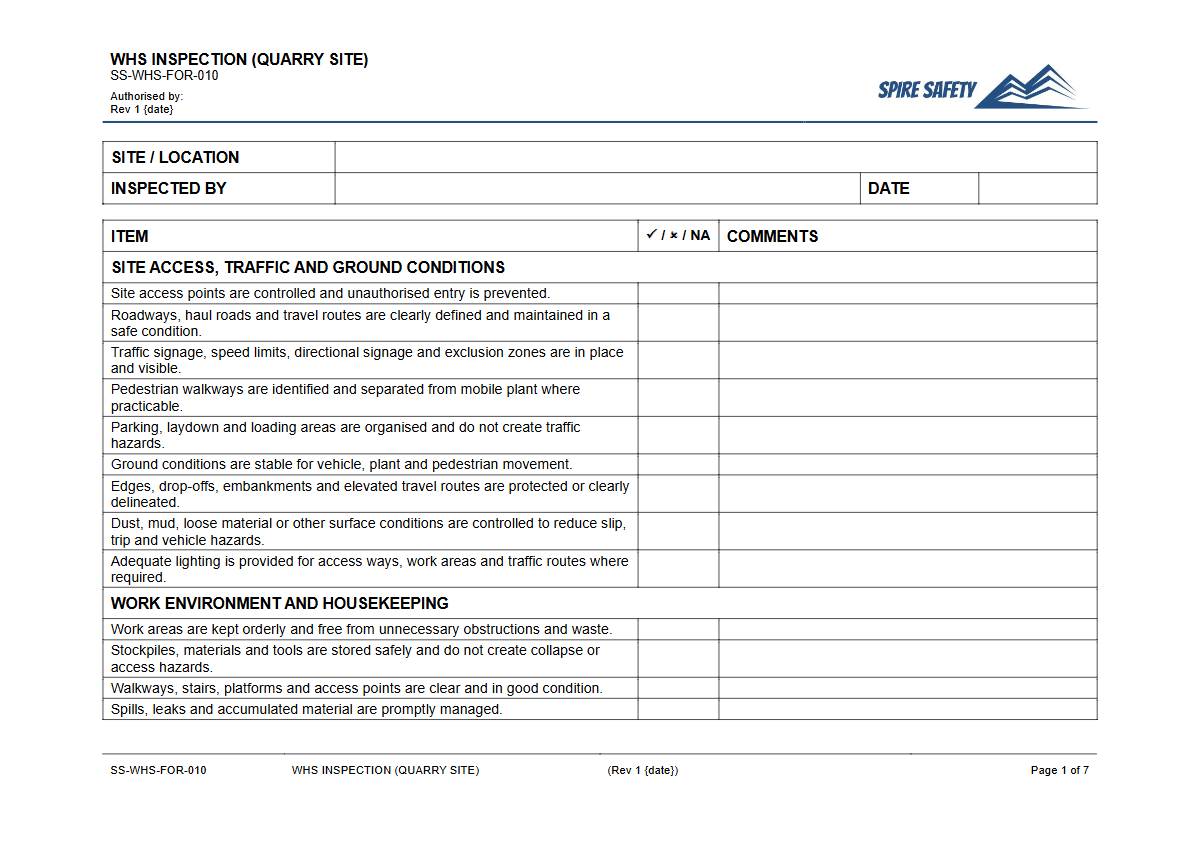
Quarries are dynamic and high-risk environments with hazards ranging from mobile plant interaction to geotechnical instability. This Free WHS Inspection (Quarry Site) Template provides a structured starting point for your organisation to conduct thorough safety inspections.
It is designed to help you systematically identify, assess, and control risks specific to quarrying operations, ensuring a safer workplace for everyone on site. Using a formal checklist helps create a consistent approach to safety, provides a documented record of your safety diligence, and serves as a critical input for your broader safety management activities.
A well-executed inspection program is a cornerstone of effective safety management. The findings from this template can be used to inform risk assessments, develop safe work procedures, and demonstrate continuous improvement within your organisation's overall WHS management systems. It prompts checks on critical areas like vehicle movement, ground conditions, blasting procedures, and dust suppression measures.
Video walkthrough
How to use the Free WHS Inspection (Quarry Site) Template
This document is a foundational template. To make it effective, you must adapt it to the specific hazards, equipment, and layout of your quarry.
No two sites are identical, and your inspection checklist should reflect the unique realities of your operation. After downloading the DOCX file, walk through your site and critically review each section, adding, removing, or modifying items to ensure they are relevant and comprehensive.
Important: This document is a template only. It has been developed to align with general Australian WHS principles, but it is not a complete or out-of-the-box solution.
We strongly recommend you customise this template in consultation with your workers and other stakeholders to ensure it is fit for purpose for your specific workplace.
Key Inspection Areas to Customise
Your inspection should be comprehensive, covering all aspects of the site. Consider creating dedicated sections for:
- Site Access and Security: Fencing, signage, and controls for unauthorised entry. A documented check can support the procedures outlined in a Site Security and Unauthorised Access Toolbox Talk Template.
- Haul Roads and Traffic Management: Condition of roads, speed limits, signage, communication protocols, and separation of vehicles and pedestrians.
- Faces, Benches, and Stockpiles: Signs of instability, erosion, undercutting, and adherence to design specifications.
- Plant and Equipment: Pre-start checks, maintenance records, guarding, emergency stops, and operator competency for both fixed and mobile plant.
- Dust, Noise, and Vibration: Effectiveness of suppression systems (e.g., water trucks), monitoring results, and use of personal protective equipment (PPE).
- Water Management: Condition of drains, dams, and sediment ponds to prevent uncontrolled releases and ensure stability.
- Explosives and Blasting: Storage security, exclusion zones, pre-blast and post-blast inspection procedures.
- Emergency and First Aid: Accessibility and stocking of first aid kits, functionality of emergency communication systems, and clear escape routes.
Regularly reviewing and verifying the effectiveness of your customised inspection process is good practice. If you need independent verification, a formal WHS compliance auditing service can provide an expert, third-party assessment of your systems.
When to conduct a Quarry Site Inspection
The frequency of inspections depends on the level of risk and the nature of the area or activity. A comprehensive site-wide inspection might be scheduled weekly or monthly.
High-traffic or high-risk areas, like haul roads or active extraction faces, may require daily checks. Inspections should also be conducted:
- Before restarting work after a weekend or public holiday.
- After significant weather events like heavy rain or high winds.
- Following any incident, near miss, or reported hazard.
- After introducing new plant, changing a process, or altering the site layout.
Environmental controls are a critical component of quarry management. Periodic checks on silt fences, sediment basins, and spill kits help supports your compliance efforts and can be reinforced with tools like our Stormwater and Waterway Protection Toolbox Talk.
Who should use this Inspection Template
This template is designed for use by competent personnel with a thorough understanding of quarry operations and WHS principles. This includes:
- Site and Quarry Managers
- Workplace Health and Safety (WHS) Advisors and Officers
- Supervisors and Forepersons
- Health and Safety Representatives (HSRs)
The person conducting the inspection must be knowledgeable enough to recognise hazards that may not be explicitly listed on the checklist. For organisations without this internal expertise, engaging external support through general WHS consulting can provide the necessary guidance to establish a robust inspection program.
Training workers to conduct routine checks, such as using a free Pre-Start Checklist (Boom Gate) Template for site access equipment, also empowers your team to take ownership of safety.
This is just one of many resources available to help you build a safer workplace. Explore our complete free WHS resources library for more templates, checklists, and toolbox talks.
Common mistakes
Common mistakes to avoid
- Failing to customise the template for the specific site, leading to missed hazards.
- Not properly training the individuals who are assigned to conduct the inspections.
- Conducting the inspection as a 'tick and flick' exercise without genuine observation.
- Inadequate follow-up and tracking of corrective actions identified during the inspection.
Legal references
Legal considerations
The following legal requirements may be relevant to this type of work.
- Work Health and Safety Act (Harmonised) — Provides the primary duties for protecting workers and other people from work health and safety risks.
- Work Health and Safety Regulations (Harmonised) — Sets out requirements supporting the management of workplace hazards and risks.
The following codes may be relevant to this type of work.
- Managing WHS Risks Code of Practice — Provides practical guidance on identifying hazards, assessing risks and applying effective controls.
- Work Health and Safety Consultation, Cooperation and Coordination Code of Practice — Provides practical guidance on consulting workers and coordinating with other duty holders.
- Managing the Work Environment and Facilities Code of Practice — Provides practical guidance on safe work environments, workplace facilities and related controls.
Did you know
Silica Dust
Respirable crystalline silica (RCS) is a major hazard in many quarries. Effective dust control measures are not just for environmental compliance; they are critical for preventing irreversible lung diseases like silicosis.
High-Risk Industry
The mining industry, which includes quarrying, is recognised as one of Australia's highest-risk industries due to the frequent interaction of heavy machinery and people in a constantly changing physical environment.
FAQ
Frequently asked questions
01What should be included in a quarry site inspection?
02How often should quarry WHS inspections be conducted?
03Is this quarry inspection template suitable for all types of quarries?
04Who is responsible for acting on findings from a WHS inspection?
Share this resource
Free WHS Inspection (Quarry Site) Template
Browse Categories
How To Use It
- 1Download and open in Word or PDF.
- 2Replace the placeholders with your business details.
- 3Get it reviewed by a WHS specialist before rollout.
Need it customised?
Our WHS consultants can adapt this template to your site, run a gap analysis, or audit what you already have in place.
Book a Free Consultation WHS consulting servicesor call 1300 156 382