
Free WHS Inspection (Pump Station) Template
Download our free WHS Inspection (Pump Station) Template. This structured DOCX & PDF helps formalise safety checks for Australian workplaces. Get started now.
Free WHS Inspection (Pump Station) Template
DOCX • 128 KB + PDF
Updated Oct 2026
No signup required
Purpose of the Free WHS Inspection (Pump Station) Template
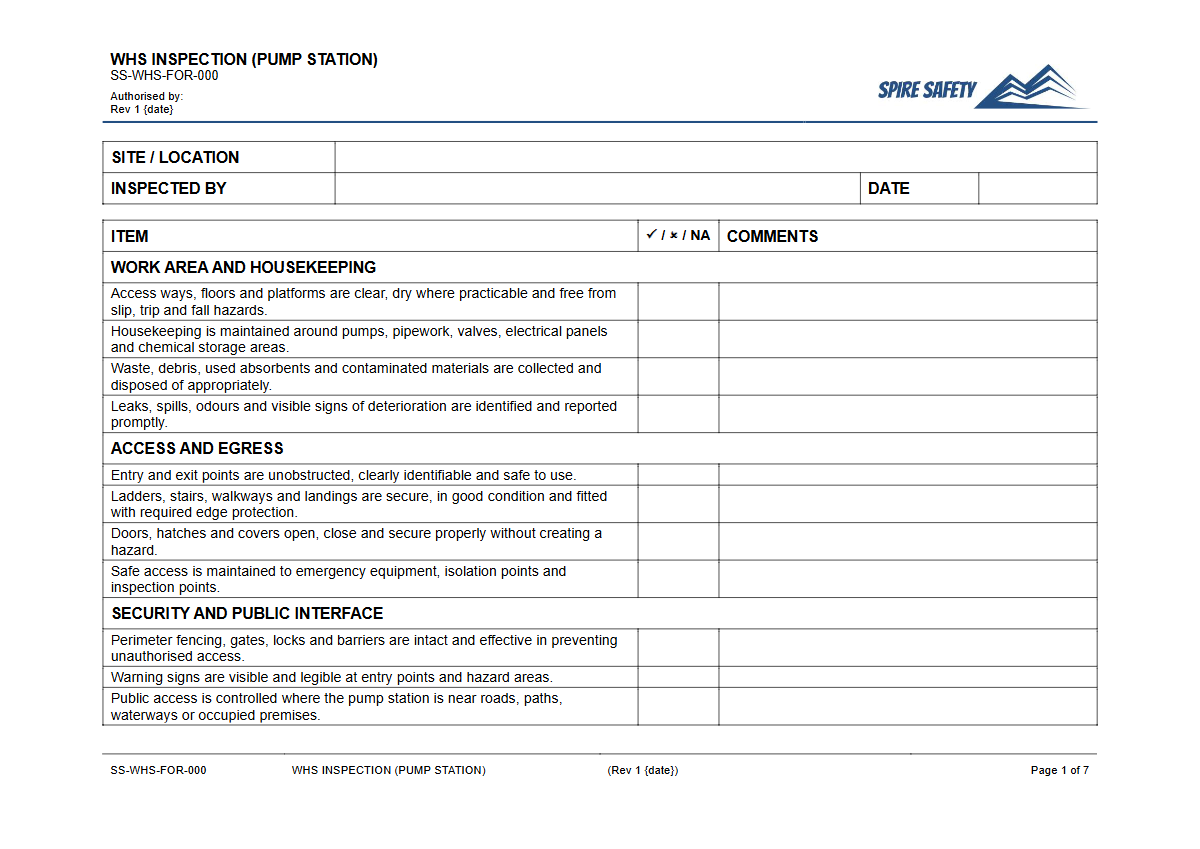
Regularly inspecting pump stations is a critical part of maintaining a safe and operational worksite. This free WHS Inspection (Pump Station) Template provides a structured starting point for organisations to formalise their safety checks.
Available as a DOCX and PDF, the template is designed to help you identify hazards, control risks, and maintain a clear record of your safety diligence. Proper inspections help prevent equipment failure, protect workers from injury, and minimise environmental risks from spills or overflows.
Pump stations present numerous hazards, including electrical shock, entanglement in moving parts, exposure to hazardous substances or wastewater, slips and falls, and the significant risks associated with confined spaces. A systematic inspection process helps ensure that controls for these risks are in place and effective.
It forms a key part of your safety documentation, alongside task-specific documents like a Boom Pump SOP (Safe Operating Procedure) Template for mobile plant.
Video walkthrough
How to use the Free WHS Inspection (Pump Station) Template
This template is designed for straightforward implementation to support your safety processes. It guides the user to check key components, including pumps, motors, valves, control panels, alarms, and structural integrity.
To get the most value from this Inspection template:
- Download the document in your preferred format (DOCX or PDF).
- Customise the checklist to reflect the specific types, models, and configurations of pump stations at your workplace. Add or remove items to align with manufacturer recommendations and site-specific risks.
- Train relevant personnel on how to conduct the inspection thoroughly and consistently.
- Schedule inspections at appropriate intervals based on risk, usage, and regulatory requirements.
- Ensure all findings, including defects and non-conformances, are clearly documented on the form.
- Establish a clear process for reporting issues and tracking corrective actions through to completion.
Important Note: This document is a template only. We have developed it as a guide, but it must be customised to suit the equipment at your workplace, as well as your unique site conditions and operational risks.
When to use it
The frequency of pump station inspections should be determined by a risk assessment. While a brief daily check might be covered by our Free Pre-Start Checklist (Cooling Pump) Template, a full formal inspection is typically required at planned intervals, such as weekly, monthly, or quarterly. Formal inspections should also be conducted:
- Before returning equipment to service after major repairs or maintenance.
- Following any incident, near miss, or reported operational issue.
- As part of a scheduled preventative maintenance program.
Who should use it
This template is designed for use by competent personnel responsible for the operation and maintenance of pump stations. This may include maintenance fitters, electricians, specialised technicians, site supervisors, and WHS managers.
The individuals conducting the inspection must have the knowledge and experience to identify faults and understand the associated risks.
Verifying the skills of these individuals is essential, which can be formalised using a document like our Verification of Competency (Concrete Pump (Stationary)) Template. The findings from these inspections are a vital input for your broader safety framework and can inform the development of robust WHS management systems.
Ultimately, a systematic inspection program demonstrates proactive risk management and supports continuous improvement. The data gathered can be invaluable during formal safety assessments, such as those conducted during WHS compliance auditing, to verify that controls are effective and consistently applied.
This document is one of many tools designed to help you build a safer workplace. Browse our complete free WHS resources library for more templates to support your safety management system.
Common mistakes
Common mistakes to avoid
- Using a generic checklist without customising it for the specific pump station model and site.
- Failing to document and track corrective actions for identified defects.
- Assigning inspections to personnel who lack the competence to identify mechanical or electrical faults.
- Ignoring 'minor' issues like small leaks, unusual noises, or vibrations, which can indicate developing failures.
Legal references
Legal considerations
The following legal requirements may be relevant to this type of work.
- Work Health and Safety Act (Harmonised) — Provides the primary duties for protecting workers and other people from work health and safety risks.
- Work Health and Safety Regulations (Harmonised) — Sets out requirements supporting the management of workplace hazards and risks.
The following codes may be relevant to this type of work.
- Managing WHS Risks Code of Practice — Provides practical guidance on identifying hazards, assessing risks and applying effective controls.
- Work Health and Safety Consultation, Cooperation and Coordination Code of Practice — Provides practical guidance on consulting workers and coordinating with other duty holders.
- Managing the Work Environment and Facilities Code of Practice — Provides practical guidance on safe work environments, workplace facilities and related controls.
Did you know
Confined Space Dangers
Many pump stations and their associated wet wells are classified as confined spaces. According to Safe Work Australia, most deaths in confined spaces are not of the initial entrant, but of would-be rescuers who enter without proper precautions.
FAQ
Frequently asked questions
01What is the difference between an inspection and a pre-start check for a pump station?
02How often should a pump station be formally inspected?
03What are the key hazards to look for during a pump station inspection?
04Can this template be used for any type of pump station?
Share this resource
Free WHS Inspection (Pump Station) Template
Browse Categories
How To Use It
- 1Download and open in Word or PDF.
- 2Replace the placeholders with your business details.
- 3Get it reviewed by a WHS specialist before rollout.
Need it customised?
Our WHS consultants can adapt this template to your site, run a gap analysis, or audit what you already have in place.
Book a Free Consultation WHS consulting servicesor call 1300 156 382