
Free WHS Inspection (Produce Market) Template
Download our Free WHS Inspection (Produce Market) Template to streamline your safety checks.
Free WHS Inspection (Produce Market) Template
DOCX • 128 KB + PDF
Updated Oct 2026
No signup required
Purpose of the Free WHS Inspection (Produce Market) Template
Produce markets are dynamic environments with a unique set of work health and safety risks. From manual handling of stock and vehicle movements to slip hazards and food safety considerations, a systematic approach to safety is essential.
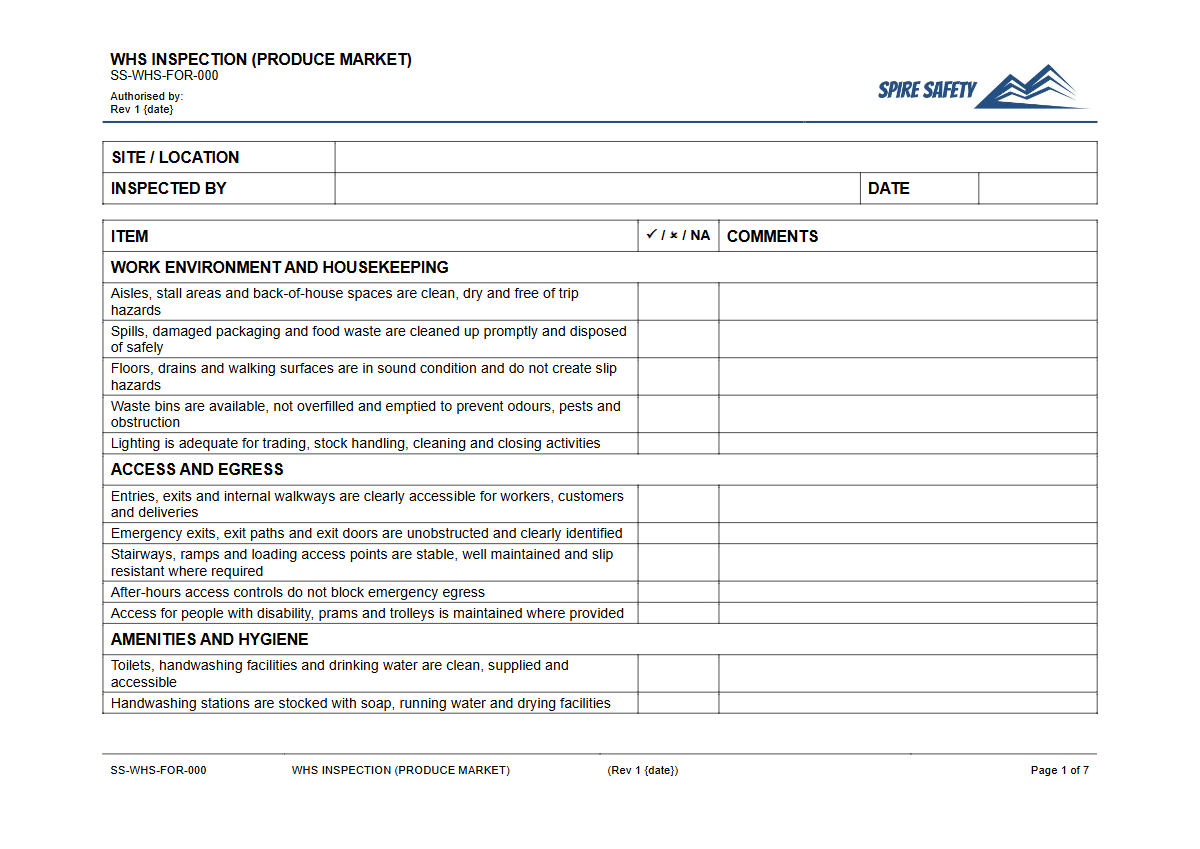
This Free WHS Inspection (Produce Market) Template provides a structured starting point for identifying hazards and assessing risks in your workplace. Regular inspections help you proactively manage safety, prevent incidents, and demonstrate a commitment to your legal duties. Using a standardised template helps formalise this process, making it a routine part of your operational rhythm and a key component of your broader WHS management systems.
Video walkthrough
How to use the Free WHS Inspection (Produce Market) Template
This resource is provided in both DOCX and PDF formats for your convenience. The DOCX file can be easily edited to align with the specific characteristics of your market, while the PDF is ready for immediate printing.
It is crucial to adapt this document to your operational context.
Important: This template is a guide, not a complete solution. We cannot know the specific hazards present in your individual workplace.
You must customise this document to accurately reflect your site, the tasks your workers perform, the equipment they use, and the public-facing areas of your operation. This might involve adding, removing, or modifying sections to ensure the inspection is relevant and thorough.
For example, if your market has extensive cold storage, you may want to integrate our freezer pre-start checklist into your regular inspection routine.
What this Inspection Template Covers
Our template is designed to prompt a review of common risk areas found in produce markets. It is organised into logical sections to guide the inspector through the premises efficiently. Key areas for inspection include:
Work Environment & Housekeeping
This section focuses on the physical environment. It includes checks for floor conditions to prevent slips and trips, adequacy of lighting in all areas, waste management practices (especially for organic waste), and general tidiness.
A clean and organised workplace is a cornerstone of safety.
Hazardous Manual Tasks
Handling crates of fruit and vegetables, stocking displays, and moving pallets are daily activities that pose a risk of musculoskeletal injury. This part of the inspection assesses the use of mechanical aids like pallet jacks and trolleys, worker lifting techniques, and the design of storage and displays to minimise awkward postures.
A more comprehensive review of your safety program can be achieved through a formal WHS compliance auditing process.
Plant & Equipment
All equipment must be safe to use and properly maintained. This includes checks on cool room doors and safety releases, pallet wrapping machines, scales, and any processing equipment.
If heavy lifting equipment is used, such as for unloading trucks, a more detailed check like our electric hoist pre-start checklist may be required for that specific plant.
Vehicle & Pedestrian Management
The interaction between forklifts, delivery trucks, staff vehicles, and people (both workers and customers) is a significant risk. The inspection should cover the effectiveness of designated walkways, signage, loading dock procedures, and traffic management plans.
For sites with controlled entry points, a boom gate safety check can also be beneficial.
Emergency Preparedness
This section verifies that emergency procedures are supported by the right equipment. It prompts checks on the accessibility and service status of fire extinguishers, the clarity of emergency exit paths, and the location and contents of first aid kits.
When to conduct a Workplace Inspection
The frequency of inspections depends on the nature of the work and the level of risk. A good practice is to establish a schedule, such as:
- Daily: Quick informal checks of key high-risk areas before opening.
- Weekly: A more detailed walk-through of a specific department or area.
- Monthly: A comprehensive formal inspection covering the entire site using this template.
- Ad-hoc: Inspections should also be conducted after an incident, when a new process or piece of equipment is introduced, or when concerns are raised by workers.
If you need help establishing an appropriate inspection schedule or require more specialised advice, our WHS consulting services can provide tailored support for your business.
Who should use this Inspection Template
Workplace inspections should be a collaborative effort. While a manager or WHS representative may lead the process, involving workers who perform the day-to-day tasks is invaluable.
They have first-hand experience with the work and can provide practical insights into potential hazards and effective controls. The template can be used by:
- Business Owners and Managers
- Supervisors and Team Leaders
- Health and Safety Representatives (HSRs)
- WHS Committee Members
- Any worker assigned to conduct an inspection
For more tools to build out your safety systems, browse our complete free WHS resources library.
Common mistakes
Common mistakes to avoid
- Failing to customise the template for the specific workplace layout and equipment.
- Conducting the inspection but not following up with corrective actions to fix identified problems.
- Not involving workers who actually perform the tasks in the inspection process.
- Only inspecting 'back of house' areas and neglecting public-facing spaces where customer safety is also a duty.
Legal references
Legal considerations
The following legal requirements may be relevant to this type of work.
- Work Health and Safety Act (Harmonised) — Provides the primary duties for protecting workers and other people from work health and safety risks.
- Work Health and Safety Regulations (Harmonised) — Sets out requirements supporting the management of workplace hazards and risks.
The following codes may be relevant to this type of work.
- Managing WHS Risks Code of Practice — Provides practical guidance on identifying hazards, assessing risks and applying effective controls.
- Work Health and Safety Consultation, Cooperation and Coordination Code of Practice — Provides practical guidance on consulting workers and coordinating with other duty holders.
- Managing the Work Environment and Facilities Code of Practice — Provides practical guidance on safe work environments, workplace facilities and related controls.
Did you know
Manual Handling Risk
In the Australian agriculture, forestry, and fishing industry, which includes many produce suppliers, body stressing accounts for over 40% of serious workers' compensation claims.
FAQ
Frequently asked questions
01What is the most common injury in a produce market?
02How do I ensure this inspection template is compliant?
03Is a digital or paper-based inspection better?
04Do I need to inspect customer-facing areas too?
Share this resource
Free WHS Inspection (Produce Market) Template
Browse Categories
How To Use It
- 1Download and open in Word or PDF.
- 2Replace the placeholders with your business details.
- 3Get it reviewed by a WHS specialist before rollout.
Need it customised?
Our WHS consultants can adapt this template to your site, run a gap analysis, or audit what you already have in place.
Book a Free Consultation WHS consulting servicesor call 1300 156 382