
Free WHS Inspection (Precast Yard) Template
Download our free WHS Inspection Template for Precast Yards. This customisable DOCX helps formalise safety checks for high-risk construction environments.
Free WHS Inspection (Precast Yard) Template
DOCX • 129 KB + PDF
Updated Oct 2026
No signup required
Purpose of the Free WHS Inspection (Precast Yard) Template
Precast concrete yards are dynamic, high-risk environments with constantly changing hazards. Effectively managing safety requires a systematic approach to identifying and controlling risks.
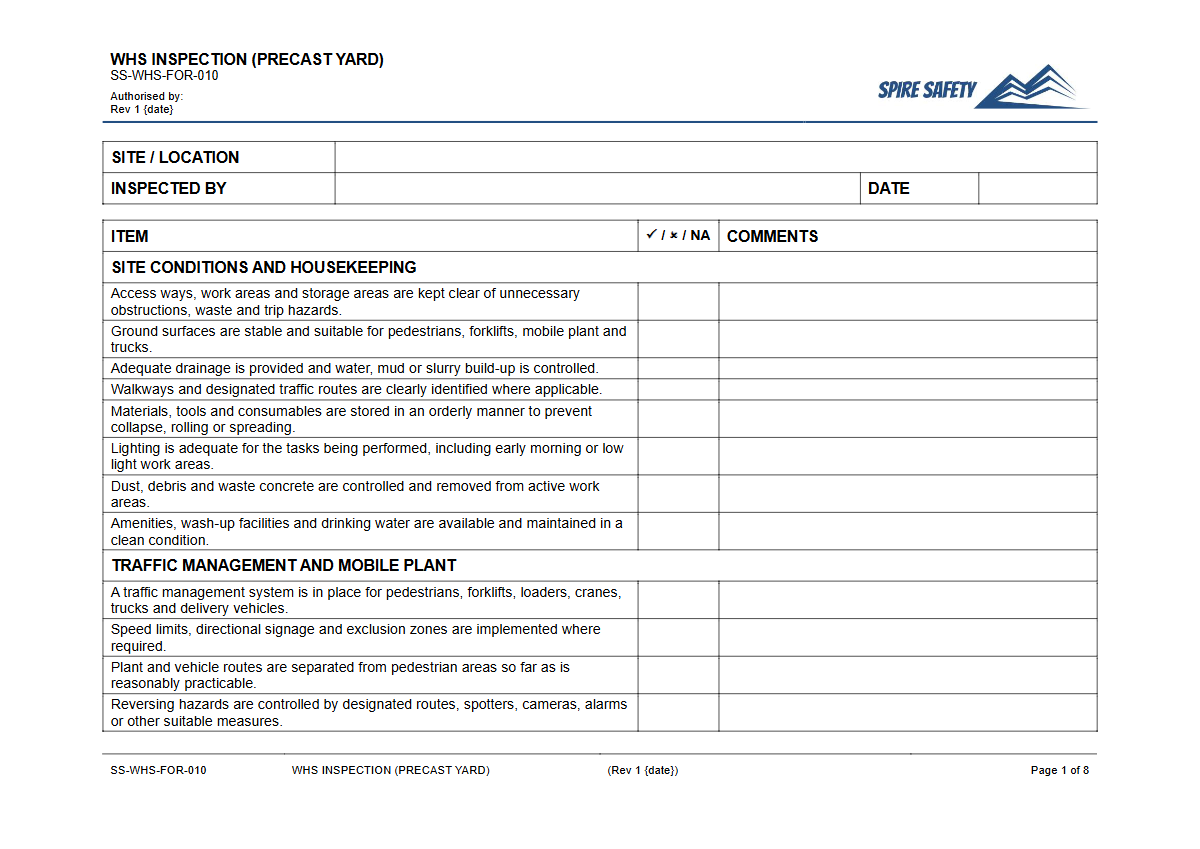
This free WHS Inspection (Precast Yard) Template provides a structured starting point for your organisation to formalise its safety walkthroughs. It is designed to guide a competent person through a methodical check of common hazard areas, including panel storage, casting beds, vehicle and pedestrian interaction, chemical handling, and lifting operations.
Consistent inspections help proactively identify unsafe conditions before they lead to an incident, demonstrating a commitment to workplace safety.
Using a documented inspection process helps embed safety checks into your operational rhythm. It forms a critical component of a proactive safety culture and provides tangible evidence of your hazard management activities.
Integrating regular checks like this into your overall safety framework is a key principle of effective WHS management systems, helping to ensure that controls are in place and working as intended.
What this Inspection covers
This template is aligned with Australian WHS principles and prompts checks across several key operational areas in a precast yard:
- General Site Conditions: Assesses housekeeping, access and egress, lighting, and signage.
- Casting and Finishing Areas: Focuses on formwork condition, chemical storage (release agents), and control of dusts like silica.
- Lifting and Handling: Includes checks on cranes, lifting clutches, chains, and storage procedures for finished elements.
- Panel Storage and Racking: Examines the stability of A-frames, racks, and dunnage, ensuring panels are stored securely.
- Traffic Management: Reviews separation of pedestrians and mobile plant, designated walkways, and signage.
- Emergency Preparedness: Checks accessibility and condition of first aid kits, fire extinguishers, and emergency communication systems.
Video walkthrough
How to use the Free WHS Inspection (Precast Yard) Template
This document is provided in DOCX format for easy customisation. After downloading, you should review the checklist with key personnel, such as supervisors and Health and Safety Representatives (HSRs), to tailor it to your specific workplace.
This ensures the inspection is relevant and effective for your unique operations, equipment, and hazards.
Important: This is a template, not a finished document. We have developed it as a starting point, but you MUST customise it to reflect the specific plant, equipment, chemicals, processes, and risks present in your precast yard.
Its effectiveness depends entirely on how well it is adapted and implemented. A periodic WHS compliance auditing process can help verify that your customised inspections and other safety procedures are being followed correctly and remain effective.
When to use it
The frequency of inspections should be determined by a risk assessment. For a precast yard, a comprehensive weekly inspection is a common and practical baseline.
This allows for timely identification of developing issues like poor housekeeping or damaged equipment. This can be supplemented with other checks as needed.
For example, you should perform specific pre-start checks on critical plant daily, such as a pre-start checklist for an electric hoist, before it is used.
Inspections should also be conducted following specific events. This includes after a period of bad weather that may affect ground stability, after any workplace incident or near miss, or when introducing new equipment or processes to the yard.
You may also conduct targeted checks on specific controls, such as a daily check of site entry points using a pre-start checklist for a boom gate, to ensure site security and traffic controls are functional.
Who should use it
This inspection should be carried out by a person with the knowledge, experience, and training to identify the hazards specific to a precast manufacturing environment. This is often a Site Supervisor, Team Leader, WHS Advisor, or a trained Health and Safety Representative.
The individuals conducting the inspection must be competent to recognise non-compliant or unsafe situations and have the authority to initiate corrective actions. It is not a task for an untrained worker. For more tools and templates to support your safety personnel, browse our complete free WHS resources library.
Common mistakes
Common mistakes to avoid
- Failing to customise the template for site-specific equipment, storage systems, and hazards.
- Completing the checklist without physically verifying the items ('pencil-whipping').
- Not assigning clear responsibility or deadlines for corrective actions identified during the inspection.
- Using untrained personnel who do not understand the risks they are supposed to be looking for.
Legal references
Legal considerations
The following legal requirements may be relevant to this type of work.
- Work Health and Safety Act (Harmonised) — Provides the primary duties for protecting workers and other people from work health and safety risks.
- Work Health and Safety Regulations (Harmonised) — Sets out requirements supporting the management of workplace hazards and risks.
The following codes may be relevant to this type of work.
- Managing WHS Risks Code of Practice — Provides practical guidance on identifying hazards, assessing risks and applying effective controls.
- Work Health and Safety Consultation, Cooperation and Coordination Code of Practice — Provides practical guidance on consulting workers and coordinating with other duty holders.
- Managing the Work Environment and Facilities Code of Practice — Provides practical guidance on safe work environments, workplace facilities and related controls.
Did you know
Curing Time
Concrete does not simply dry; it 'cures' through a chemical reaction called hydration. This process continues for years, meaning concrete panels get progressively stronger long after they leave the yard.
Sling Angles Matter
Using incorrect sling angles when lifting a precast panel can multiply the stress on the element and its lifting points. An angle of 30 degrees from horizontal can double the tension in the slings, risking catastrophic failure.
FAQ
Frequently asked questions
01What are the main WHS hazards in a precast concrete yard?
02How often should I conduct a WHS inspection in a precast yard?
03Is this inspection template a substitute for a full WHS audit?
04Can I use this precast yard inspection template on a phone or tablet?
Share this resource
Free WHS Inspection (Precast Yard) Template
Browse Categories
How To Use It
- 1Download and open in Word or PDF.
- 2Replace the placeholders with your business details.
- 3Get it reviewed by a WHS specialist before rollout.
Need it customised?
Our WHS consultants can adapt this template to your site, run a gap analysis, or audit what you already have in place.
Book a Free Consultation WHS consulting servicesor call 1300 156 382