
Free WHS Inspection (Paint Shop) Template
Download our Free WHS Inspection (Paint Shop) Template (DOCX & PDF) to formalise your safety checks and manage high-risk workplace hazards. Get started now.
Free WHS Inspection (Paint Shop) Template
DOCX • 127 KB + PDF
Updated Oct 2026
No signup required
Purpose of the Free WHS Inspection (Paint Shop) Template
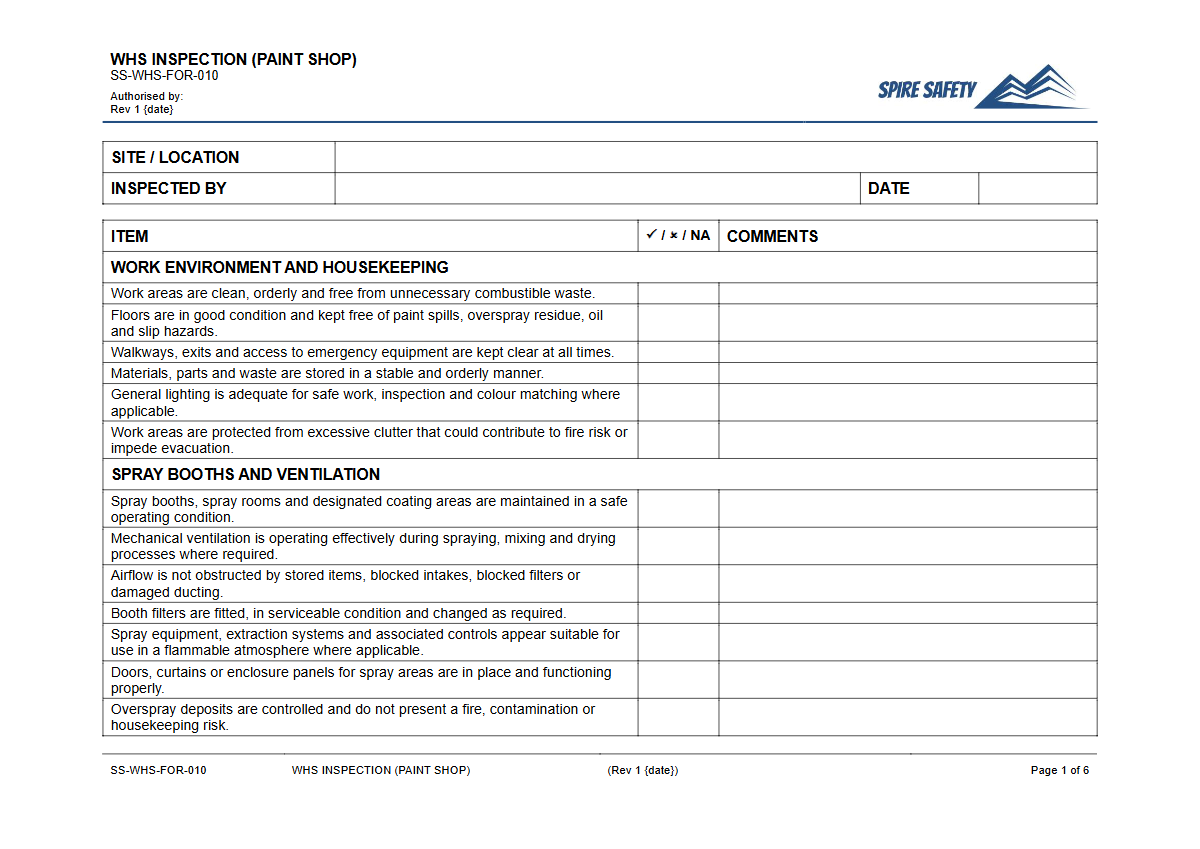
Paint and panel shops present a unique combination of workplace health and safety risks, from hazardous chemical exposure to fire and explosion hazards. This Free WHS Inspection (Paint Shop) Template provides a structured starting point for systematically identifying, assessing, and controlling these risks.
Regular, documented inspections are a fundamental component of proactive safety management, helping your organisation meet its duty of care. The template guides you through key areas, including chemical storage, ventilation systems, personal protective equipment (PPE), fire safety, and electrical equipment, ensuring critical checkpoints are not overlooked.
Using this template helps formalise your safety processes, moving beyond ad-hoc checks to a scheduled, recordable activity. It encourages a consistent approach to safety across all shifts and personnel.
Integrating such regular checks is a cornerstone of building robust WHS management systems that protect workers and support legislative compliance. It is designed to be adapted to any automotive, manufacturing, or industrial paint shop environment, focusing on the specific hazards associated with spray painting and finishing operations.
Video walkthrough
How to use the Free WHS Inspection (Paint Shop) Template
This document provides a comprehensive baseline for conducting safety inspections in your paint shop or spray-painting area. It covers common hazards and control measures aligned with Australian WHS principles.
The checklist format is designed for ease of use, allowing inspectors to quickly identify non-conformances and assign corrective actions. By documenting findings, you create a valuable record for safety meetings, management reviews, and continuous improvement activities.
To get the most value from this resource, follow these steps:
- Download: Select the DOCX file for easy editing or the PDF for immediate printing.
- Customise: This is a critical step. You must adapt the template to your specific workplace. Add or remove items to reflect the exact types of spray booths, mixing equipment, chemicals, and processes you use. We cannot know your specific site risks, so customisation is essential for effectiveness.
- Train: Ensure any person conducting the inspection is competent to do so. They must understand the hazards of the paint shop and know what they are looking for.
- Schedule & Conduct: Integrate the inspection into your regular safety schedule. Assign responsibility to a supervisor, WHS representative, or other qualified person.
- Review & Act: Systematically review completed inspection reports. Prioritise and assign all identified corrective actions with clear deadlines and responsibilities. Track them to completion.
If your team requires assistance in tailoring this template or developing specific procedures for high-risk tasks, engaging professional WHS consulting services can provide expert guidance and ensure your safety documentation is fit-for-purpose.
When to use it
The frequency of paint shop inspections should be determined by a risk assessment, but a combination of schedules is often most effective. Daily pre-start checks are essential for critical safety equipment like spray booth ventilation and emergency stops.
A more thorough inspection, as detailed in this template, is typically performed on a weekly or monthly basis. Additionally, an inspection should always be conducted after any maintenance, repair, or modification to equipment like spray guns, air compressors, or the booth itself.
Many workshops also use specific equipment checklists, similar to our Free Pre-Start Checklist (Electric Hoist) Template, for ancillary machinery used within the shop.
Who should use it
Paint shop inspections should be carried out by a person with the knowledge and competence to identify the relevant hazards. This could be a workshop manager, team leader, supervisor, or an elected Health and Safety Representative (HSR).
Involving the workers who operate in the area is also highly beneficial, as they have direct, hands-on knowledge of the equipment and processes. For an inspection to be effective, the person conducting it must be empowered by management to halt unsafe work and initiate corrective actions. The records from these inspections provide crucial evidence of safety monitoring during periodic WHS compliance audits.
The responsibility for overall site safety often extends beyond the workshop floor. Broader workplace inspections might cover site access and traffic management, including checks on infrastructure like security barriers, which can be managed using tools like a free Pre-Start Checklist (Boom Gate) Template. By ensuring all aspects of the site are regularly checked, you create a more comprehensive safety culture. For more templates and safety guides, explore our complete free WHS resources library.
Common mistakes
Common mistakes to avoid
- Using generic checklists without customising them for the specific paints, thinners, and equipment on site.
- Neglecting to check or maintain the spray booth's ventilation and filtration systems, leading to poor air quality.
- Improper storage of flammable liquids, such as leaving them in open containers or outside of designated fire-rated cabinets.
- Workers using incorrect or poorly maintained PPE, especially respirators, that do not provide adequate protection.
Legal references
Legal considerations
The following legal requirements may be relevant to this type of work.
- Work Health and Safety Act (Harmonised) — Provides the primary duties for protecting workers and other people from work health and safety risks.
- Work Health and Safety Regulations (Harmonised) — Sets out requirements supporting the management of workplace hazards and risks.
The following codes may be relevant to this type of work.
- Managing WHS Risks Code of Practice — Provides practical guidance on identifying hazards, assessing risks and applying effective controls.
- Work Health and Safety Consultation, Cooperation and Coordination Code of Practice — Provides practical guidance on consulting workers and coordinating with other duty holders.
- Managing the Work Environment and Facilities Code of Practice — Provides practical guidance on safe work environments, workplace facilities and related controls.
Did you know
Ignition Source
Static electricity from an ungrounded object or even a person can be enough to ignite flammable paint vapours in a poorly ventilated space, causing a fire or explosion.
Isocyanate Exposure
Isocyanates, common in two-pack paints, are a leading cause of occupational asthma. The effects of exposure are cumulative, and sensitisation can occur at any time, even after years of working without issue.
FAQ
Frequently asked questions
01What are the main WHS hazards in a vehicle paint shop?
02How often should a spray booth be inspected?
03Is this template enough to be WHS-aligned?
04What PPE is required for working in a paint shop?
Share this resource
Free WHS Inspection (Paint Shop) Template
Browse Categories
How To Use It
- 1Download and open in Word or PDF.
- 2Replace the placeholders with your business details.
- 3Get it reviewed by a WHS specialist before rollout.
Need it customised?
Our WHS consultants can adapt this template to your site, run a gap analysis, or audit what you already have in place.
Book a Free Consultation WHS consulting servicesor call 1300 156 382