
Free WHS Inspection (Office) Template
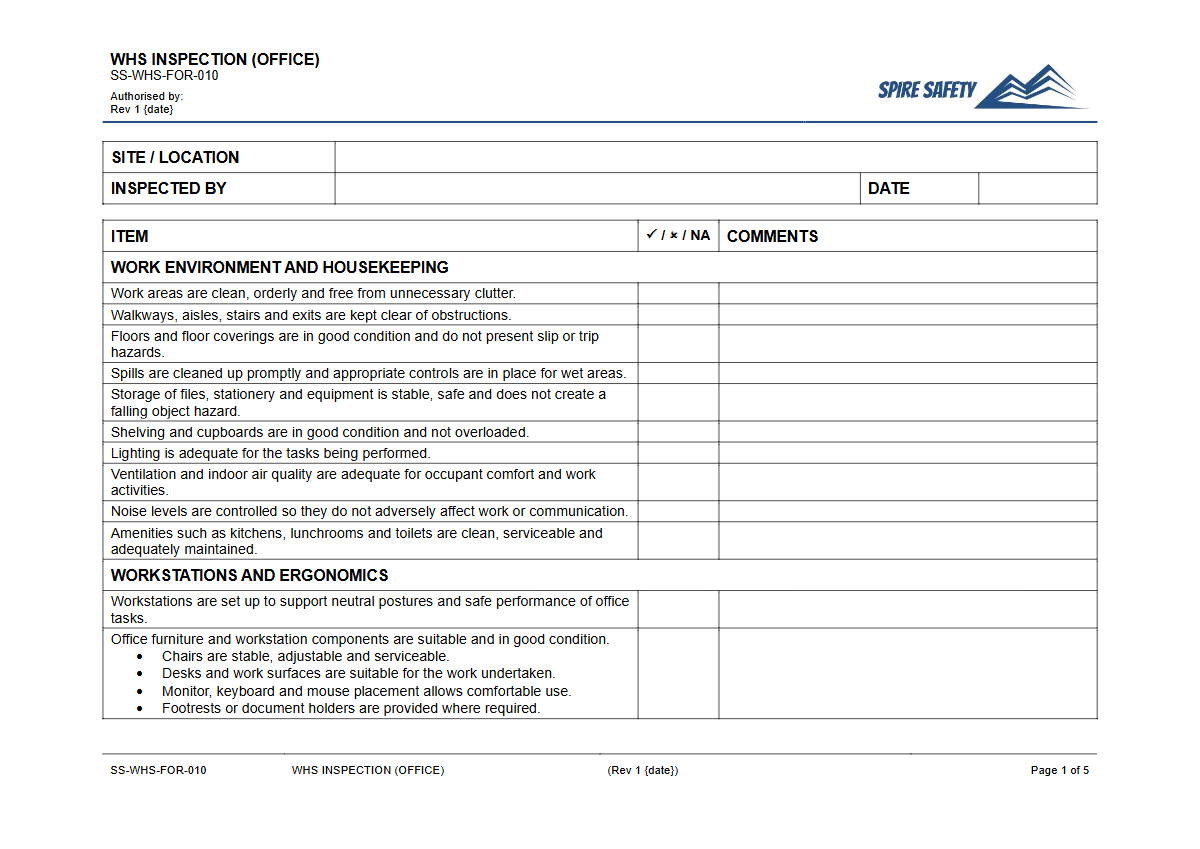
Download our Free WHS Inspection (Office) Template (DOCX & PDF) to formalise your workplace safety checks.
Free WHS Inspection (Office) Template
DOCX • 127 KB + PDF
Updated Oct 2026
No signup required
Purpose of the Free WHS Inspection (Office) Template
Regularly inspecting your office environment is a fundamental part of managing health and safety risks. While offices are often perceived as low-risk, they contain numerous hazards that can lead to injury or illness.
Using this Free WHS Inspection (Office) Template helps a Person Conducting a Business or Undertaking (PCBU) systematically identify, assess, and control these risks, from ergonomic issues at workstations to slip and trip hazards in common areas.
A documented inspection process demonstrates a proactive approach to safety and forms a critical component of effective WHS management systems. It provides a structured method for maintaining a safe working environment, fulfilling primary duties of care, and creating a historical record of safety management activities. This template is aligned with Australian WHS practice and provides a solid foundation for your internal processes.
Video walkthrough
How to use the Free WHS Inspection (Office) Template
Our Free WHS Inspection (Office) Template is available for download in both DOCX and PDF formats. The DOCX version is fully editable, allowing you to tailor the checklist to your specific operational needs.
To use the template effectively, you should review each section and add, remove, or modify items to reflect the unique layout, equipment, and work practices of your office. A generic checklist is a starting point, not a final solution.
Note: This template provides a foundation based on common Australian WHS practice. However, you must customise it to reflect the specific hazards of your workplace.
We cannot guarantee its suitability for your specific circumstances without thorough customisation by a competent person.
Implementing the Inspection
Once customised, the inspection should be conducted by a designated person, such as a manager, supervisor, or Health and Safety Representative (HSR). During the inspection, walk through the premises and systematically check each item on the list.
For any non-conforming items or identified hazards, record the details, assess the risk level, and propose a corrective action with a clear deadline and responsible person. It's important to differentiate these routine checks from more comprehensive WHS compliance auditing, which formally assesses the performance of your entire safety system against legal and other standards.
What to include in your office inspection
A thorough office inspection should cover all areas and potential hazards. While our template provides a comprehensive list, key areas for customisation and focus include:
- Workstations: Assess ergonomic setups, including chair height, screen position, desk layout, and cable management.
- Floors and Walkways: Check for trip hazards (e.g., loose cables, boxes), slip hazards (e.g., spills), and adequate lighting.
- Electrical Equipment: Visually inspect cords, power boards, and appliances for damage. Ensure equipment has been tested and tagged where required by legislation. For specific appliances, you may want a dedicated pre-start checklist for a coffee machine.
- Fire Safety: Verify that fire extinguishers are in date and accessible, exit signs are illuminated, and emergency exits are unobstructed.
- First Aid: Ensure first aid kits are fully stocked, easily accessible, and that contact details for first aid officers are clearly displayed.
- Amenities: Check the cleanliness and maintenance of kitchens and bathrooms.
When to conduct an office inspection
The frequency of workplace inspections depends on the level of risk. For a typical office environment, conducting a formal inspection on a monthly or quarterly basis is a common and effective practice. However, inspections should also be triggered by specific events, such as:
- After a reported incident or near miss.
- When new office equipment is introduced.
- Following changes to the office layout or work procedures.
- When concerns are raised by workers or HSRs.
These formal inspections supplement the day-to-day responsibility of all workers to be aware of and report hazards as they see them. For certain office machinery, daily checks may be more appropriate, such as using a pre-start checklist for an envelope sealer before use.
Who should conduct the inspection
Office inspections are typically carried out by supervisors, line managers, or members of a safety committee. Health and Safety Representatives (HSRs) also play a vital role and have specific powers under WHS legislation to conduct inspections.
The most effective inspections involve consultation with the workers who use the space every day, as they have firsthand knowledge of the risks involved in their tasks and work area. Regardless of who performs the inspection, findings must be communicated to management for action and follow-up.
If you need more specialised templates, you can browse our complete free WHS resources library for other checklists and forms.
Common mistakes
Common mistakes to avoid
- Using a generic checklist without customising it for the specific workplace layout and equipment.
- Failing to document findings or track corrective actions through to completion.
- Conducting inspections without involving or consulting the workers who use the space daily.
- Only looking for physical hazards and ignoring less visible risks like poor ergonomics or psychosocial factors.
Legal references
Legal considerations
The following legal requirements may be relevant to this type of work.
- Work Health and Safety Act (Harmonised) — Provides the primary duties for protecting workers and other people from work health and safety risks.
- Work Health and Safety Regulations (Harmonised) — Sets out requirements supporting the management of workplace hazards and risks.
The following codes may be relevant to this type of work.
- Managing WHS Risks Code of Practice — Provides practical guidance on identifying hazards, assessing risks and applying effective controls.
- Work Health and Safety Consultation, Cooperation and Coordination Code of Practice — Provides practical guidance on consulting workers and coordinating with other duty holders.
- Managing the Work Environment and Facilities Code of Practice — Provides practical guidance on safe work environments, workplace facilities and related controls.
Did you know
Hidden Office Hazards
Slips, trips, and falls are a leading cause of serious workers' compensation claims in Australia, with many incidents occurring in seemingly safe office environments due to hazards like trailing cables or wet floors.
The Importance of Consultation
Under model WHS law, businesses have a duty to consult with workers on safety matters. Involving employees in your workplace inspection process is not only a legal requirement but also leads to better hazard identification.
FAQ
Frequently asked questions
01What is the difference between a WHS inspection and an audit?
02How often should I conduct WHS inspections in my office?
03Is this office inspection template WHS-aligned?
04Who is responsible for conducting workplace inspections?
Share this resource
Free WHS Inspection (Office) Template
Browse Categories
How To Use It
- 1Download and open in Word or PDF.
- 2Replace the placeholders with your business details.
- 3Get it reviewed by a WHS specialist before rollout.
Need it customised?
Our WHS consultants can adapt this template to your site, run a gap analysis, or audit what you already have in place.
Book a Free Consultation WHS consulting servicesor call 1300 156 382