
Free WHS Inspection (Nursery) Template
Download our free WHS Inspection Template for nurseries. A structured starting point for identifying hazards in childcare and horticultural settings.
Free WHS Inspection (Nursery) Template
DOCX • 128 KB + PDF
Updated Oct 2026
No signup required
Purpose of the Free WHS Inspection (Nursery) Template
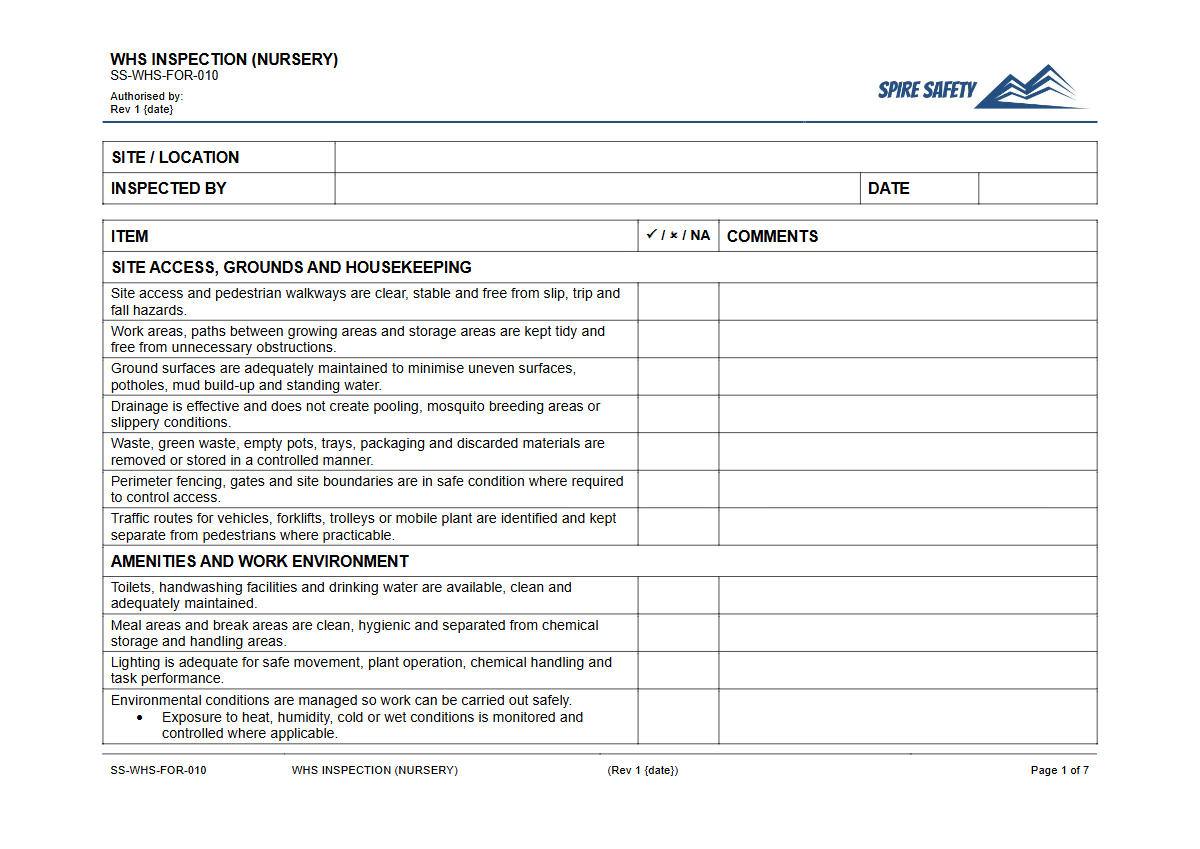
Regular workplace inspections are a cornerstone of effective safety management. This Free WHS Inspection (Nursery) Template provides a structured starting point for systematically identifying and controlling health and safety risks in your nursery environment.
Whether you operate a childcare centre or a horticultural business, this template helps you move beyond informal checks to a formal, documented process. Using this template helps your organisation meet its primary duty of care by proactively managing hazards, preventing incidents, and fostering a safer workplace for staff, children, and visitors.
The document is designed to prompt a thorough review of common and specific hazards, from slips and trips to equipment safety and chemical handling. It’s a tool for demonstrating due diligence and continuously improving your safety performance.
A well-executed inspection program is a critical component of any organisation's safety framework and helps ensure you are actively monitoring your work environment for new or changing risks.
Video walkthrough
How to use the Free WHS Inspection (Nursery) Template
This template is provided in both DOCX and PDF formats for your convenience. The DOCX file is fully editable, allowing for comprehensive customisation. To use it effectively, follow these steps:
- Download: Choose the format that best suits your needs.
- Customise: This is the most critical step. The template is a general guide. You must adapt it to reflect the specific equipment, layout, tasks, and hazards present in your nursery. We cannot know your site-specific risks; it's your responsibility to ensure the final document is comprehensive and relevant to your operations.
- Schedule: Determine a suitable frequency for inspections (e.g., weekly, monthly) and assign responsibility to a competent person.
- Conduct: Walk through the workplace, systematically checking the items listed. Record observations, noting both compliant and non-compliant findings.
- Report & Act: Document any identified hazards or areas for improvement. Assign corrective actions with clear responsibilities and deadlines. Follow up to ensure actions are completed effectively.
Maintaining clear and accessible records of inspections, findings, and corrective actions is essential. This documentation forms a vital part of your overall safety records and is a key element of all successful WHS management systems.
When to use it
A workplace inspection should not be a one-off event. It should be an integrated part of your routine safety procedures. Inspections should be conducted:
- On a regular, scheduled basis (e.g., weekly, fortnightly, or monthly). The frequency should be based on the level of risk; higher-risk areas or activities require more frequent checks.
- After any incident, accident, or near miss to identify contributing factors and prevent recurrence.
- When new machinery, equipment, or substances are introduced into the workplace.
- When there are changes to the work environment, layout, or processes.
- Following extended shutdowns or before seasonal peaks to ensure the environment is safe to resume full operations.
Who should use it
Workplace inspections should be carried out by a person or team with the knowledge and competence to identify hazards. This could include a line manager, supervisor, a dedicated WHS officer, or a Health and Safety Representative (HSR).
It is beneficial to involve workers who are familiar with the area being inspected, as they can provide valuable insights into day-to-day risks and operational realities. For a more formal, third-party review of your safety processes, you may consider engaging external WHS consulting professionals who can provide an objective assessment.
What to Look For During a Nursery Inspection
A thorough inspection covers multiple aspects of the work environment. While your customised checklist will be more detailed, here are key areas to focus on in a nursery setting.
General Environment & Housekeeping
Assess walkways, floors, and storage areas for slip, trip, and fall hazards. This includes trailing electrical cords, hoses in a garden centre, or toys left on the floor in a childcare facility.
Check for adequate lighting, ventilation, and clear access to all emergency exits and firefighting equipment.
Equipment & Machinery
All equipment, from office printers to major machinery, should be inspected for safety. Ensure machine guarding is in place and effective.
In childcare centres, even simple appliances need regular checks; our pre-start checklist for bottle warmers is a useful tool. For nurseries with large grounds, formalising checks on landscaping equipment with a pre-start checklist for a lawn tractor is crucial.
Chemical & Substance Safety
Review the storage, handling, and use of all chemicals, including cleaning products, sanitisers, fertilisers, and pesticides. Verify that all substances are correctly labelled, Safety Data Sheets (SDS) are readily available, and appropriate Personal Protective Equipment (PPE) is provided and used.
Child Safety (Childcare Nurseries)
This requires specific attention. Check for the safety of play equipment (e.g., fall heights, entrapment points), the integrity of safety gates and fences, the condition of toys (e.g., no small parts, not broken), and general hygiene standards in change rooms and food preparation areas.
Kitchens are a key area; using our Free Pre-Start Checklist (Freezer) Template helps ensure food is stored at correct, safe temperatures.
For more specific checklists and templates, you can explore our entire free WHS resources library.
Common mistakes
Common mistakes to avoid
- Using the template 'as-is' without customising it for specific site hazards.
- Failing to document and follow up on corrective actions identified during the inspection.
- Performing inspections only after an incident has occurred, rather than proactively.
- Not involving workers who perform the tasks and understand the day-to-day risks.
Legal references
Legal considerations
The following legal requirements may be relevant to this type of work.
- Work Health and Safety Act (Harmonised) — Provides the primary duties for protecting workers and other people from work health and safety risks.
- Work Health and Safety Regulations (Harmonised) — Sets out requirements supporting the management of workplace hazards and risks.
The following codes may be relevant to this type of work.
- Managing WHS Risks Code of Practice — Provides practical guidance on identifying hazards, assessing risks and applying effective controls.
- Work Health and Safety Consultation, Cooperation and Coordination Code of Practice — Provides practical guidance on consulting workers and coordinating with other duty holders.
- Managing the Work Environment and Facilities Code of Practice — Provides practical guidance on safe work environments, workplace facilities and related controls.
Did you know
A Leading Cause of Injury
Slips, trips, and falls are a leading cause of serious but preventable injuries in Australian workplaces, accounting for thousands of workers' compensation claims each year.
Consultation is Key
The model WHS Act requires a PCBU to consult with workers on health and safety matters. Involving workers in the inspection process is a great way to meet this duty and gain valuable safety insights.
FAQ
Frequently asked questions
01What's the difference between an inspection and a risk assessment?
02Can this template be used for both childcare and plant nurseries?
03How often should I inspect my nursery?
04Who is responsible for workplace safety in a nursery?
Share this resource
Free WHS Inspection (Nursery) Template
Browse Categories
How To Use It
- 1Download and open in Word or PDF.
- 2Replace the placeholders with your business details.
- 3Get it reviewed by a WHS specialist before rollout.
Need it customised?
Our WHS consultants can adapt this template to your site, run a gap analysis, or audit what you already have in place.
Book a Free Consultation WHS consulting servicesor call 1300 156 382