
Free WHS Inspection (Mining Site) Template
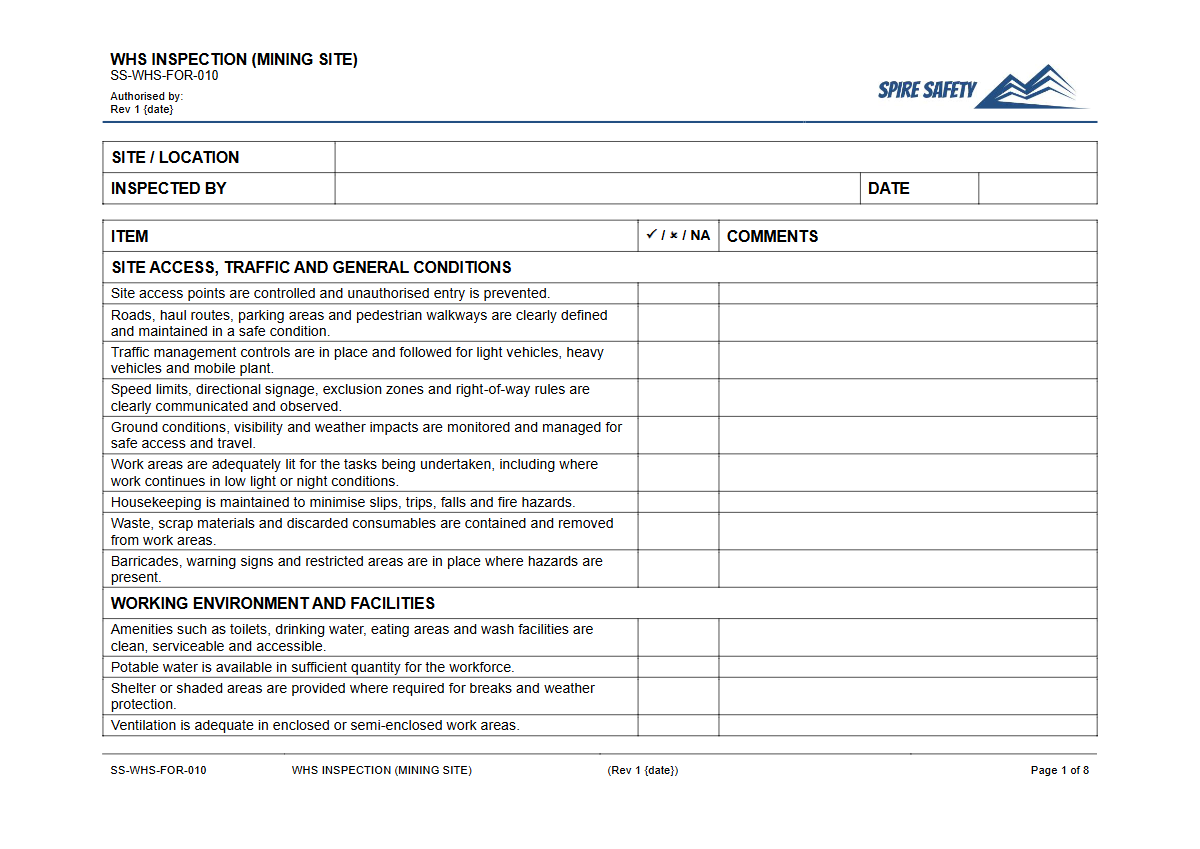
Formalise safety checks on your mining site with our Free WHS Inspection (Mining Site) Template. This structured document helps identify hazards.
Free WHS Inspection (Mining Site) Template
DOCX • 129 KB + PDF
Updated Oct 2026
No signup required
Purpose of the Free WHS Inspection (Mining Site) Template
Regular safety inspections are fundamental to managing health and safety risks in the high-risk mining sector. This Free WHS Inspection (Mining Site) Template provides a structured starting point for your organisation to conduct thorough and systematic site-wide safety checks.
Using a formalised checklist helps ensure that key hazards are not overlooked, from mobile plant and equipment to ground stability and emergency preparedness. It serves as a critical tool for identifying unsafe conditions and behaviours, allowing for timely corrective actions to be implemented before an incident occurs.
Integrating such inspections is a key component of a robust WHS management system, demonstrating a proactive approach to safety.
This template is aligned with Australian WHS principles and is designed to be adapted to any surface mining operation. It prompts a review of physical conditions, work processes, and safety procedures across the entire site, helping you maintain a safe working environment for all personnel and meet your duty of care obligations.
Video walkthrough
How to use the Free WHS Inspection (Mining Site) Template
To effectively use the Free WHS Inspection (Mining Site) Template, begin by downloading the DOCX version, which allows for full customisation. The document is organised into logical sections covering common areas of a mining site, such as haul roads, processing plants, workshops, and administrative areas.
During the inspection, the designated person should walk through each area, observing the environment and work practices against the checklist items. Any non-conformances, hazards, or opportunities for improvement should be clearly noted, with details on their location and the risk they pose.
Assigning responsibility and a due date for corrective actions is a critical step in closing the loop on identified issues.
Important: This template provides a solid foundation, but it is not a complete, off-the-shelf solution. We stress that you must customise it to address the specific hazards, equipment, processes, and layout of your particular mining operation.
We recommend a consultation with key personnel, including workers and safety representatives, to ensure all relevant risks are covered. The effectiveness of your safety program can be further verified through regular WHS compliance audits.
When to use this Inspection Template
The frequency of full site inspections depends on the size and complexity of the operation, the level of risk, and any specific legislative requirements. As a guide, comprehensive site inspections should be scheduled at regular intervals, such as weekly or monthly.
This template is also valuable for ad-hoc inspections that may be required after significant changes or events. These might include the introduction of new heavy machinery, modifications to the mine plan, an extended period of severe weather, or following a near miss or incident.
A post-weather event inspection could also inform a stormwater and waterway protection talk to address environmental risks.
Who should use this Inspection Template
A site inspection should be conducted by a competent person with the knowledge and experience to recognise mining hazards. This typically includes roles such as Site Supervisors, Mine Managers, WHS Advisors, or appointed Safety and Health Representatives (SHRs).
For a more comprehensive and effective inspection, it is best practice to involve a team that includes both management and workers from the areas being inspected. This collaborative approach leverages the practical experience of frontline workers, who often have the most detailed understanding of the risks associated with their specific tasks. A thorough inspection process also reinforces site-wide safety standards, which can be supported with tools like our Site Security and Unauthorised Access Toolbox Talk Template.
Key Areas for an Inspection
A comprehensive mining site inspection should cover a broad range of operational areas to ensure all potential risks are assessed. While this template provides a detailed checklist, key focus areas should always include:
- Mobile and Heavy Equipment: Check for maintenance records, pre-start compliance, operator competency, braking systems, lights, alarms, and guarding.
- Fixed Plant and Structures: Inspect conveyors, crushers, screens, and processing facilities for guarding, emergency stops, structural integrity, and safe access.
- Ground Control and Geotechnical Stability: Assess the condition of highwalls, low walls, dumps, and stockpiles for signs of instability, cracking, or erosion.
- Traffic Management: Review the effectiveness of the traffic management plan, including signage, road conditions, intersection design, and interaction between light vehicles, heavy vehicles, and pedestrians.
- Emergency Systems: Verify that fire-fighting equipment, first aid kits, emergency communication systems, and evacuation routes are accessible, functional, and clearly marked. Addressing these systematically is a core principle of OHS management, a topic we cover in our ISO 45001 consulting services.
- Hazardous Substances: Check storage, handling, labelling, and Safety Data Sheets (SDS) for all chemicals and hazardous materials on site.
For operations with unique or complex hazards, such as those involving autonomous systems or specialised processing methods, seeking specialised WHS consulting can help ensure your inspection regime is sufficiently robust.
This inspection template is one of many tools available to help strengthen your safety processes. You can explore our complete free WHS resources library for more templates, checklists, and toolbox talks.
Common mistakes
Common mistakes to avoid
- Using the template "as is" without customising it for the site's specific hazards, plant, and procedures.
- "Pencil-whipping" the checklist without conducting a genuine, thorough physical inspection of the area.
- Failing to document and follow up on corrective actions, leaving identified hazards unaddressed.
- Conducting the inspection in isolation without involving workers and health and safety representatives from the relevant areas.
Legal references
Legal considerations
The following legal requirements may be relevant to this type of work.
- Work Health and Safety Act (Harmonised) — Provides the primary duties for protecting workers and other people from work health and safety risks.
- Work Health and Safety Regulations (Harmonised) — Sets out requirements supporting the management of workplace hazards and risks.
The following codes may be relevant to this type of work.
- Managing WHS Risks Code of Practice — Provides practical guidance on identifying hazards, assessing risks and applying effective controls.
- Work Health and Safety Consultation, Cooperation and Coordination Code of Practice — Provides practical guidance on consulting workers and coordinating with other duty holders.
- Managing the Work Environment and Facilities Code of Practice — Provides practical guidance on safe work environments, workplace facilities and related controls.
Did you know
A Major Hazard Industry
Mining is identified as a national priority industry by Safe Work Australia due to its high number of fatalities and serious injuries. Proactive inspections are a key control measure to manage these risks.
Harmonised Laws
While WHS laws are harmonised across most of Australia, mining safety is often regulated under specific state or territory legislation that complements the model WHS framework.
FAQ
Frequently asked questions
01What is the difference between a site inspection and a pre-start check?
02How often should a mining site WHS inspection be conducted?
03Who is responsible for actioning items from a mining site inspection?
04Can this template be used for underground mining?
Share this resource
Free WHS Inspection (Mining Site) Template
Browse Categories
How To Use It
- 1Download and open in Word or PDF.
- 2Replace the placeholders with your business details.
- 3Get it reviewed by a WHS specialist before rollout.
Need it customised?
Our WHS consultants can adapt this template to your site, run a gap analysis, or audit what you already have in place.
Book a Free Consultation WHS consulting servicesor call 1300 156 382