
Free WHS Inspection (Motel) Template
Download our Free WHS Inspection (Motel) Template to streamline your safety checks.
Free WHS Inspection (Motel) Template
DOCX • 128 KB + PDF
Updated Oct 2026
No signup required
Purpose of the Free WHS Inspection (Motel) Template
Managing work health and safety in a motel environment involves overseeing a diverse range of risks, from guest areas to staff-only zones. A systematic inspection process is fundamental to identifying hazards before they cause harm.
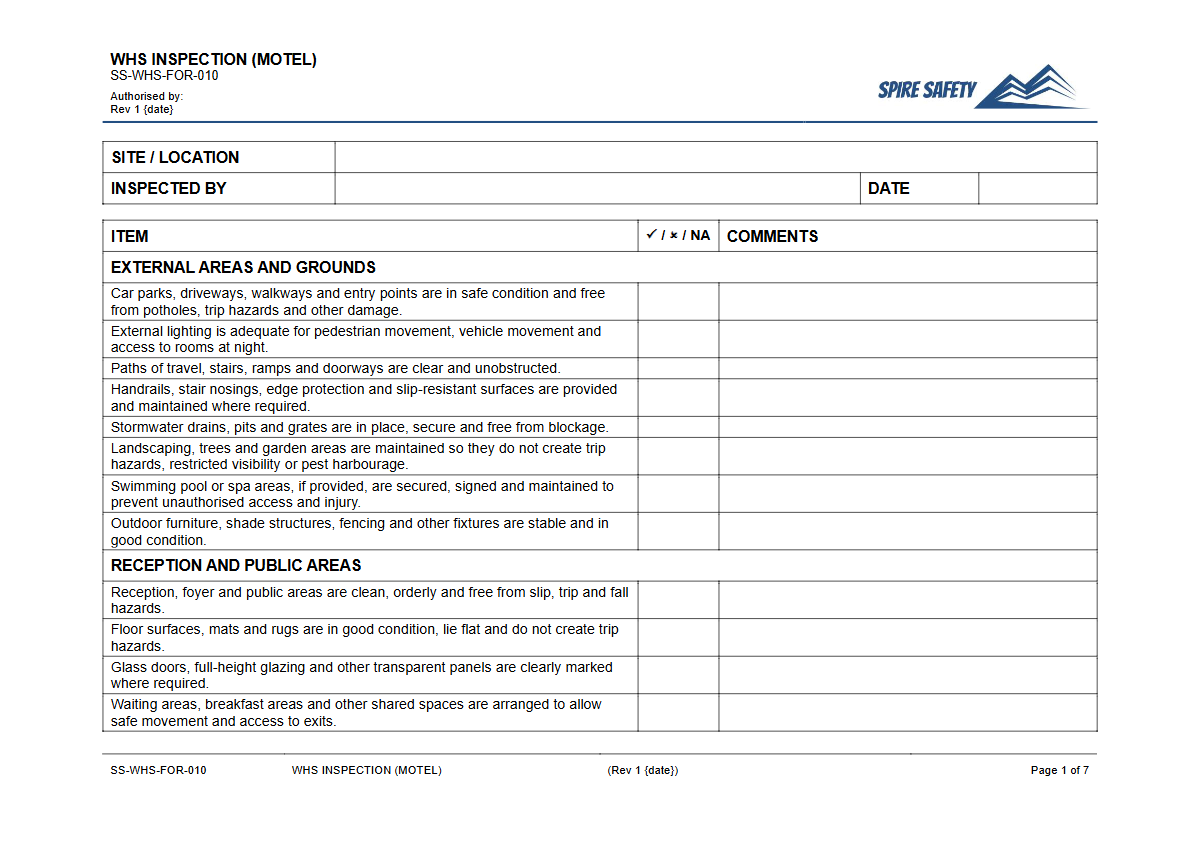
This Free WHS Inspection (Motel) Template provides a structured starting point for your organisation to conduct thorough safety checks. It helps formalise the process of regularly examining your premises, equipment, and work practices to ensure potential risks are controlled.
Using a template helps ensure consistency and completeness in your inspections. It prompts the inspector to check key areas such as guest rooms, pools, kitchens, laundries, car parks, and staff facilities.
Documenting these findings is a critical part of demonstrating due diligence and forms an essential component of an effective safety management system. Regular inspections help protect not only your staff but also your guests and contractors, reinforcing a positive safety culture within your organisation.
This process supports your duty as a PCBU to provide and maintain a work environment that is without risks to health and safety.
Video walkthrough
How to use the Free WHS Inspection (Motel) Template
This template is designed to be a comprehensive but adaptable tool for your motel's specific needs. It covers common hazards found in the accommodation industry, but every workplace is unique.
Begin by downloading the template in your preferred format (DOCX for easy editing or PDF). Before your first inspection, walk through your entire premises and modify the checklist to reflect your specific layout, equipment, and operational tasks.
You might need to add sections for a restaurant, gym, or conference facilities, or remove items that don't apply.
When conducting the inspection, the designated person should walk through each area listed, methodically checking the items. For each point, they should note whether it is satisfactory or if there is a hazard present.
If a hazard is identified, they should describe it clearly, assess the risk level, and recommend a corrective action with a responsible person and a due date. This creates a clear action plan for risk mitigation.
The completed inspection should be signed, dated, and filed as a WHS record. For specific equipment within your facility, you might also use our free pre-start checklist for gym treadmills to supplement your daily checks.
A note on customisation
This document is a template and is not a substitute for professional WHS advice. We have provided it as a starting point, and you must customise it to suit the specific hazards, risks, and operational needs of your workplace.
The effectiveness of this tool is dependent on its correct implementation and the commitment to addressing identified issues.
When to use it
The frequency of your motel inspections should be based on your own risk assessment. A common approach is to schedule comprehensive inspections on a monthly or quarterly basis.
However, certain areas or situations may require more frequent checks. For example, high-traffic areas like lobbies and pools might need weekly walk-throughs, while plant rooms might be checked monthly.
It's also crucial to conduct an inspection after an incident or near miss, following the introduction of new equipment or procedures, or when concerns are raised by staff or guests. Integrating these inspections into your overall WHS management systems ensures they become a routine part of your safety practices rather than a reactive task.
For any automated access points, such as car park entries, using a specific checklist like our free Pre-Start Checklist (Boom Gate) Template can help ensure daily operational safety is maintained between your more comprehensive site inspections.
Who should use it
Inspections can be carried out by various personnel, and a team-based approach is often most effective. The motel manager or an appointed supervisor is typically responsible for overseeing the inspection program.
They can conduct the inspections themselves or delegate the task to a trained WHS representative or a competent staff member. Involving different employees in inspections can increase hazard awareness across the workforce and bring fresh eyes to potential problems.
Regardless of who performs the inspection, they must be trained to recognise hazards specific to the motel environment. The ultimate responsibility for ensuring inspections are completed and corrective actions are implemented lies with the management of the Person Conducting a Business or Undertaking (PCBU).
Periodic, independent checks can also add significant value. Engaging an external consultant for WHS compliance auditing provides an objective assessment of your safety performance and can identify systemic issues that internal teams might overlook.
These audits offer a deeper dive than a routine inspection and are a valuable tool for continuous improvement. For kitchen or food service areas, you might also consider our Free Pre-Start Checklist (Freezer) Template for daily checks by kitchen staff.
For groundskeeping equipment, a specific checklist can ensure machinery is safe before each use. Our lawn tractor pre-start checklist is a useful tool for maintenance staff.
You can find many more specific checklists and templates in our complete free WHS resources library to build a comprehensive safety toolkit for your motel.
Common mistakes
Common mistakes to avoid
- Using a generic checklist without customising it for the motel's specific layout and equipment.
- Failing to assign clear responsibility and deadlines for corrective actions, leading to unresolved hazards.
- Treating the inspection as a 'tick-and-flick' exercise without genuine observation or engagement.
- Neglecting to follow up on completed corrective actions to ensure they were effective in controlling the risk.
Legal references
Legal considerations
The following legal requirements may be relevant to this type of work.
- Work Health and Safety Act (Harmonised) — Provides the primary duties for protecting workers and other people from work health and safety risks.
- Work Health and Safety Regulations (Harmonised) — Sets out requirements supporting the management of workplace hazards and risks.
The following codes may be relevant to this type of work.
- Managing WHS Risks Code of Practice — Provides practical guidance on identifying hazards, assessing risks and applying effective controls.
- Work Health and Safety Consultation, Cooperation and Coordination Code of Practice — Provides practical guidance on consulting workers and coordinating with other duty holders.
- Managing the Work Environment and Facilities Code of Practice — Provides practical guidance on safe work environments, workplace facilities and related controls.
Did you know
Slips, Trips, and Falls
Slips, trips, and falls are one of the leading causes of injury in the accommodation industry, accounting for a significant percentage of workers' compensation claims. Common causes include wet floors, uneven surfaces, and poor housekeeping.
Diverse Hazard Profile
The accommodation industry has a uniquely diverse risk profile. A single site can contain hazards related to food safety, chemical handling, manual tasks, electrical equipment, machinery, and public safety, making systematic inspections essential.
FAQ
Frequently asked questions
01What areas should a motel WHS inspection cover?
02How often should we conduct a motel safety inspection?
03Who is responsible for fixing hazards found during an inspection?
04Can this inspection template be used for larger hotels?
Share this resource
Free WHS Inspection (Motel) Template
Browse Categories
How To Use It
- 1Download and open in Word or PDF.
- 2Replace the placeholders with your business details.
- 3Get it reviewed by a WHS specialist before rollout.
Need it customised?
Our WHS consultants can adapt this template to your site, run a gap analysis, or audit what you already have in place.
Book a Free Consultation WHS consulting servicesor call 1300 156 382