
Free WHS Inspection (Metal Yard) Template
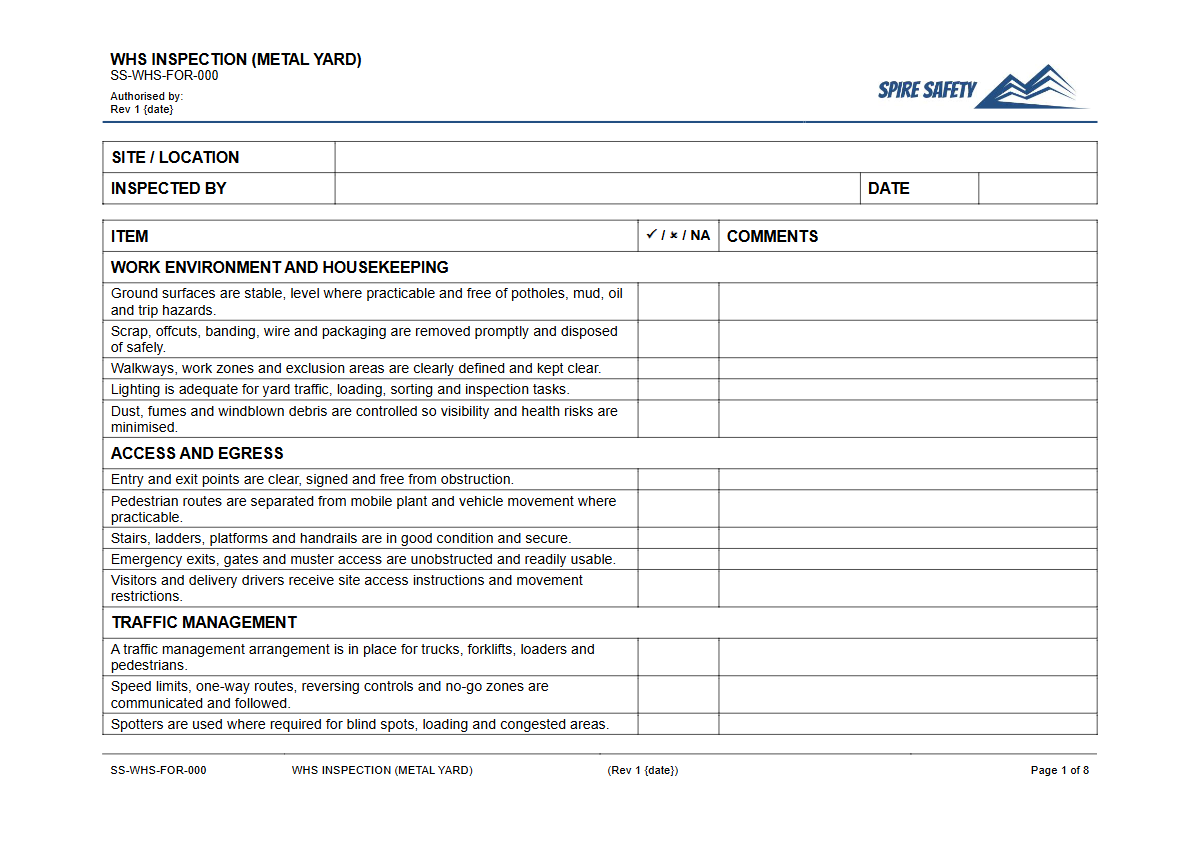
Download our Free WHS Inspection (Metal Yard) Template to formalise safety checks in scrap metal environments.
Free WHS Inspection (Metal Yard) Template
DOCX • 129 KB + PDF
Updated Oct 2026
No signup required
Purpose of the Free WHS Inspection (Metal Yard) Template
Metal yards are high-risk environments with a unique combination of hazards, from heavy mobile plant and falling objects to sharp materials and hazardous substances. This Free WHS Inspection (Metal Yard) Template provides a structured starting point for systematically identifying and managing these risks.
Regular, documented inspections are a cornerstone of any effective safety management system, helping your organisation meet its duty of care under Australian WHS legislation.
This template prompts a review of critical safety elements, including traffic management, stockpile stability, machine guarding, and the handling of scrap materials. It encourages a proactive approach to safety, aiming to identify potential issues before they lead to an incident.
For equipment-specific checks, such as those for lifting machinery, it's best to use a dedicated checklist like our free Pre-Start Checklist for Electric Hoists in conjunction with this broader site inspection.
Video walkthrough
How to use the Free WHS Inspection (Metal Yard) Template
This resource is available as a fully editable DOCX file and a print-ready PDF. After downloading, you can adapt the checklist to suit the specific conditions of your workplace.
It is designed to be a comprehensive foundation, but no two metal yards are identical. Effective safety documentation is a key part of implementing robust WHS management systems that protect your workers.
Important: This is a template, not a finished document. To ensure it is effective, we strongly recommend you customise it to reflect the specific layout, plant, equipment, materials, and work processes at your site.
Walk through your yard and add or remove checklist items to ensure it captures the unique risks your team faces every day. For example, you may need to add sections for specific processes like shearing, baling, or shredding.
When to conduct a Metal Yard Inspection
The frequency of inspections should be determined by a risk assessment. High-risk areas, such as active sorting zones or heavy traffic intersections, may require daily or weekly checks.
Less dynamic areas like storage yards might be inspected monthly. A comprehensive, site-wide inspection should be conducted on a regular schedule (e.g., quarterly) to capture the bigger picture. These routine inspections are distinct from, but complementary to, more intensive processes like formal WHS compliance auditing.
Additional inspections should also be performed after an incident or near miss, when new machinery or work processes are introduced, or when concerns are raised by workers. Regularly reviewing site conditions helps ensure that control measures remain effective and that new hazards have not been introduced. Controlled site access is also a major safety factor, which can be managed with tools like our free Pre-Start Checklist (Boom Gate) Template.
Who should use this Inspection Template
This template is designed for use by competent personnel with a thorough understanding of metal yard operations and WHS principles. This typically includes:
- Site Managers and Supervisors
- Work Health and Safety (WHS) Officers or Advisors
- Health and Safety Representatives (HSRs)
- Experienced workers who have received specific training on conducting workplace inspections
The person conducting the inspection must be familiar with the hazards being assessed and empowered to recommend and implement corrective actions. For organisations that lack in-house expertise, engaging external support through specialist WHS consulting can provide the necessary guidance to establish effective inspection protocols.
Whoever performs the inspection, the results should be communicated to management and relevant workers, and a clear action plan should be developed to address any identified deficiencies.
By integrating this template into your operational procedures, you create a documented record of your commitment to safety and continuous improvement. To discover more tools to support your safety framework, browse our free WHS resources library for a wide range of checklists, templates, and guides.
Common mistakes
Common mistakes to avoid
- Using a generic checklist without customising it for the site's specific plant and processes.
- Failing to create and track a clear action plan to address hazards found during the inspection.
- Assigning inspections to personnel who lack the training or authority to identify risks and initiate change.
- Treating the inspection as a 'tick and flick' exercise rather than a genuine opportunity to improve safety.
Legal references
Legal considerations
The following legal requirements may be relevant to this type of work.
- Work Health and Safety Act (Harmonised) — Provides the primary duties for protecting workers and other people from work health and safety risks.
- Work Health and Safety Regulations (Harmonised) — Sets out requirements supporting the management of workplace hazards and risks.
The following codes may be relevant to this type of work.
- Managing WHS Risks Code of Practice — Provides practical guidance on identifying hazards, assessing risks and applying effective controls.
- Work Health and Safety Consultation, Cooperation and Coordination Code of Practice — Provides practical guidance on consulting workers and coordinating with other duty holders.
- Managing the Work Environment and Facilities Code of Practice — Provides practical guidance on safe work environments, workplace facilities and related controls.
Did you know
Recycling Power
Australia's waste and resource recovery industry contributes significantly to the economy, generating thousands of jobs and diverting millions of tonnes of material from landfill each year.
Noise Hazards
The noise from heavy machinery in metal yards can easily exceed the exposure standard of 85 decibels (dBA). Prolonged exposure without adequate hearing protection can lead to permanent hearing loss.
FAQ
Frequently asked questions
01What are the most significant hazards in a metal yard?
02How often should I conduct a metal yard WHS inspection?
03Can I use this template for any type of scrap yard?
04Is a documented WHS inspection a legal requirement in Australia?
Share this resource
Free WHS Inspection (Metal Yard) Template
Browse Categories
How To Use It
- 1Download and open in Word or PDF.
- 2Replace the placeholders with your business details.
- 3Get it reviewed by a WHS specialist before rollout.
Need it customised?
Our WHS consultants can adapt this template to your site, run a gap analysis, or audit what you already have in place.
Book a Free Consultation WHS consulting servicesor call 1300 156 382