
Free WHS Inspection (Kennel Facility) Template
Download our Free WHS Inspection (Kennel Facility) Template to systematically identify and manage workplace hazards in your animal care environment.
Free WHS Inspection (Kennel Facility) Template
DOCX • 129 KB + PDF
Updated Oct 2026
No signup required
Purpose of the Free WHS Inspection (Kennel Facility) Template
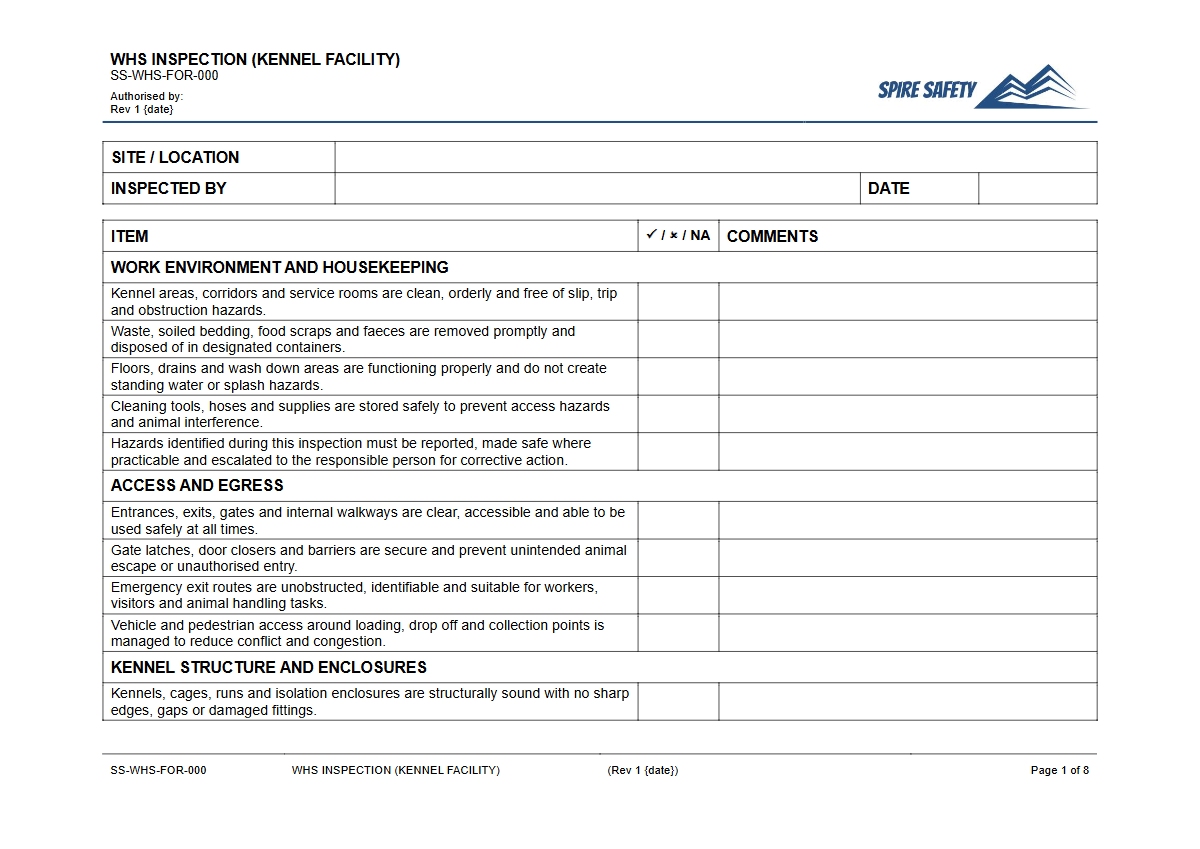
Managing a kennel or animal boarding facility involves a unique set of work health and safety risks. Our Free WHS Inspection (Kennel Facility) Template provides a structured starting point for systematically identifying and controlling these hazards.
Regular, documented inspections are a cornerstone of proactive safety management, helping your organisation meet its primary duty of care under Australian WHS laws. This template guides you through checking key areas, from animal enclosures and handling procedures to chemical storage and staff amenities.
Using this template helps create a documented record of your safety efforts, demonstrating due diligence. It formalises the process of hazard identification, moving your organisation beyond reactive measures.
The findings from these inspections can be a critical input for your broader WHS management system, informing risk assessments, safe work procedures, and training programs. It helps ensure that controls are not only implemented but are also effective and maintained over time.
Video walkthrough
How to use the Free WHS Inspection (Kennel Facility) Template
This resource is provided as a fully editable DOCX file, allowing for complete customisation. After downloading, you should conduct a thorough review of the checklist items.
Add, remove, or modify questions to accurately reflect the specific layout, equipment, tasks, and risks present in your facility. Consider all operational areas, including reception, animal enclosures, grooming rooms, exercise yards, and food storage areas.
IMPORTANT NOTE:
This document is a template and has not been prepared for your specific operational needs. We strongly recommend you customise this inspection by adding, removing, or editing sections to ensure it fully reflects the unique hazards and control measures of your kennel facility.
When completing the inspection, the designated inspector should walk through each area, methodically checking items and making detailed notes. Any identified hazards, non-conformances, or areas for improvement should be clearly documented.
For each issue, assign a corrective action, a responsible person, and a due date to ensure timely resolution. This process ensures accountability and helps close the loop on safety issues.
What to Inspect in a Kennel Facility
A comprehensive kennel inspection should cover all aspects of the operation. While your customised checklist will be specific, key areas to focus on include:
- Animal Enclosures & Handling: Check for secure latches, structural integrity of enclosures, appropriate ventilation, and safe access for staff. Assess risks associated with animal behaviour, such as bites and scratches.
- Manual Tasks: Inspect procedures for lifting animals, carrying heavy bags of food, and moving equipment. Look for ergonomic risks and opportunities for mechanical aids.
- Slips, Trips & Falls: Examine floor surfaces for water, waste, or food spills. Ensure adequate drainage, non-slip surfaces in wet areas, and clear, unobstructed walkways.
- Chemical Safety: Review the storage and use of cleaning agents, disinfectants, and pest control products. Check for correct labelling, Safety Data Sheets (SDS), and availability of appropriate personal protective equipment (PPE).
- Equipment & Plant: Inspect any machinery used on site. This could range from food preparation devices to groundskeeping equipment. Using specific checklists, such as our free feed mixer checklist, can enhance this process.
- Food Storage & Preparation: Check that food is stored correctly to prevent contamination and spoilage. Areas with cold storage should be regularly checked for temperature and electrical safety, which can be formalised using a resource like our freezer pre-start checklist.
When to use this Inspection Template
The frequency of inspections should be determined by a risk assessment, but a regular schedule is essential for maintaining safety standards. Consider conducting inspections:
- Routinely: A full facility inspection should be carried out on a weekly, fortnightly, or monthly basis, depending on the size and complexity of your kennel.
- After an Incident: Use the checklist to conduct a thorough inspection following any incident, accident, or near-miss to identify underlying causes.
- Following Changes: Perform an inspection whenever new equipment is introduced, procedures are changed, or the facility layout is altered. For example, if you acquire new groundskeeping machinery, using a lawn tractor checklist becomes an important part of the change management process.
Who should use this Inspection Template
This inspection should be completed by a person who is competent to identify the hazards associated with a kennel environment. This could include:
- Facility Managers or Supervisors
- Work Health and Safety (WHS) Representatives
- Designated WHS Officers
- An experienced team member familiar with all operational tasks
It is beneficial to involve different staff members in the inspection process over time. This fosters a stronger safety culture and brings fresh eyes to familiar environments.
The results of the inspection should be reviewed by management and communicated to all relevant workers. For a more in-depth, third-party evaluation of your safety compliance, you may consider engaging external consultants for formal WHS compliance audits.
This document is just one of many tools available to help you manage your workplace safety. Explore our complete library of free WHS resources for more templates and guides.
Common mistakes
Common mistakes to avoid
- Using a generic inspection checklist without customising it to the specific kennel layout and risks.
- Failing to document corrective actions or assign responsibility for fixing identified hazards.
- Only performing inspections after an incident has occurred, rather than on a proactive, scheduled basis.
- Not involving workers who perform the day-to-day tasks in the inspection process, missing their valuable insights.
Legal references
Legal considerations
The following legal requirements may be relevant to this type of work.
- Work Health and Safety Act (Harmonised) — Provides the primary duties for protecting workers and other people from work health and safety risks.
- Work Health and Safety Regulations (Harmonised) — Sets out requirements supporting the management of workplace hazards and risks.
The following codes may be relevant to this type of work.
- Managing WHS Risks Code of Practice — Provides practical guidance on identifying hazards, assessing risks and applying effective controls.
- Work Health and Safety Consultation, Cooperation and Coordination Code of Practice — Provides practical guidance on consulting workers and coordinating with other duty holders.
- Managing the Work Environment and Facilities Code of Practice — Provides practical guidance on safe work environments, workplace facilities and related controls.
Did you know
Zoonotic Disease Risk
Zoonoses are diseases that can be transmitted from animals to humans. Kennel workers are at an elevated risk of exposure to pathogens like campylobacter, salmonella, and giardia through contact with animal waste or saliva.
Manual Task Injuries
According to Safe Work Australia data, injuries from manual handling are a leading cause of serious workers' compensation claims across many industries, including animal care.
FAQ
Frequently asked questions
01What are the most common hazards in a kennel facility?
02How often should I conduct a WHS inspection in a kennel?
03Is this template compliant with my state's WHS laws?
04Who is responsible for health and safety in a kennel?
Share this resource
Free WHS Inspection (Kennel Facility) Template
Browse Categories
How To Use It
- 1Download and open in Word or PDF.
- 2Replace the placeholders with your business details.
- 3Get it reviewed by a WHS specialist before rollout.
Need it customised?
Our WHS consultants can adapt this template to your site, run a gap analysis, or audit what you already have in place.
Book a Free Consultation WHS consulting servicesor call 1300 156 382