
Free WHS Inspection (Landfill Site) Template
Formalise landfill safety with our free WHS Inspection (Landfill Site) Template. Aligned with Australian WHS practice. Download your DOCX & PDF now.
Free WHS Inspection (Landfill Site) Template
DOCX • 128 KB + PDF
Updated Oct 2026
No signup required
Purpose of the Free WHS Inspection (Landfill Site) Template
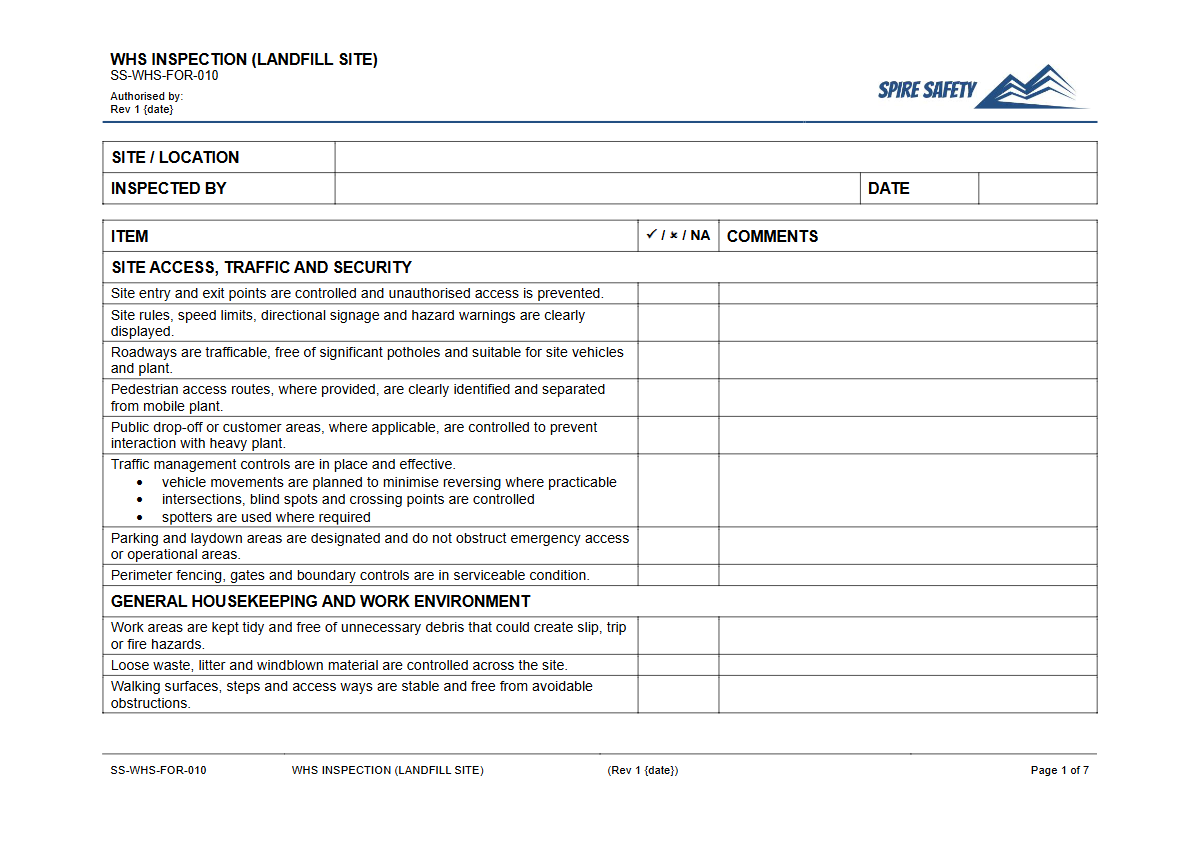
Landfill and waste management sites present a unique and complex combination of workplace health and safety risks. This free WHS Inspection (Landfill Site) Template provides a structured framework for systematically identifying, assessing, and controlling these hazards.
It is designed to guide site supervisors and WHS personnel through a thorough examination of key operational areas, from traffic management and ground stability to environmental controls and emergency preparedness. Using this template helps formalise your safety processes, encourages proactive hazard identification, and creates a documented record of your safety efforts.
A consistent inspection regime is a cornerstone of effective WHS management systems, helping to prevent incidents and promote a positive safety culture.
Video walkthrough
How to use the Free WHS Inspection (Landfill Site) Template
To get started, simply download the template in your preferred format (DOCX for easy editing or PDF for straightforward printing). Before use, it is crucial to review and adapt the checklist to reflect the specific conditions of your site.
This includes adding or removing items related to your particular machinery, site layout, waste types handled, and local environmental regulations. Once customised, the inspection can be conducted by a designated competent person.
Findings should be clearly documented, with responsibilities and deadlines assigned for any corrective actions required. The completed records should then be filed as part of your organisation's safety documentation.
Important: This document is a template and not a complete solution. We strongly recommend you customise it to address the specific hazards, machinery, and operational procedures of your workplace.
For guidance on tailoring safety documents to your specific operational needs, consider engaging professional WHS consulting services.
Key Areas Covered in the Inspection
The template prompts a review of critical safety areas unique to landfill operations, including:
- Site Access, Security & Signage: Verifying that access controls are effective, security measures are in place to prevent unauthorised entry, and safety signage is clear and correctly positioned. This includes checking the operational status of key infrastructure, for which our free Pre-Start Checklist (Boom Gate) Template can also be a useful tool.
- Traffic Management: Assessing the separation of heavy machinery, waste collection vehicles, and public vehicles. It covers road conditions, speed limits, and communication protocols between drivers and spotters.
- Tipping Face & Stockpiles: Inspecting the stability of the active tipping area, checking for signs of slippage, managing dust, and ensuring safe operating procedures for plant and personnel.
- Plant & Equipment: Confirming that heavy machinery like compactors, excavators, and loaders are in safe condition, with pre-start checks completed and safety features (e.g., reversing alarms, lights) functional.
- Hazardous Substances & Materials: Checking procedures for handling potentially hazardous waste, managing asbestos, and controlling exposure to biological hazards.
- Leachate & Gas Management: Inspecting the integrity of leachate collection systems, monitoring for landfill gas, and ensuring control systems are operational to prevent fire, explosion, and environmental contamination.
- Environmental Controls: Evaluating measures for dust suppression, litter control, and stormwater management. Using a dedicated Stormwater and Waterway Protection Toolbox Talk template can help reinforce team responsibilities in this area.
- Emergency Preparedness: Ensuring fire-fighting equipment is accessible and maintained, emergency contact information is displayed, and first aid facilities are adequately stocked.
When to use it
Regular, scheduled inspections are vital for maintaining safety standards. This template should be used as part of a routine safety program, for instance, on a weekly or monthly basis, depending on the site's size and risk profile.
Additionally, an inspection should be conducted after any significant incident or near miss, following extreme weather events that could affect site stability (e.g., heavy rain), or prior to a formal WHS compliance auditing process to identify and rectify potential non-conformances.
Who should use it
This inspection template is intended for individuals with responsibility for safety on a landfill site. This typically includes Site Managers, WHS Officers, Safety Supervisors, and members of the Health and Safety Committee.
The person conducting the inspection must be competent to identify the specific hazards associated with landfill operations and have the authority to initiate corrective actions. It's also a valuable resource for training new supervisors or for facilitating discussions during safety meetings.
To improve awareness around specific issues like site security, you can use our Site Security and Unauthorised Access Toolbox Talk Template alongside your inspections.
By integrating this inspection into your regular safety practices, you create a powerful tool for risk management. For more tools to support your safety framework, explore our complete free WHS resources library, which offers a wide range of checklists, templates, and toolbox talks.
Common mistakes
Common mistakes to avoid
- Failing to update the checklist when new equipment, waste streams, or procedures are introduced.
- Not properly documenting and tracking corrective actions through to completion.
- Conducting the inspection as a 'tick-and-flick' exercise without genuine observation and engagement.
- Overlooking environmental hazards like minor leachate leaks or inadequate stormwater diversion.
Legal references
Legal considerations
The following legal requirements may be relevant to this type of work.
- Work Health and Safety Act (Harmonised) — Provides the primary duties for protecting workers and other people from work health and safety risks.
- Work Health and Safety Regulations (Harmonised) — Sets out requirements supporting the management of workplace hazards and risks.
The following codes may be relevant to this type of work.
- Managing WHS Risks Code of Practice — Provides practical guidance on identifying hazards, assessing risks and applying effective controls.
- Work Health and Safety Consultation, Cooperation and Coordination Code of Practice — Provides practical guidance on consulting workers and coordinating with other duty holders.
- Managing the Work Environment and Facilities Code of Practice — Provides practical guidance on safe work environments, workplace facilities and related controls.
Did you know
Flammable Gas
Landfill gas, primarily methane produced during waste decomposition, is highly flammable. In concentrations between 5% and 15% in the air, it can be explosive, making gas monitoring a critical safety function.
Complex Engineering
Modern sanitary landfills are complex engineered facilities. They are designed with multiple layers of impermeable liners, gas vents, and leachate collection systems to protect the surrounding environment from contamination.
FAQ
Frequently asked questions
01What are the biggest WHS risks at a landfill site?
02How often should landfill site safety inspections be conducted?
03Is this landfill inspection template suitable for all Australian states?
04What is leachate and why is it a hazard?
Share this resource
Free WHS Inspection (Landfill Site) Template
Browse Categories
How To Use It
- 1Download and open in Word or PDF.
- 2Replace the placeholders with your business details.
- 3Get it reviewed by a WHS specialist before rollout.
Need it customised?
Our WHS consultants can adapt this template to your site, run a gap analysis, or audit what you already have in place.
Book a Free Consultation WHS consulting servicesor call 1300 156 382