
Free WHS Inspection (Health Clinic) Template
Download our free WHS Inspection Template for Health Clinics (DOCX & PDF). A structured starting point to help you identify and control workplace hazards.
Free WHS Inspection (Health Clinic) Template
DOCX • 127 KB + PDF
Updated Oct 2026
No signup required
Purpose of the Free WHS Inspection (Health Clinic) Template
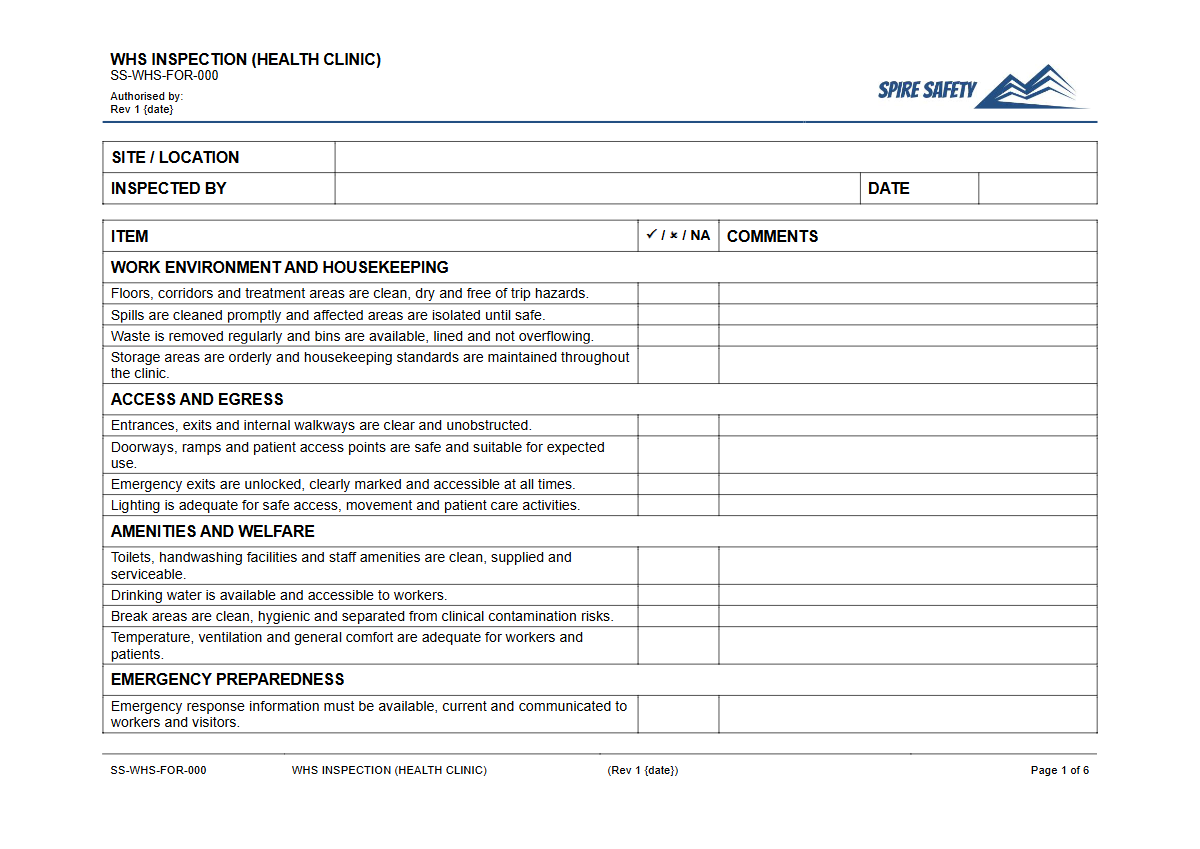
Running a health clinic involves managing a unique set of work health and safety risks, from clinical hazards to administrative ones. This Free WHS Inspection (Health Clinic) Template provides a structured starting point for systematically examining your practice.
It helps you identify potential hazards, assess risks, and document controls across various areas, including waiting rooms, consultation areas, storage, and staff facilities. Proactive inspections are fundamental to preventing incidents and fostering a safe environment for staff, patients, and visitors.
This template is designed to align with Australian WHS principles and can be adapted to suit general practices, specialist clinics, dental surgeries, and allied health centres.
The template covers common checkpoints like electrical safety, slip and trip hazards, waste management, and emergency preparedness. It also prompts consideration for specific clinical risks, such as infection control and the safe handling of medical equipment.
For machinery like patient lifts, supplementing this general inspection with more detailed checks is crucial. You can formalise these using dedicated tools like our free Pre-Start Checklist (Patient Hoist) Template to ensure equipment is safe before each use.
Video walkthrough
How to use the Free WHS Inspection (Health Clinic) Template
This resource is provided as a fully editable DOCX file and a print-ready PDF. To get started, download the file and adapt it to the specific layout, equipment, and procedures of your clinic.
Walk through each area of your workplace, using the checklist to systematically observe and record your findings. Document any hazards, non-conformances, or areas for improvement, noting their location and assigning a risk level.
For each identified issue, specify the corrective action required, the person responsible for its implementation, and a due date.
Important: This document is a template only. It provides a foundation, but it cannot cover every specific hazard or legal requirement applicable to your unique operations.
You must customise this template by adding, removing, or modifying sections to ensure it is fully relevant to your workplace. We recommend a competent person reviews the customised document before use to confirm its suitability.
Once customised, the inspection document serves as a formal record. Consistently completing and storing these inspections provides valuable data for your safety management system and demonstrates due diligence. For organisations aiming for a higher level of systematic safety management, these records are essential evidence when undergoing WHS compliance auditing.
When to conduct a Health Clinic Inspection
Regular, scheduled inspections are key to maintaining a safe workplace. The frequency depends on the level of risk and the nature of the work environment.
A common practice for a health clinic is to conduct a full inspection quarterly. However, more frequent checks may be needed for high-traffic or high-risk areas, such as sterilisation rooms or areas with hazardous substances.
Inspections should also be triggered by specific events, such as after an incident or near miss, when new equipment is introduced, when work processes change, or when concerns are raised by staff. Regularly reviewing safety performance is a core part of an effective safety framework.
Who should use it
This inspection template is designed for use by individuals responsible for WHS within a health clinic setting. This typically includes:
- Practice Managers or Clinic Managers
- The Person Conducting the Business or Undertaking (PCBU)
- WHS or Safety Officers
- Health and Safety Representatives (HSRs)
- Supervisors or team leaders responsible for specific departments
Engaging a variety of staff in the inspection process can provide different perspectives and increase overall safety awareness. It is also an effective way to meet your consultative obligations.
An understanding of key WHS definitions is beneficial for everyone involved in the safety process, clarifying roles and responsibilities.
Ultimately, a robust safety culture is built on a foundation of both physical safety checks and psychological wellbeing. Prioritising mental health first aid in the workplace complements physical safety inspections, creating a holistic approach to staff welfare.
If developing a comprehensive safety program feels overwhelming, consider engaging specialists for guidance on developing a WHS management system tailored to your practice.
Common mistakes
Common mistakes to avoid
- Overlooking ergonomic risks at reception desks and clinical workstations.
- Forgetting to regularly check expiry dates on sterile supplies and first aid kits.
- Failing to document and track the closure of corrective actions identified during the inspection.
- Neglecting to inspect non-clinical areas like staff rooms, car parks, or storage areas.
Legal references
Legal considerations
The following legal requirements may be relevant to this type of work.
- Work Health and Safety Act (Harmonised) — Provides the primary duties for protecting workers and other people from work health and safety risks.
- Work Health and Safety Regulations (Harmonised) — Sets out requirements supporting the management of workplace hazards and risks.
The following codes may be relevant to this type of work.
- Managing WHS Risks Code of Practice — Provides practical guidance on identifying hazards, assessing risks and applying effective controls.
- Work Health and Safety Consultation, Cooperation and Coordination Code of Practice — Provides practical guidance on consulting workers and coordinating with other duty holders.
- Managing the Work Environment and Facilities Code of Practice — Provides practical guidance on safe work environments, workplace facilities and related controls.
Did you know
Healthcare Hazards
The healthcare and social assistance industry is one of Australia's largest and highest-risk sectors, accounting for a significant number of serious workers' compensation claims each year, particularly from manual handling and slips, trips, and falls.
FAQ
Frequently asked questions
01What areas should a WHS inspection cover in a health clinic?
02How often should we inspect our health clinic for WHS issues?
03Is a WHS inspection a legal requirement for Australian health clinics?
04What's the difference between a workplace inspection and a risk assessment?
Share this resource
Free WHS Inspection (Health Clinic) Template
Browse Categories
How To Use It
- 1Download and open in Word or PDF.
- 2Replace the placeholders with your business details.
- 3Get it reviewed by a WHS specialist before rollout.
Need it customised?
Our WHS consultants can adapt this template to your site, run a gap analysis, or audit what you already have in place.
Book a Free Consultation WHS consulting servicesor call 1300 156 382