
Free WHS Inspection (Horse Stable) Template
Manage WHS risks in your equestrian facility with our Free WHS Inspection (Horse Stable) Template. A structured starting point for your safety program.
Free WHS Inspection (Horse Stable) Template
DOCX • 129 KB + PDF
Updated Oct 2026
No signup required
Purpose of the Free WHS Inspection (Horse Stable) Template
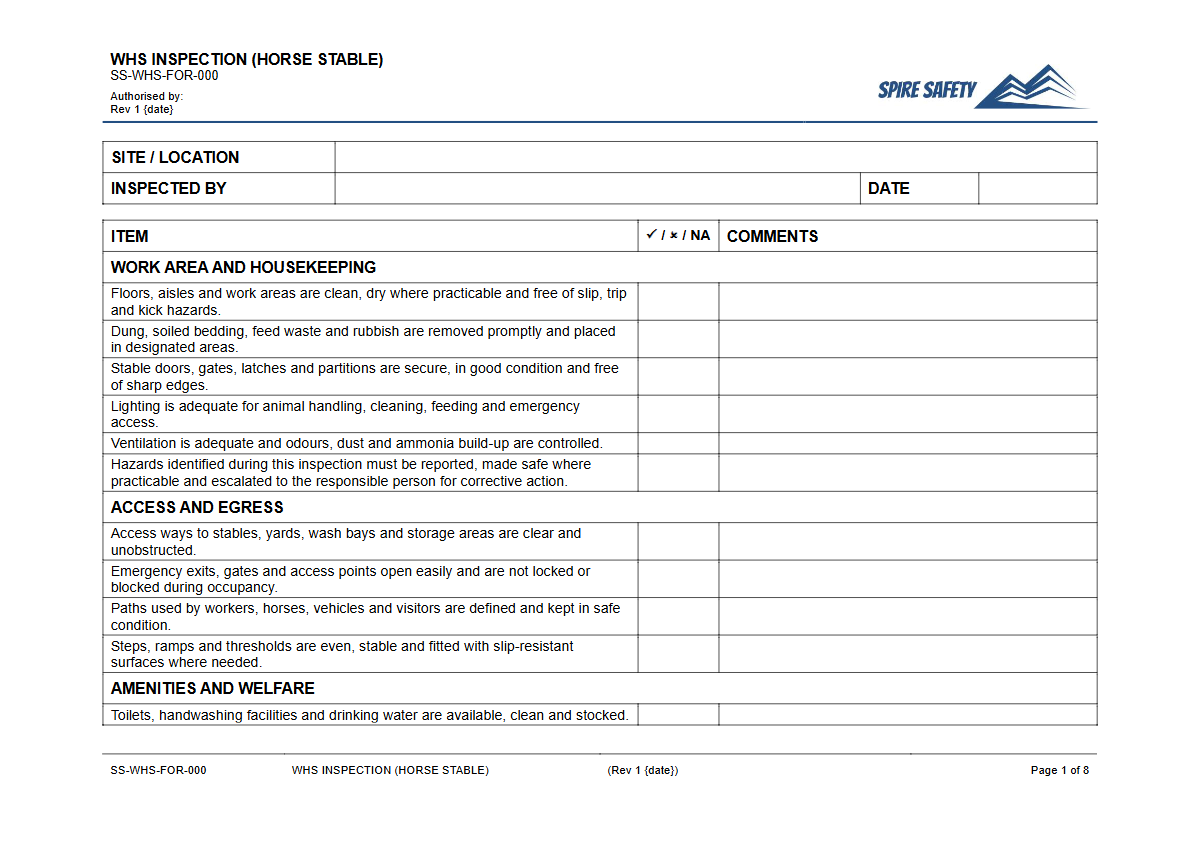
Horse stables and equestrian centres are unique workplaces with a specific set of health and safety risks. Our Free WHS Inspection (Horse Stable) Template is designed to help you systematically identify and manage these hazards.
Risks in a stable environment range from the unpredictable behaviour of horses to hazards associated with manual handling, machinery, dust, chemicals, and public access. This template provides a structured starting point aligned with Australian WHS principles, guiding you through a thorough check of your facility's key areas.
Using a formal inspection checklist helps create a safer environment for staff, clients, and visitors. It also serves as important documentation for your safety management system, demonstrating your organisation's commitment to proactively controlling risks before they lead to an incident.
A consistent inspection program is a critical part of meeting your duties as a Person Conducting a Business or Undertaking (PCBU).
Video walkthrough
How to use the Free WHS Inspection (Horse Stable) Template
Download the template in your preferred format (DOCX or PDF). The DOCX file is fully editable, allowing you to tailor the checklist to the specifics of your operation.
This step is crucial for the template's effectiveness.
Customisation is Essential
This template provides a solid foundation, but it is essential that you customise it for your specific workplace. We cannot know the unique layout, equipment, tasks, and hazards present in your stable.
A walk-through of your facility is necessary to add or remove checklist items to ensure it is fully relevant. Consider factors like the number and temperament of horses, the type of flooring, the design of your wash bays and arenas, and the specific equipment you use.
A well-implemented inspection process is a cornerstone of effective WHS management systems. It integrates safety into your regular operational rhythm, moving beyond a simple tick-box exercise to become a tool for genuine risk reduction.
What to Inspect
A comprehensive horse stable inspection should cover all areas and activities. The template is organised to guide you through these zones logically. Key areas for inspection include:
- Structures and Environment: Check the condition of stable buildings, fences, gates, and pathways. Look for slip, trip, and fall hazards, adequate lighting and ventilation, and the accessibility and condition of fire safety equipment.
- Horse Handling Areas: Inspect yards, wash bays, tack-up areas, and arenas for hazards. This includes checking ground surfaces, enclosure integrity, and ensuring there are safe systems of work for moving horses.
- Equipment and Machinery: All equipment must be maintained in safe working order. This includes everything from wheelbarrows and tack to larger machinery. For example, if your stable uses automated feed systems, our free Pre-Start Checklist (Feed Mixer) Template can be adapted for daily checks.
- Storage Areas: Ensure that feed, bedding (hay/straw), tack, and chemicals (like medications and cleaning products) are stored safely. Pay special attention to the storage of hay to minimise fire risk and to the secure storage of hazardous chemicals.
- Worker Facilities and First Aid: Check that amenities are clean and hygienic. Verify that first aid kits are fully stocked, easily accessible, and that emergency contact information is clearly displayed. Ensure there is a specific first aid kit equipped to handle injuries common in equestrian environments.
Regular property maintenance is also a key part of stable safety. If tractors are used for slashing paddocks or moving materials, operators should complete a pre-start checklist for a lawn tractor before every use to ensure it is safe to operate.
When to Conduct an Inspection
The frequency of inspections depends on the size and complexity of your operation. A good practice is to establish a regular schedule, such as monthly or quarterly, for full site inspections. Additionally, inspections should be carried out:
- Before and after major events (e.g., competitions or clinics).
- Seasonally, to address risks like summer fire hazards or winter slip hazards.
- After any incident, accident, or near miss to identify contributing factors.
- Whenever new facilities are built, or new equipment is introduced.
Integrating these checks into your operational calendar ensures safety remains a proactive priority. For complex operations or guidance on establishing a robust safety framework, seeking advice from a WHS consulting professional can provide valuable, tailored support.
Who Should Use This Inspection Template
This template is designed for anyone responsible for safety in an equestrian facility. This includes:
- Stable Managers and Property Owners (PCBUs).
- WHS or Safety Officers.
- Head Grooms or Senior Staff.
- Worker Health and Safety Representatives (HSRs).
The individuals conducting the inspection should be competent and experienced. They must be familiar with stable operations and have a good understanding of the potential hazards involved in working with and around horses. For more specialised checklists or safety documents, feel free to browse our complete free WHS resources library.
Common mistakes
Common mistakes to avoid
- Using a generic workplace checklist that fails to address specific equestrian hazards like animal behaviour.
- Failing to properly train staff on how to conduct the inspection and what to look for.
- Not following up on corrective actions identified during the inspection, leaving risks uncontrolled.
- Forgetting to inspect areas used by clients, agistees, or the public, such as viewing areas or parking.
Legal references
Legal considerations
The following legal requirements may be relevant to this type of work.
- Work Health and Safety Act (Harmonised) — Provides the primary duties for protecting workers and other people from work health and safety risks.
- Work Health and Safety Regulations (Harmonised) — Sets out requirements supporting the management of workplace hazards and risks.
The following codes may be relevant to this type of work.
- Managing WHS Risks Code of Practice — Provides practical guidance on identifying hazards, assessing risks and applying effective controls.
- Work Health and Safety Consultation, Cooperation and Coordination Code of Practice — Provides practical guidance on consulting workers and coordinating with other duty holders.
- Managing the Work Environment and Facilities Code of Practice — Provides practical guidance on safe work environments, workplace facilities and related controls.
Did you know
Horse Behaviour
Horses are prey animals with a strong fight-or-flight instinct. Many incidents occur because a horse is startled by an unexpected sight, sound, or movement, highlighting the need for calm and predictable environments.
Zoonotic Diseases
Working with horses carries a risk of zoonotic diseases (illnesses passed from animals to humans), like ringworm or salmonella. Good personal hygiene, including hand washing, is a critical control measure.
FAQ
Frequently asked questions
01What specific hazards should a horse stable inspection focus on?
02How often should I conduct a WHS inspection of my stables?
03Is this WHS inspection template suitable for a small, private horse stable?
04What is the first thing I should do if an inspection finds a serious hazard?
Share this resource
Free WHS Inspection (Horse Stable) Template
Browse Categories
How To Use It
- 1Download and open in Word or PDF.
- 2Replace the placeholders with your business details.
- 3Get it reviewed by a WHS specialist before rollout.
Need it customised?
Our WHS consultants can adapt this template to your site, run a gap analysis, or audit what you already have in place.
Book a Free Consultation WHS consulting servicesor call 1300 156 382