
Free WHS Inspection (Government Office) Template
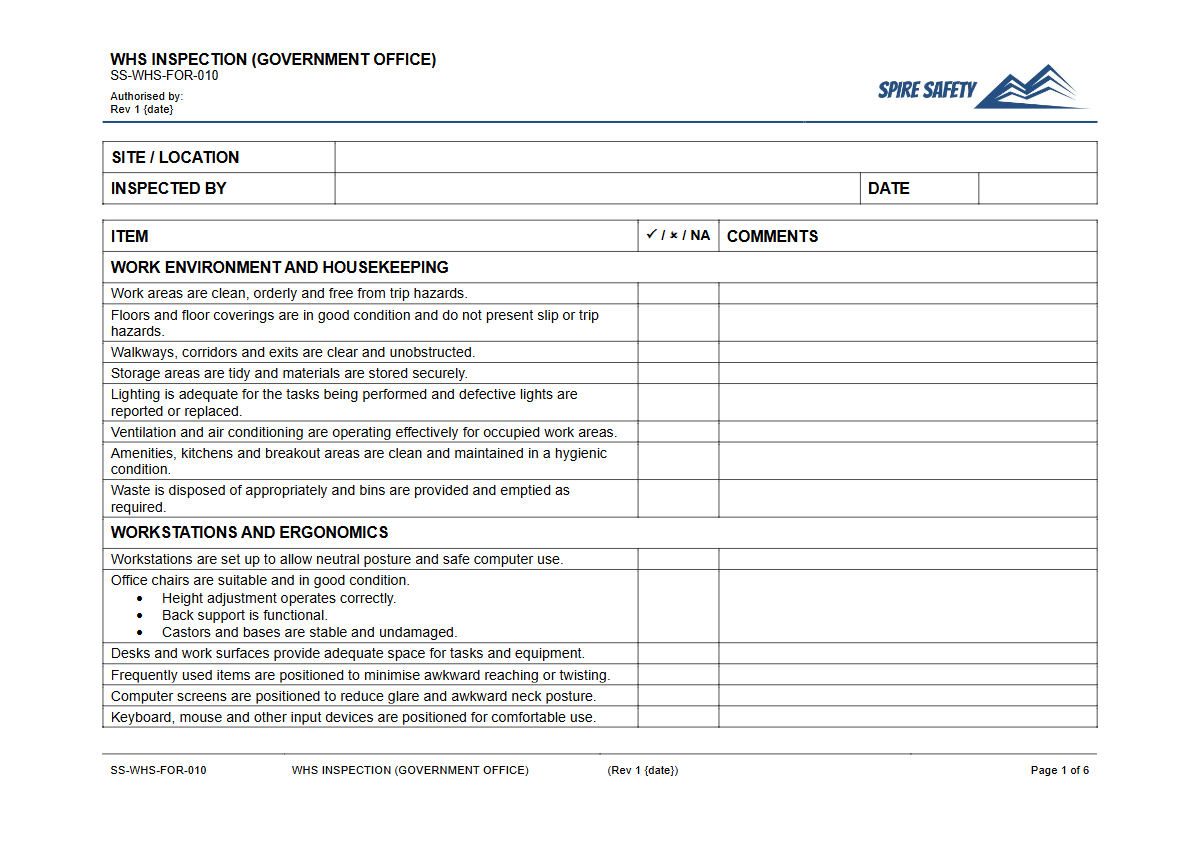
Download our free WHS Inspection Template for Government Offices. This structured DOCX & PDF helps you identify and manage common workplace hazards.
Free WHS Inspection (Government Office) Template
DOCX • 127 KB + PDF
Updated Oct 2026
No signup required
Purpose of the Free WHS Inspection (Government Office) Template
Regular safety inspections are a cornerstone of effective Work Health and Safety (WHS) management in any workplace, including government offices. While often perceived as low-risk environments, offices contain numerous hazards such as ergonomic issues, electrical faults, trip hazards, and inadequate emergency preparedness.
This Free WHS Inspection (Government Office) Template provides a structured starting point for systematically identifying, assessing, and controlling these risks. Using a formal checklist helps ensure that inspections are consistent, thorough, and documented, forming a crucial part of your overall WHS management systems.
The template is designed to guide a competent person through a physical walk-through of the office environment. It prompts the user to check key areas and common hazards, record observations, and recommend corrective actions.
By formalising this process, your organisation can demonstrate proactive risk management, meet its duty of care, and foster a stronger safety culture among employees and managers.
Video walkthrough
How to use the Free WHS Inspection (Government Office) Template
Using this Inspection template effectively involves more than just ticking boxes. Follow these steps to integrate it into your safety processes:
- Download and Customise: Download the template in your preferred format (DOCX or PDF). The DOCX version is fully editable to suit your specific workplace.
- Schedule the Inspection: Determine a regular schedule for inspections (e.g., quarterly) and assign the task to a competent person, such as a WHS Representative, manager, or facilities coordinator.
- Conduct the Walk-through: The designated inspector should walk through all areas of the office, using the checklist to guide their observations. They should look for deviations from safe standards and talk to staff about any concerns they may have.
- Document Findings: Record all observations, both positive and negative. For any identified hazards or non-conformances, note the location, describe the issue, and assign a risk level if applicable.
- Assign Corrective Actions: For each identified issue, a corrective action must be documented. This includes defining the action required, assigning responsibility to a specific person, and setting a realistic due date for completion.
- Review and Sign Off: Once the inspection is complete and actions are assigned, it should be reviewed by a manager. Completed actions should be verified and signed off to close the loop.
Important: This document is a template only. You must customise it to address the specific layout, equipment, and work activities of your government office.
For example, your kitchenette might require specific checks detailed in our Free Pre-Start Checklist (Coffee Machine) Template. We cannot guarantee the template’s suitability for your unique circumstances without thorough customisation.
Key Areas Covered in the Inspection
Our template prompts you to assess a range of critical areas in a typical government office environment, including:
- Workstations & Ergonomics: Desk setup, chair adjustment, monitor height, and cable management.
- Housekeeping: Clear walkways, secure storage of materials, and management of slip, trip, and fall hazards.
- Electrical Safety: Condition of electrical cords, testing and tagging of appliances, and overloading of power boards.
- Fire & Emergency: Clear access to fire exits and equipment, functioning alarms, and up-to-date evacuation diagrams and first aid kits.
- Amenities: Cleanliness and maintenance of kitchens, bathrooms, and breakout areas.
- Lighting & Ventilation: Adequate lighting levels for tasks and sufficient air circulation.
- Security: Functioning access control systems and clear security procedures.
Specific equipment in your office, such as a mailroom machine, may warrant its own check. You can incorporate items from a dedicated checklist like our Free Pre-Start Checklist (Envelope Sealer) Template directly into your customised inspection form.
When to use this Inspection Template
Workplace inspections should be conducted on a regular, planned basis as part of your proactive safety program. A typical frequency for a government office is quarterly. However, an inspection should also be triggered by specific events, such as:
- After an incident, accident, or near miss.
- Following an office relocation or refurbishment.
- When new equipment or work processes are introduced.
- In response to staff raising specific health or safety concerns.
Regularly scheduled inspections are a key component of a robust safety framework and provide valuable data for periodic WHS compliance auditing to verify the effectiveness of your controls.
Who should use this Inspection Template
This template is designed for use by personnel with delegated responsibility for workplace safety. This can include:
- Health and Safety Representatives (HSRs)
- Managers and Supervisors
- Facilities or Building Managers
- Members of a WHS Committee
The person conducting the inspection must be competent to do so. This means they should be familiar with the workplace, understand common office hazards, and have received adequate training on the inspection process and relevant safety procedures.
For complex environments or specialised guidance, engaging external expertise through WHS consulting can provide valuable support and ensure a comprehensive assessment. This template is just one of many tools available in our free WHS resources library to help you build a safer workplace.
Common mistakes
Common mistakes to avoid
- Failing to customise the template to the specific workplace layout and risks.
- Not assigning clear responsibility and deadlines for corrective actions.
- Performing the inspection as a 'tick-box' exercise without genuine observation or staff consultation.
- Neglecting to follow up and verify that identified hazards have been fixed.
Legal references
Legal considerations
The following legal requirements may be relevant to this type of work.
- Work Health and Safety Act (Harmonised) — Provides the primary duties for protecting workers and other people from work health and safety risks.
- Work Health and Safety Regulations (Harmonised) — Sets out requirements supporting the management of workplace hazards and risks.
The following codes may be relevant to this type of work.
- Managing WHS Risks Code of Practice — Provides practical guidance on identifying hazards, assessing risks and applying effective controls.
- Work Health and Safety Consultation, Cooperation and Coordination Code of Practice — Provides practical guidance on consulting workers and coordinating with other duty holders.
- Managing the Work Environment and Facilities Code of Practice — Provides practical guidance on safe work environments, workplace facilities and related controls.
Did you know
Slips, Trips, and Falls
According to Safe Work Australia, slips, trips, and falls are a leading cause of serious injury in Australian workplaces, making good housekeeping and regular inspections in office environments critically important.
The Cost of Poor Ergonomics
Body stressing, often resulting from poor ergonomic setups at workstations, is one of the most common mechanisms of workplace injury. Proactive ergonomic assessments during inspections can significantly reduce the risk of musculoskeletal disorders.
FAQ
Frequently asked questions
01What is the purpose of a WHS inspection in a government office?
02How often should government office safety inspections be conducted?
03Can this template be used for all types of government workplaces?
04Who is responsible for actioning hazards found during an inspection?
Share this resource
Free WHS Inspection (Government Office) Template
Browse Categories
How To Use It
- 1Download and open in Word or PDF.
- 2Replace the placeholders with your business details.
- 3Get it reviewed by a WHS specialist before rollout.
Need it customised?
Our WHS consultants can adapt this template to your site, run a gap analysis, or audit what you already have in place.
Book a Free Consultation WHS consulting servicesor call 1300 156 382