
Free WHS Inspection (Green Waste Site) Template
Download our free WHS Inspection Template for Green Waste Sites.
Free WHS Inspection (Green Waste Site) Template
DOCX • 128 KB + PDF
Updated Oct 2026
No signup required
Purpose of the Free WHS Inspection (Green Waste Site) Template
Green waste sites present a unique combination of hazards, including heavy machinery, flammable stockpiles, biological agents, and public interaction. This Free WHS Inspection (Green Waste Site) Template provides a structured framework for systematically identifying and controlling these risks.
It is designed to guide you through a thorough check of your work environment, promoting a proactive approach to safety.
Using this template helps your organisation formalise its safety procedures and demonstrate due diligence. It covers key areas such as mobile plant operation, stockpile management, fire prevention, dust control, traffic management, and site security.
Regular inspections are a fundamental component of any effective WHS management system, helping to prevent incidents before they occur and fostering a positive safety culture.
Video walkthrough
How to use the Free WHS Inspection (Green Waste Site) Template
This template is available for download in both DOCX for easy editing and PDF for straightforward printing. It is designed as a comprehensive starting point aligned with Australian WHS principles.
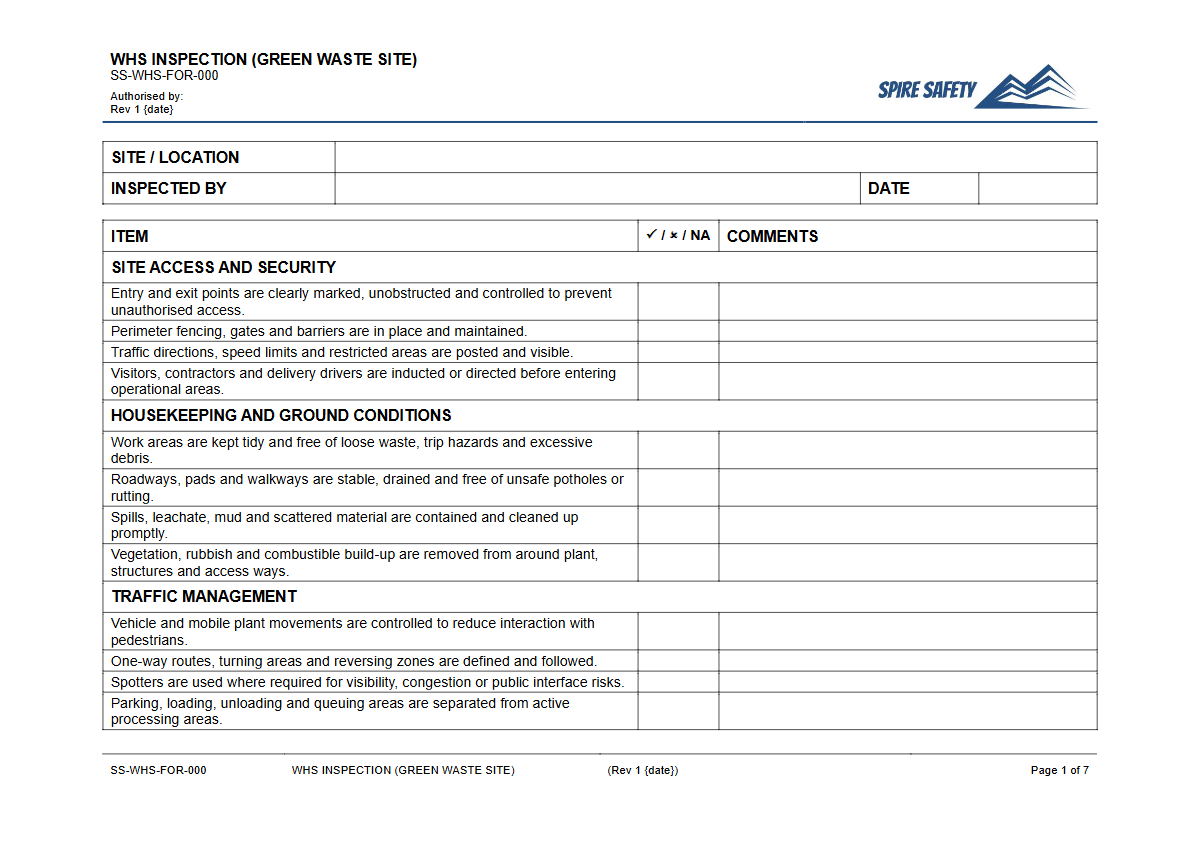
The checklist prompts you to examine potential hazards, assess risk controls, and record necessary corrective actions. It includes sections for detailing the inspection date, location, inspector's name, and a sign-off to close out the process.
Important: This is a general template that must be adapted for your specific workplace. We recommend you consult with your workers, supervisors, and other stakeholders to customise the checklist, adding or removing items to reflect the unique equipment, layout, materials, and procedures at your green waste facility. For specific machinery, you may also need more detailed checks, such as those found in our Free Pre-Start Checklist (Lawn Tractor) Template.
The Inspection Process
- Preparation: Review previous inspection reports and any incident data to identify recurring issues or areas of concern.
- Walkthrough: Conduct a physical inspection of the site, methodically working through the checklist items. Engage with workers on the ground to get their input on potential hazards and the effectiveness of existing controls.
- Documentation: Clearly record your findings. For any non-conformance or identified hazard, note the specific location and details. Use photos where it helps to clarify the issue.
- Corrective Actions: For each identified issue, assign a corrective action, a responsible person, and a realistic due date. Prioritise actions based on the level of risk.
- Follow-up: Verify that all corrective actions have been completed effectively and have not introduced new hazards.
When to use this Inspection Template
The frequency of inspections should be determined by your site's risk assessment. High-risk areas, such as machinery operation zones or public drop-off points, may require daily or weekly checks.
A full site inspection is typically conducted on a weekly or monthly basis.
Consider using this template at other key times, including:
- After an incident, near miss, or hazard report.
- Before and after periods of extreme weather, like heavy rain or high winds, which can affect stockpile stability and drainage.
- When introducing new equipment or changing a work process.
- During seasonal changes that affect the volume or type of green waste being processed.
Environmental factors are also a key consideration. Regular checks on sediment fences and drainage systems are crucial for compliance, and this process can be supported with our Stormwater and Waterway Protection Toolbox Talk Template to improve team awareness.
Who should use this Template
This inspection should be carried out by a competent person who is familiar with green waste operations and their associated hazards. This could include:
- Site Managers or Supervisors
- Work Health and Safety (WHS) Officers or Advisors
- Health and Safety Representatives (HSRs)
- Experienced Team Leaders
It is beneficial to involve different people in inspections over time to bring a fresh perspective. The findings from the inspection should be communicated to all relevant workers and reviewed by management to ensure that necessary resources are allocated for any required improvements. To ensure your safety processes are robust, you might consider engaging external help for a periodic, independent review through WHS compliance auditing.
By integrating this inspection template into your operational rhythm, you can build a stronger, safer workplace. Explore our free WHS resources library for more tools to support your safety management efforts.
Common mistakes
Common mistakes to avoid
- Using a generic checklist without customising it for the site's specific plant and layout.
- Failing to document corrective actions and track them through to completion.
- Inspecting only equipment and structures, while neglecting process-related hazards like traffic management.
- Not involving the workers who perform the tasks day-to-day in the inspection process.
- Poor record-keeping, making it difficult to identify trends or prove due diligence.
Legal references
Legal considerations
The following legal requirements may be relevant to this type of work.
- Work Health and Safety Act (Harmonised) — Provides the primary duties for protecting workers and other people from work health and safety risks.
- Work Health and Safety Regulations (Harmonised) — Sets out requirements supporting the management of workplace hazards and risks.
The following codes may be relevant to this type of work.
- Managing WHS Risks Code of Practice — Provides practical guidance on identifying hazards, assessing risks and applying effective controls.
- Work Health and Safety Consultation, Cooperation and Coordination Code of Practice — Provides practical guidance on consulting workers and coordinating with other duty holders.
- Managing the Work Environment and Facilities Code of Practice — Provides practical guidance on safe work environments, workplace facilities and related controls.
Did you know
Spontaneous Combustion
Large stockpiles of green waste can self-heat through microbial decomposition. If the pile is too large and not turned regularly, temperatures can rise high enough to cause spontaneous combustion, posing a significant fire risk.
Airborne Hazards
The decomposition of organic matter releases airborne biological hazards like fungal spores (e.g., Aspergillus fumigatus) and bacteria. Inhaling these can cause respiratory issues, making dust suppression and appropriate PPE critical.
FAQ
Frequently asked questions
01What are the main hazards at a green waste recycling site?
02How often should inspections be conducted at a green waste facility?
03Is this template suitable for a general waste transfer station?
04What should happen if an inspection identifies a serious and immediate risk?
Share this resource
Free WHS Inspection (Green Waste Site) Template
Browse Categories
How To Use It
- 1Download and open in Word or PDF.
- 2Replace the placeholders with your business details.
- 3Get it reviewed by a WHS specialist before rollout.
Need it customised?
Our WHS consultants can adapt this template to your site, run a gap analysis, or audit what you already have in place.
Book a Free Consultation WHS consulting servicesor call 1300 156 382