
Free WHS Inspection (Golf Club) Template
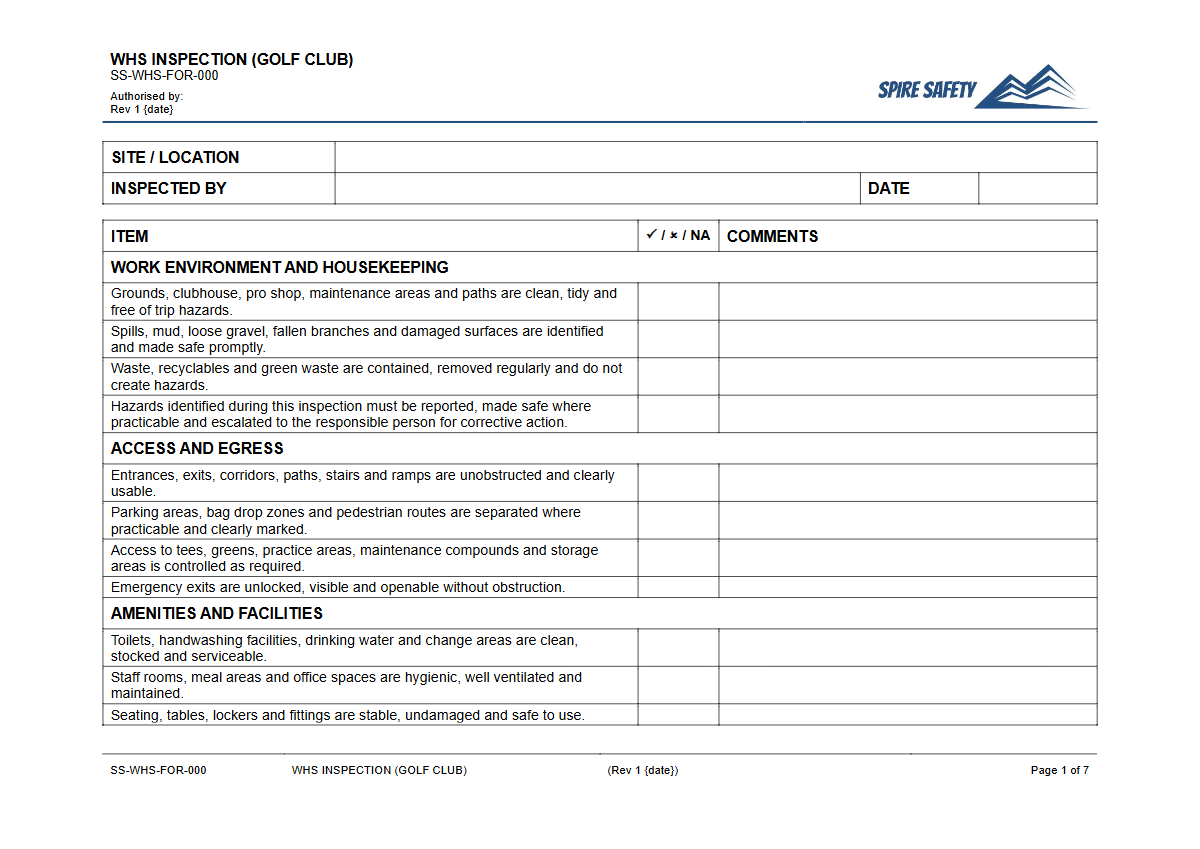
Download our free WHS Inspection (Golf Club) Template. A structured DOCX & PDF to help you identify and manage safety risks on the course and in the clubhouse.
Free WHS Inspection (Golf Club) Template
DOCX • 128 KB + PDF
Updated Oct 2026
No signup required
Purpose of the Free WHS Inspection (Golf Club) Template
Managing health and safety at a golf club involves overseeing a diverse range of environments, from the manicured fairways to the bustling clubhouse. Our Free WHS Inspection (Golf Club) Template provides a structured starting point for systematically identifying and controlling hazards across your entire facility.
This downloadable document helps you formalise your safety processes, ensuring a safer environment for staff, members, and visitors. This template is designed to assist golf club managers, WHS officers, and greenkeepers in conducting thorough safety inspections.
It covers a wide range of potential hazards unique to golf club operations, including course maintenance, clubhouse hospitality, pro shop retail, and player safety on the course. By using a structured checklist, you can ensure key areas are not overlooked, create a record of your safety efforts, and demonstrate due-diligence in managing WHS risks.
It facilitates a proactive approach to safety, moving beyond reactive incident response to preventative risk management. Regular inspections are a cornerstone of effective WHS management systems, helping to cultivate a strong safety culture within your organisation.
Video walkthrough
How to use the Free WHS Inspection (Golf Club) Template
This document is provided in both DOCX and PDF formats for your convenience. The DOCX version is fully editable, allowing you to tailor it to the specific layout, equipment, and operations of your club.
It is crucial to customise this template before use; we do not know the specific hazards of your workplace. Add, remove, or modify checklist items to reflect your site's unique risks, including specific machinery used by your grounds crew or particular features of your clubhouse.
Once customised, the template can be used by designated personnel to conduct walk-through inspections, noting any non-conformances or areas for improvement. All findings and corrective actions should be clearly documented, assigned, and tracked through to completion.
When to use this Inspection
The frequency of inspections depends on the nature of the area and the level of risk. A general rule is to establish a regular schedule—for example, monthly or quarterly for a full club inspection.
More frequent checks may be needed for high-risk areas or activities. For instance, daily checks of groundskeeping machinery are essential for safe operation.
You can use our pre-start checklist for a lawn tractor to formalise these daily checks. Inspections should also be conducted after any incident, when new equipment or chemicals are introduced, or when work processes change.
Who should conduct the Inspection
Inspections are most effective when conducted by competent personnel with a good understanding of the club's operations and WHS principles. This could be a dedicated WHS manager, a club manager, a supervisor, or a member of the health and safety committee.
Involving different people can also bring fresh perspectives. For example, having a greenkeeper inspect the clubhouse or a hospitality staff member inspect a section of the course can help identify hazards that may have become 'normalised' to those who work in an area every day. For specialised plant like course maintenance equipment, it's vital to have specific checks in place, such as those detailed in our pre-start checklist for an aerator.
Integrating with Other Safety Procedures
Beyond the greens and fairways, the clubhouse itself presents numerous hazards. Kitchens, bars, and function rooms have risks related to food safety, manual handling, and slips, trips, and falls.
The electrical appliances in these areas require regular checks to ensure they are safe for use. A simple tool like a pre-start checklist for a commercial blender can be adapted for various kitchen equipment to ensure staff are checking for defects before use.
A comprehensive inspection should also cover public areas, including car parks, paths, and locker rooms. Factors like adequate lighting, clear signage, and the condition of walking surfaces are critical for preventing incidents involving members and visitors.
Independent Audits
Periodically, it may be beneficial to engage external experts for a WHS compliance audit to get an independent assessment of your safety systems and identify any gaps that internal inspections may have missed. This provides a valuable third-party perspective and can help ensure your procedures are aligned with current standards and legislation.
This template serves as a robust foundation for your golf club's inspection program. By consistently applying and adapting it, you can systematically reduce risks and maintain a safe environment for everyone.
Explore our extensive free WHS resources library for more templates and checklists to support your safety management system.
Common mistakes
Common mistakes to avoid
- Focusing only on the golf course and neglecting clubhouse, kitchen, and pro shop hazards.
- Failing to customise a generic checklist to the club's specific equipment, layout, and activities.
- Simply ticking boxes without properly investigating potential issues or documenting findings.
- Not creating and tracking corrective actions to resolve identified hazards in a timely manner.
Legal references
Legal considerations
The following legal requirements may be relevant to this type of work.
- Work Health and Safety Act (Harmonised) — Provides the primary duties for protecting workers and other people from work health and safety risks.
- Work Health and Safety Regulations (Harmonised) — Sets out requirements supporting the management of workplace hazards and risks.
The following codes may be relevant to this type of work.
- Managing WHS Risks Code of Practice — Provides practical guidance on identifying hazards, assessing risks and applying effective controls.
- Work Health and Safety Consultation, Cooperation and Coordination Code of Practice — Provides practical guidance on consulting workers and coordinating with other duty holders.
- Managing the Work Environment and Facilities Code of Practice — Provides practical guidance on safe work environments, workplace facilities and related controls.
Did you know
Machinery Risk
According to Safe Work Australia, incidents involving machinery are a leading cause of serious injury in the agriculture sector, which shares many equipment types with golf course maintenance.
Slips & Trips
Slips, trips, and falls are one of the most common causes of injury in the hospitality industry, making clubhouse and function centre floors a key area of focus for any golf club inspection.
FAQ
Frequently asked questions
01What hazards should a golf club WHS inspection cover?
02How often should a golf club be inspected for safety?
03Who is responsible for WHS at a golf club?
04Can this template be used for official compliance reporting?
Share this resource
Free WHS Inspection (Golf Club) Template
Browse Categories
How To Use It
- 1Download and open in Word or PDF.
- 2Replace the placeholders with your business details.
- 3Get it reviewed by a WHS specialist before rollout.
Need it customised?
Our WHS consultants can adapt this template to your site, run a gap analysis, or audit what you already have in place.
Book a Free Consultation WHS consulting servicesor call 1300 156 382