
Free WHS Inspection (Garden Nursery) Template
Download our free WHS Inspection Template for Garden Nurseries. A structured starting point to help identify hazards and manage risks. Get your template today.
Free WHS Inspection (Garden Nursery) Template
DOCX • 129 KB + PDF
Updated Oct 2026
No signup required
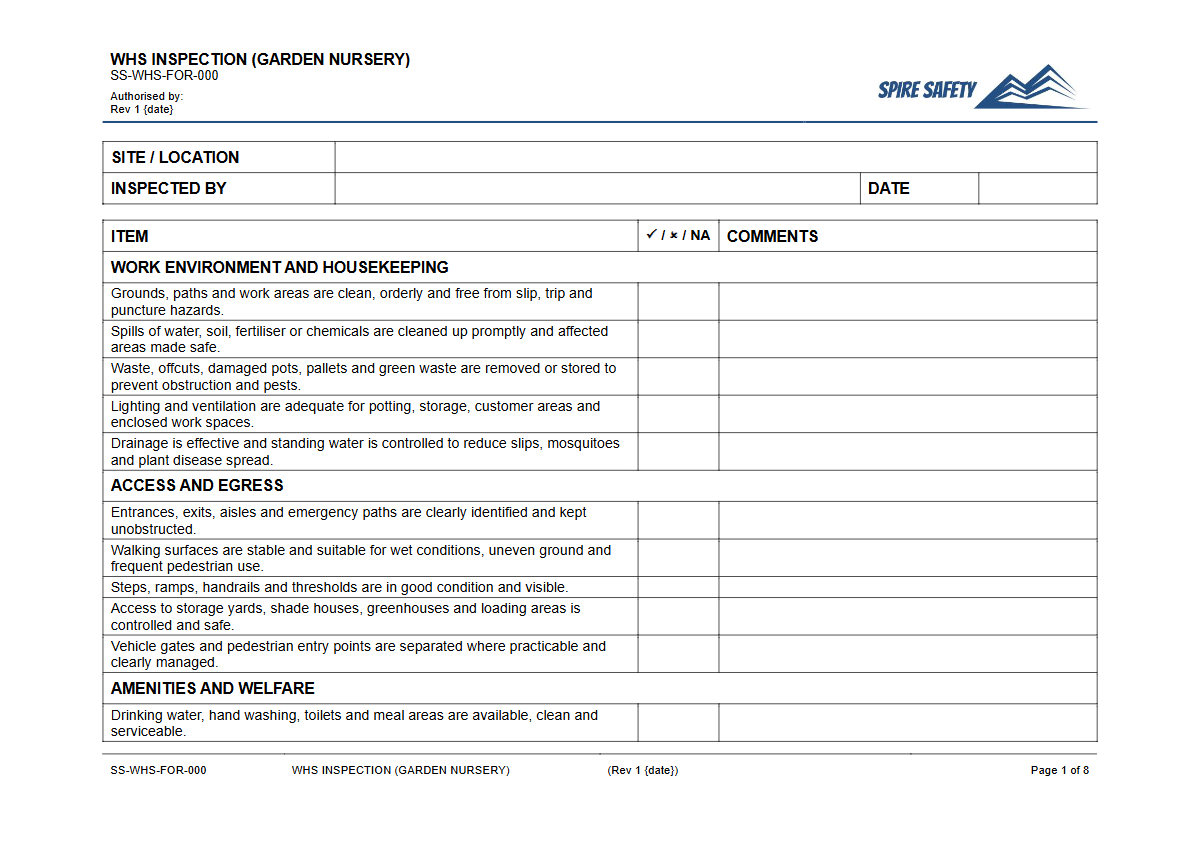
Purpose of the Free WHS Inspection (Garden Nursery) Template
Garden nurseries present a unique mix of hazards, from manual tasks and chemical handling to interactions with the public. Our Free WHS Inspection (Garden Nursery) Template provides a structured starting point for systematically identifying these hazards before they can cause an incident.
Using this template helps your organisation conduct thorough workplace walkthroughs, ensuring all key areas are assessed for potential risks.
This inspection checklist is aligned with Australian WHS principles and is designed to prompt a review of common risk areas in a nursery environment, including plant and equipment, chemical storage, staff amenities, and public access zones. Regular inspections not only help in preventing injuries but also demonstrate a proactive commitment to health and safety, fostering a positive safety culture among staff and management.
Video walkthrough
How to use the Free WHS Inspection (Garden Nursery) Template
Using this template effectively involves more than just ticking boxes. The process should be a critical assessment of your work environment.
First, download the document and adapt it to the specific layout, equipment, and procedures of your garden nursery. Add or remove items to make the checklist truly relevant to your site.
During the inspection, walk through each area noted on the form, carefully observing work practices and the condition of the environment. Document any hazards or non-conformances you identify, noting their location and a clear description of the issue.
Assign a risk rating if appropriate and recommend a corrective action to control the hazard. For specific equipment like turf aerators, you can supplement this with our Free Pre-Start Checklist (Aerator) Template.
Please note: This document is a template and must be customised to suit the specific hazards, equipment, and operational procedures of your workplace. We are not liable for any incidents that may occur from the use of this template.
When to conduct a Garden Nursery Inspection
The frequency of inspections should be based on the level of risk. A general rule is to conduct a full site inspection on a regular, scheduled basis, such as weekly or monthly.
This creates a consistent rhythm for safety monitoring. However, inspections should also be triggered by certain events, including:
- After a workplace incident, accident, or near miss.
- When new machinery, chemicals, or equipment are introduced.
- When work processes or the layout of the nursery changes.
- In response to concerns raised by workers or Health and Safety Representatives (HSRs).
These formal inspections are separate from, and additional to, daily pre-start checks on high-risk equipment. For daily checks of specific machinery like ride-on mowers, use a dedicated checklist such as our Free Pre-Start Checklist (Lawn Tractor) Template.
Who should use it
This inspection template is designed for use by anyone with responsibility for health and safety in a garden nursery. This includes the Person Conducting a Business or Undertaking (PCBU), site managers, supervisors, and designated WHS officers.
Health and Safety Representatives (HSRs) can also use this template to facilitate their inspections and discussions with management.
For the most effective outcome, inspections should be a consultative process. Involving workers who perform the day-to-day tasks provides valuable, practical insight into potential hazards that managers might otherwise overlook.
The findings from these inspections form a critical part of your safety records, which may be reviewed during a formal WHS compliance auditing process.
Key Areas to Inspect in a Garden Nursery
A comprehensive garden nursery inspection should cover all operational areas. Your customised template should include checks for hazards related to:
- Public and Customer Areas: Clear, unobstructed walkways, trolley safety, adequate signage, and management of slip, trip, and fall hazards.
- Retail and Indoor Spaces: Shelf stability, clear emergency exits, fire safety equipment, and electrical safety.
- Plant and Potting Areas: Ergonomics of potting benches, manual handling risks (lifting soil bags, pots), and housekeeping.
- Chemical and Fertiliser Storage: Correct segregation, availability of Safety Data Sheets (SDS), adequate ventilation, and spill kits.
- Equipment and Machinery: Guarding on machinery, safe operation of forklifts or loaders, and condition of hand and power tools. Consider other site-specific equipment, like access control systems, using a resource like our Free Pre-Start Checklist (Boom Gate) Template.
- Outdoor Areas: UV radiation controls (shade, sunscreen), vehicle and pedestrian interaction, and irrigation system safety.
After the Inspection
An inspection is only effective if its findings lead to action. Once the walkthrough is complete, all identified hazards must be addressed.
Create a corrective action plan that details the issue, the required action, the person responsible for implementing it, and a deadline for completion. Tracking these actions is crucial.
Integrating these inspections into your broader WHS management systems ensures that findings are tracked and corrective actions are managed effectively. Communicating the results and the subsequent improvements to all staff helps close the loop and reinforces the value of their participation in the safety process.
This template is one of many tools available to help you build a robust safety system, and you can explore our full free WHS resources library for more checklists and guides.
Common mistakes
Common mistakes to avoid
- Forgetting to check chemical storage for correct labelling, segregation, and accessible Safety Data Sheets (SDS).
- Overlooking common trip hazards like trailing water hoses, uneven paving, or misplaced stock.
- Failing to customise the template to include site-specific equipment, such as potting machines or delivery vehicles.
- Not creating or following up on a corrective action plan to address hazards found during the inspection.
Legal references
Legal considerations
The following legal requirements may be relevant to this type of work.
- Work Health and Safety Act (Harmonised) — Provides the primary duties for protecting workers and other people from work health and safety risks.
- Work Health and Safety Regulations (Harmonised) — Sets out requirements supporting the management of workplace hazards and risks.
The following codes may be relevant to this type of work.
- Managing WHS Risks Code of Practice — Provides practical guidance on identifying hazards, assessing risks and applying effective controls.
- Work Health and Safety Consultation, Cooperation and Coordination Code of Practice — Provides practical guidance on consulting workers and coordinating with other duty holders.
- Managing the Work Environment and Facilities Code of Practice — Provides practical guidance on safe work environments, workplace facilities and related controls.
Did you know
Manual Tasks Risk
The 'Agriculture, Forestry and Fishing' industry division, which includes nurseries, has one of the highest rates of serious workers' compensation claims, with manual handling injuries being a primary cause.
Chemical Safety Data
Even common fertilisers and pesticides are classed as hazardous chemicals and legally require a Safety Data Sheet (SDS) to be readily accessible to workers who use them.
FAQ
Frequently asked questions
01What are the most common hazards in a garden nursery?
02How often should a garden nursery be inspected for WHS?
03Who is responsible for WHS in a garden nursery?
04Can this template be used on a mobile or tablet?
Share this resource
Free WHS Inspection (Garden Nursery) Template
Browse Categories
How To Use It
- 1Download and open in Word or PDF.
- 2Replace the placeholders with your business details.
- 3Get it reviewed by a WHS specialist before rollout.
Need it customised?
Our WHS consultants can adapt this template to your site, run a gap analysis, or audit what you already have in place.
Book a Free Consultation WHS consulting servicesor call 1300 156 382