
Free WHS Inspection (Fuel Depot) Template
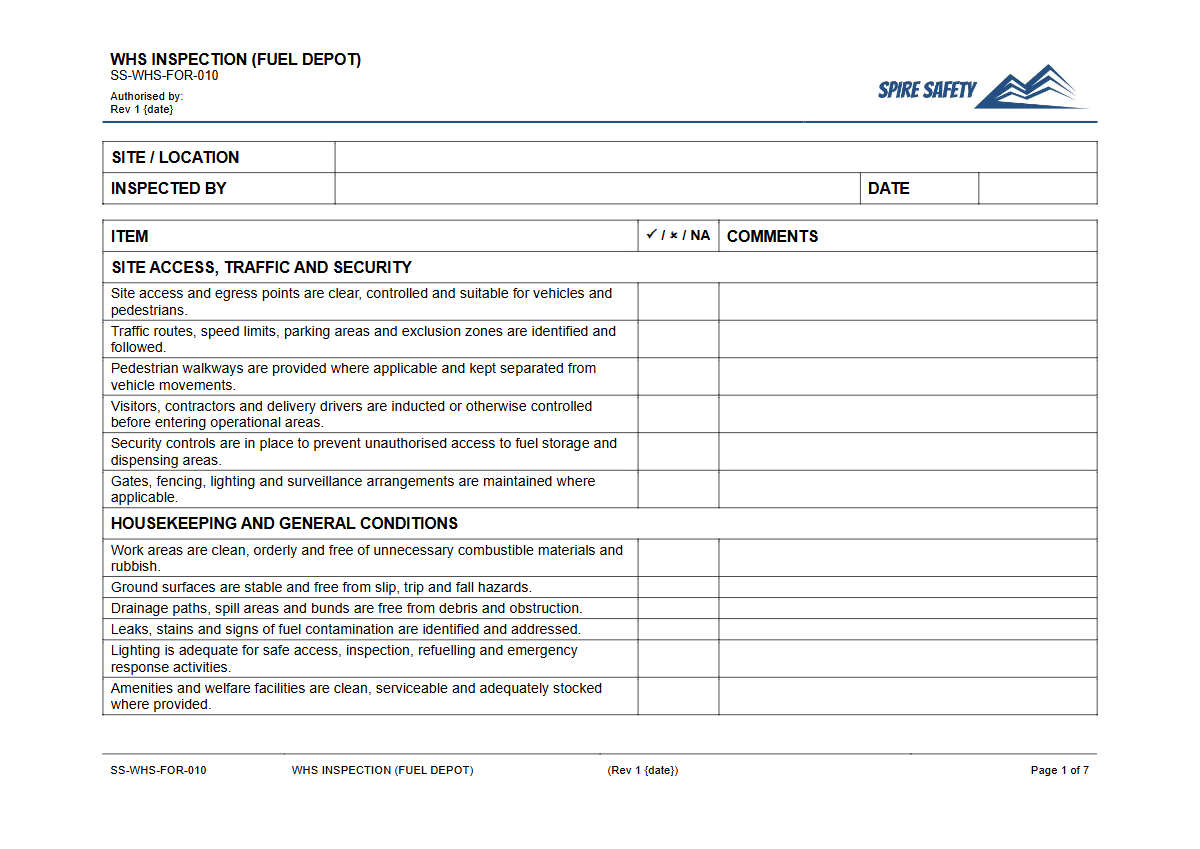
Download our Free WHS Inspection (Fuel Depot) Template. This structured DOCX & PDF helps you formalise safety checks for fuel storage and dispensing areas.
Free WHS Inspection (Fuel Depot) Template
DOCX • 128 KB + PDF
Updated Oct 2026
No signup required
Purpose of the Free WHS Inspection (Fuel Depot) Template
Managing a fuel depot involves significant risks, from flammable liquids and hazardous chemicals to vehicle movements and environmental contamination. Our Free WHS Inspection (Fuel Depot) Template provides a structured starting point for systematically identifying and controlling these hazards.
Regular, documented inspections are a critical component of any safety management system, helping your organisation meet its duty of care under Australian WHS laws. This template guides you through checking key safety elements, ensuring controls are in place and functioning correctly.
Using this template helps formalise your inspection process, creating a consistent record of due diligence. It prompts a thorough review of high-risk areas like storage tanks, dispensing pumps, spill containment systems, and emergency equipment.
Integrating these checks is a key part of developing robust WHS management systems that protect your workers, the public, and the environment.
Key Areas Covered
This inspection template is designed to cover critical safety aspects of a typical fuel depot, including:
- Hazardous Chemical Storage: Checks for correct segregation, bunding integrity, and clear labelling of tanks and containers.
- Dispensing Equipment: Inspection of pumps, hoses, nozzles, and emergency shut-off mechanisms for damage or leaks.
- Spill & Fire Safety: Verification that spill kits, fire extinguishers, and alarms are present, accessible, and serviceable.
- Signage & Documentation: Ensures that safety data sheets (SDS), manifests, and required placarding (e.g., HAZCHEM) are current and visible.
- Site Access & Traffic Management: Review of vehicle routes, pedestrian safety, and security measures like perimeter fencing. For controlled entry points, a specific free Pre-Start Checklist (Boom Gate) Template can enhance daily operational safety.
- Electrical & Ignition Control: Checks for correct earthing, bonding, and the condition of electrical equipment in hazardous zones.
Video walkthrough
How to use the Free WHS Inspection (Fuel Depot) Template
To get the most value from this resource, follow these steps:
- Download: Choose your preferred format, DOCX for easy editing or PDF for straightforward printing.
- Customise: This is the most important step. This template is a guide, not a final document. You must adapt it to your specific site, including the types and quantities of fuel stored, the equipment used, and your operational procedures. We cannot guarantee its suitability for your workplace without this customisation. If you need assistance, consider engaging professional WHS consulting services.
- Train: Ensure the personnel conducting the inspections are competent. They need to understand the hazards associated with fuel depots and be trained on what to look for.
- Schedule & Conduct: Integrate the inspection into your regular safety schedule. The frequency will depend on the risk level and operational tempo of your site.
- Document & Act: Keep completed inspection records. Any identified issues, defects, or non-conformances must be documented, assigned for corrective action, and tracked through to completion.
When to use it
Regular inspections should be conducted at a frequency determined by a risk assessment. A common schedule might include:
- Daily Checks: Quick visual inspections of high-use areas like dispensing pumps and spill kits before operations begin.
- Weekly Inspections: More detailed checks of critical equipment, bunding, and safety signage.
- Monthly Reviews: A comprehensive walkthrough of the entire depot using this template.
- Post-Incident: An inspection should always be conducted after any incident, near miss, or significant spill to identify causal factors and prevent recurrence.
Periodic, in-depth reviews are also essential for maintaining standards. These can be scheduled as part of a formal WHS compliance auditing program to verify that procedures are being followed correctly over the long term.
Who should use it
This template is designed for use by competent personnel responsible for workplace safety at a fuel storage facility. This can include:
- Site Managers or Supervisors
- WHS/HSE Officers and Advisors
- Operations Team Leaders
- Designated and trained workers or safety representatives
The person performing the inspection must have adequate knowledge of fuel handling hazards, relevant Australian Standards (like AS 1940), and the site's specific emergency procedures. Inspections also cover ancillary equipment, and for facilities with maintenance bays, a dedicated electric hoist pre-start checklist is vital for ensuring lifting safety.
This resource is one of many tools available to help improve safety in your workplace. You can explore our full free WHS resources library for a wide range of templates, checklists, and guides covering various industries and hazards.
Common mistakes
Common mistakes to avoid
- Using a generic checklist that hasn't been customised for the specific chemicals, equipment, and layout of the site.
- Failing to document and track corrective actions for hazards identified during the inspection.
- Neglecting to inspect 'minor' equipment like hoses, nozzles, and seals, which are common failure points.
- Inadequate training for personnel conducting the inspection, leading to overlooked hazards.
Legal references
Legal considerations
The following legal requirements may be relevant to this type of work.
- Work Health and Safety Act (Harmonised) — Provides the primary duties for protecting workers and other people from work health and safety risks.
- Work Health and Safety Regulations (Harmonised) — Sets out requirements supporting the management of workplace hazards and risks.
The following codes may be relevant to this type of work.
- Managing WHS Risks Code of Practice — Provides practical guidance on identifying hazards, assessing risks and applying effective controls.
- Work Health and Safety Consultation, Cooperation and Coordination Code of Practice — Provides practical guidance on consulting workers and coordinating with other duty holders.
- Managing the Work Environment and Facilities Code of Practice — Provides practical guidance on safe work environments, workplace facilities and related controls.
Did you know
Static Electricity
A static spark so small you can't see or feel it can carry enough energy to ignite flammable fuel vapours. This is why bonding and earthing procedures are critical during fuel transfer operations.
Bunding Capacity
Spill containment bunds around storage tanks are typically required to hold at least 110% of the volume of the largest single tank within the bund. This ensures that even a catastrophic tank failure can be fully contained.
FAQ
Frequently asked questions
01What is the difference between a WHS inspection and an audit?
02How often should a fuel depot be inspected?
03What Australian Standard applies to fuel depots?
04Who is qualified to conduct a fuel depot inspection?
Share this resource
Free WHS Inspection (Fuel Depot) Template
Browse Categories
How To Use It
- 1Download and open in Word or PDF.
- 2Replace the placeholders with your business details.
- 3Get it reviewed by a WHS specialist before rollout.
Need it customised?
Our WHS consultants can adapt this template to your site, run a gap analysis, or audit what you already have in place.
Book a Free Consultation WHS consulting servicesor call 1300 156 382