
Free WHS Inspection (Freight Terminal) Template
Download our Free WHS Inspection (Freight Terminal) Template. This structured DOCX & PDF helps you formalise safety checks for your transport hub.
Free WHS Inspection (Freight Terminal) Template
DOCX • 128 KB + PDF
Updated Oct 2026
No signup required
Purpose of the Free WHS Inspection (Freight Terminal) Template
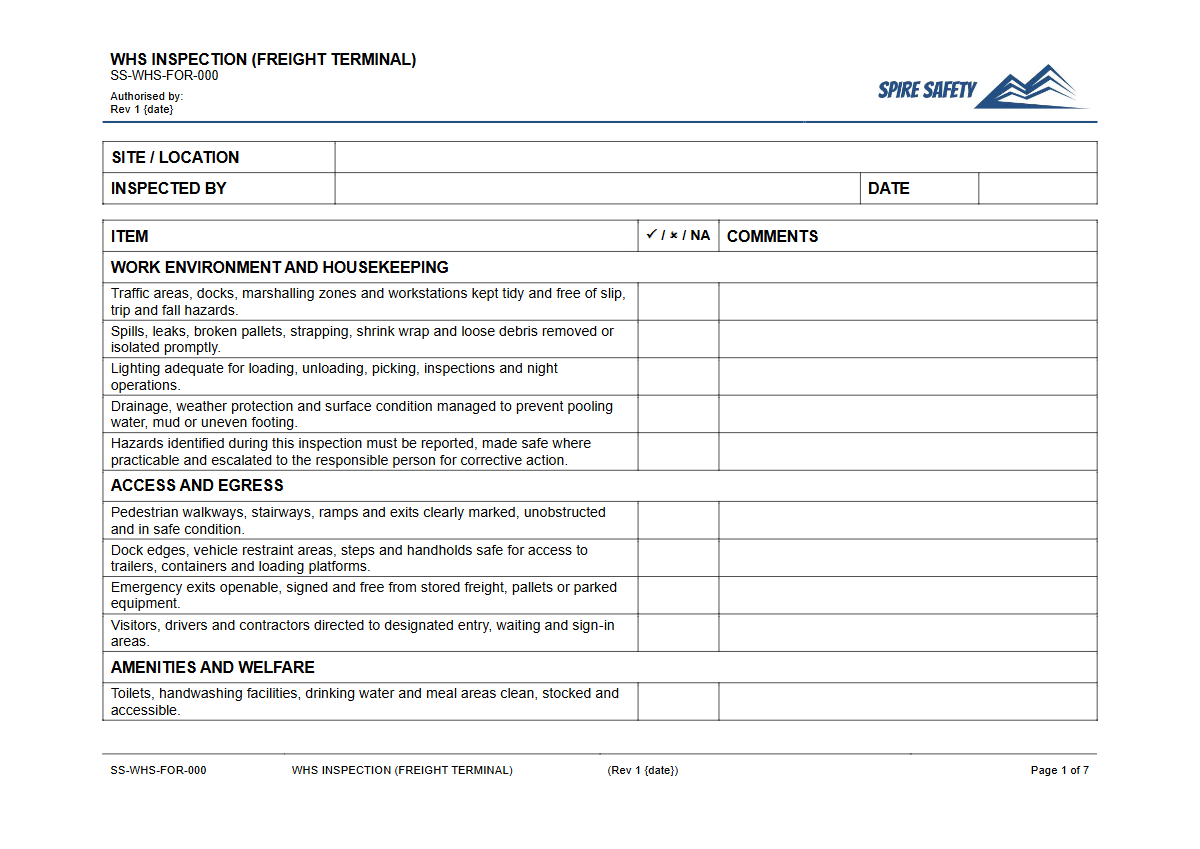
Freight terminals are dynamic and high-risk environments, with constant interaction between heavy vehicles, mobile plant, and pedestrians. This Free WHS Inspection (Freight Terminal) Template provides a structured starting point for systematically identifying and managing workplace hazards.
Using this document helps an organisation conduct regular safety checks, covering key areas such as traffic management, loading and unloading zones, storage and racking, plant and equipment condition, and general site amenities. It is designed to assist in meeting general duties under WHS legislation by promoting a proactive approach to finding and fixing hazards before they cause an incident.
The template encourages a thorough review of the physical work environment and associated operational practices. A formal inspection process helps create a safer workplace, demonstrates due diligence, and provides valuable records for your safety management system.
It's a critical tool for any business operating within the transport, postal, and warehousing sector. Formalising your checks with a tool like our free Pre-Start Checklist (Boom Gate) Template can further strengthen your site safety procedures.
Video walkthrough
How to use the Free WHS Inspection (Freight Terminal) Template
Using this template effectively involves more than just filling in boxes. First, download the document in your preferred format (DOCX or PDF).
The DOCX version is fully editable, allowing for complete customisation.
Note: This template provides a general framework. To be effective, you must customise it to reflect the specific layout, equipment, traffic flow, and hazards present in your unique freight terminal.
We cannot guarantee that this template covers all risks specific to your site.
Once customised, the designated inspector (or team) should walk through the site, methodically observing conditions and work practices against the checklist items. For each item, they should note whether it is compliant, non-compliant, or not applicable.
All non-compliant findings must be clearly documented with details about the location, the specific hazard, and photographic evidence if possible. The report should then be provided to the relevant manager or supervisor to develop and assign corrective actions.
Integrating this process within your broader WHS management systems ensures that findings are tracked and resolved effectively.
When to conduct a freight terminal inspection
Regularity is key to an effective inspection program. The frequency should be determined by a risk assessment, but a common schedule for a high-traffic environment like a freight terminal is weekly or monthly.
More frequent, targeted inspections may be needed for high-risk areas, such as loading docks or forklift charging stations. For specific equipment, daily checks are often required, which can be formalised using documents like our Free Pre-Start Checklist (Electric Hoist) Template.
In addition to routine schedules, inspections should also be conducted:
- After any workplace incident or near miss.
- When new plant, equipment, or substances are introduced.
- When work processes or the site layout are changed.
- Following concerns raised by workers or Health and Safety Representatives (HSRs).
- As part of a periodic review of your safety management system.
Who should use this inspection template?
This template is designed for use by personnel with responsibility for workplace health and safety. This typically includes:
- WHS Managers and Safety Officers.
- Site Supervisors and Team Leaders.
- Members of the Health and Safety Committee (HSC).
- Health and Safety Representatives (HSRs).
- Operations Managers responsible for the facility.
It is crucial that individuals conducting the inspection are competent to do so. They should be familiar with the workplace, understand the relevant hazards, and be trained in the inspection procedure. If significant hazards are identified that require specialist knowledge to assess or control, you may need to engage external WHS consulting professionals for assistance. The process often works best when it's collaborative, involving both management and workers who perform the day-to-day tasks.
This inspection template is one of many tools available to help improve safety in your workplace. For other specific checklists and forms, you can browse our complete free WHS resources library. Keeping all areas of your operation safe, including amenities and storage like cold rooms, is crucial; a Free Pre-Start Checklist (Freezer) Template can help formalise those specific checks.
Common mistakes
Common mistakes to avoid
- Failing to customise the template for specific site hazards and traffic flow.
- Completing the checklist as a paper exercise without genuinely observing work practices.
- Not formally assigning or tracking corrective actions for identified hazards.
- Neglecting to train inspectors on what to look for and how to document findings properly.
Legal references
Legal considerations
The following legal requirements may be relevant to this type of work.
- Work Health and Safety Act (Harmonised) — Provides the primary duties for protecting workers and other people from work health and safety risks.
- Work Health and Safety Regulations (Harmonised) — Sets out requirements supporting the management of workplace hazards and risks.
The following codes may be relevant to this type of work.
- Managing WHS Risks Code of Practice — Provides practical guidance on identifying hazards, assessing risks and applying effective controls.
- Work Health and Safety Consultation, Cooperation and Coordination Code of Practice — Provides practical guidance on consulting workers and coordinating with other duty holders.
- Managing the Work Environment and Facilities Code of Practice — Provides practical guidance on safe work environments, workplace facilities and related controls.
Did you know
Traffic Management is Critical
The transport, postal, and warehousing industry consistently has one of Australia's highest rates of serious injury claims. Implementing a formal traffic management plan is a critical control measure to separate pedestrians from moving vehicles and reduce incidents.
Forklift Dangers
Collisions involving forklifts are a leading cause of serious injury and death in Australian workplaces, particularly in freight terminals. Maintaining clear separation between people and mobile plant is a fundamental principle of workplace safety.
FAQ
Frequently asked questions
01What is the difference between a workplace inspection and a WHS audit?
02How often should our freight terminal be inspected?
03Who is responsible for fixing the hazards found during an inspection?
04Does this template cover Chain of Responsibility (CoR) duties?
Share this resource
Free WHS Inspection (Freight Terminal) Template
Browse Categories
How To Use It
- 1Download and open in Word or PDF.
- 2Replace the placeholders with your business details.
- 3Get it reviewed by a WHS specialist before rollout.
Need it customised?
Our WHS consultants can adapt this template to your site, run a gap analysis, or audit what you already have in place.
Book a Free Consultation WHS consulting servicesor call 1300 156 382