
Free WHS Inspection (Fleet Depot) Template
Download our Free WHS Inspection (Fleet Depot) Template to identify and manage hazards in your transport yard, workshop, and storage areas. Get your DOCX.
Free WHS Inspection (Fleet Depot) Template
DOCX • 129 KB + PDF
Updated Oct 2026
No signup required
Purpose of the Free WHS Inspection (Fleet Depot) Template
A fleet depot is a dynamic environment with significant safety risks, from vehicle movements and pedestrian interactions to workshop activities and hazardous substance storage. Systematically identifying these hazards is the first step in creating a safer workplace.
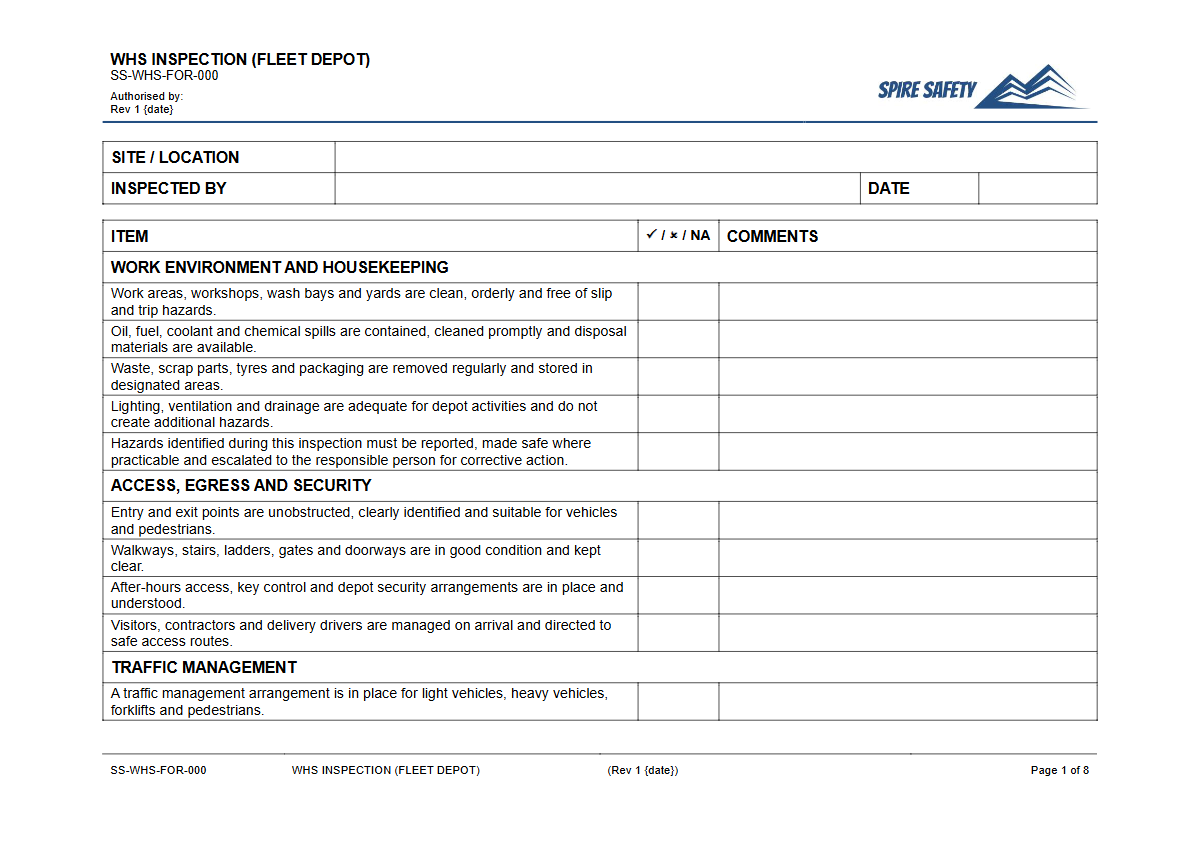
Our Free WHS Inspection (Fleet Depot) Template provides a structured starting point for your inspection process. This document is designed to help you methodically assess key areas of your depot, prompting a thorough review of traffic management, emergency procedures, housekeeping, and the condition of facilities.
Using a formal template helps standardise your safety checks, ensuring consistency regardless of who performs the inspection. It creates a documented record of your safety efforts, which is a crucial component of any effective safety management system.
The goal is to move beyond simple compliance and foster a proactive safety culture where risks are identified and controlled before they can cause harm. Integrating this process with regular reviews and follow-ups can significantly reduce incident rates and improve overall operational safety.
Video walkthrough
How to use the Free WHS Inspection (Fleet Depot) Template
This resource is available in both DOCX and PDF formats for your convenience. The DOCX version is fully editable, allowing you to tailor the checklist to the unique layout, equipment, and procedures of your specific fleet depot.
It's crucial to customise the document to ensure it's relevant and effective for your site.
Important Note: This template provides a structured starting point aligned with Australian WHS principles. However, it is not a substitute for a site-specific risk assessment.
We strongly recommend you adapt it to reflect the specific hazards and control measures relevant to your workplace. If you require assistance with this customisation or need to develop a more comprehensive safety system, our WHS consulting team can provide expert guidance.
When to use this Inspection Template
Regular, scheduled inspections are essential for maintaining a safe fleet depot. The frequency of these inspections will depend on the size and complexity of your operation, the level of risk, and any specific state or territory requirements.
As a general guide, a comprehensive depot inspection should be conducted on a routine basis, such as monthly or quarterly. In addition to your regular schedule, this inspection should also be performed after an incident occurs, when significant changes are made to the depot layout or operations, or when new vehicles or equipment are introduced.
This proactive approach helps ensure your safety controls remain effective. For a deeper analysis of your safety posture, consider engaging professional WHS compliance auditing services.
Who should use this Inspection Template
This template is designed for use by personnel with responsibility for workplace safety. This typically includes Depot Managers, Workshop Supervisors, WHS Officers, and Health and Safety Representatives (HSRs).
To be effective, the person conducting the inspection must be familiar with the depot's operations and have a solid understanding of WHS principles. They should be competent to identify hazards, assess risks, and recommend appropriate control measures.
Providing training to your inspectors on how to use the checklist and what to look for is a vital step in ensuring the quality and effectiveness of your inspection program.
The inspection process should not exist in isolation. Findings must be formally documented, with corrective actions assigned to responsible persons and tracked through to completion.
This creates a closed-loop system that drives continuous improvement. This principle applies to all areas, from the main yard to specific equipment like that found at the depot entrance, which might be covered by a pre-start checklist for a boom gate.
A well-managed inspection program is a cornerstone of a robust WHS management system. It provides management with valuable insights into the state of safety on the ground and demonstrates a clear commitment to providing a safe and healthy work environment for all employees and visitors.
Your depot's workshop is another critical area requiring specific attention. While this template covers the general workshop environment, individual pieces of machinery require their own checks. For example, lifting equipment should be subject to rigorous daily checks, which can be formalised using tools like a pre-start checklist for an electric hoist.
Common mistakes
Common mistakes to avoid
- Failing to customise the generic template for the specific site layout and risks.
- Not assigning responsibility or deadlines for corrective actions identified during the inspection.
- Treating the inspection as a 'tick-and-flick' exercise without genuine observation.
- Having untrained or inexperienced personnel conduct the inspection.
Legal references
Legal considerations
The following legal requirements may be relevant to this type of work.
- Work Health and Safety Act (Harmonised) — Provides the primary duties for protecting workers and other people from work health and safety risks.
- Work Health and Safety Regulations (Harmonised) — Sets out requirements supporting the management of workplace hazards and risks.
The following codes may be relevant to this type of work.
- Managing WHS Risks Code of Practice — Provides practical guidance on identifying hazards, assessing risks and applying effective controls.
- Work Health and Safety Consultation, Cooperation and Coordination Code of Practice — Provides practical guidance on consulting workers and coordinating with other duty holders.
- Managing the Work Environment and Facilities Code of Practice — Provides practical guidance on safe work environments, workplace facilities and related controls.
Did you know
Transport Industry Risks
The transport, postal, and warehousing industry has one of the highest rates of serious workers' compensation claims in Australia. Vehicle incidents are the leading cause of fatalities in this sector.
FAQ
Frequently asked questions
01What are the biggest WHS risks in a fleet depot?
02How often should I inspect my fleet depot?
03Is this template enough for my WHS obligations?
04What's the difference between a pre-start check and a depot inspection?
Share this resource
Free WHS Inspection (Fleet Depot) Template
Browse Categories
How To Use It
- 1Download and open in Word or PDF.
- 2Replace the placeholders with your business details.
- 3Get it reviewed by a WHS specialist before rollout.
Need it customised?
Our WHS consultants can adapt this template to your site, run a gap analysis, or audit what you already have in place.
Book a Free Consultation WHS consulting servicesor call 1300 156 382