
Free WHS Inspection (Factory) Template
Download our Free WHS Inspection (Factory) Template to streamline your workplace safety checks.
Free WHS Inspection (Factory) Template
DOCX • 128 KB + PDF
Updated Oct 2026
No signup required
Purpose of the Free WHS Inspection (Factory) Template
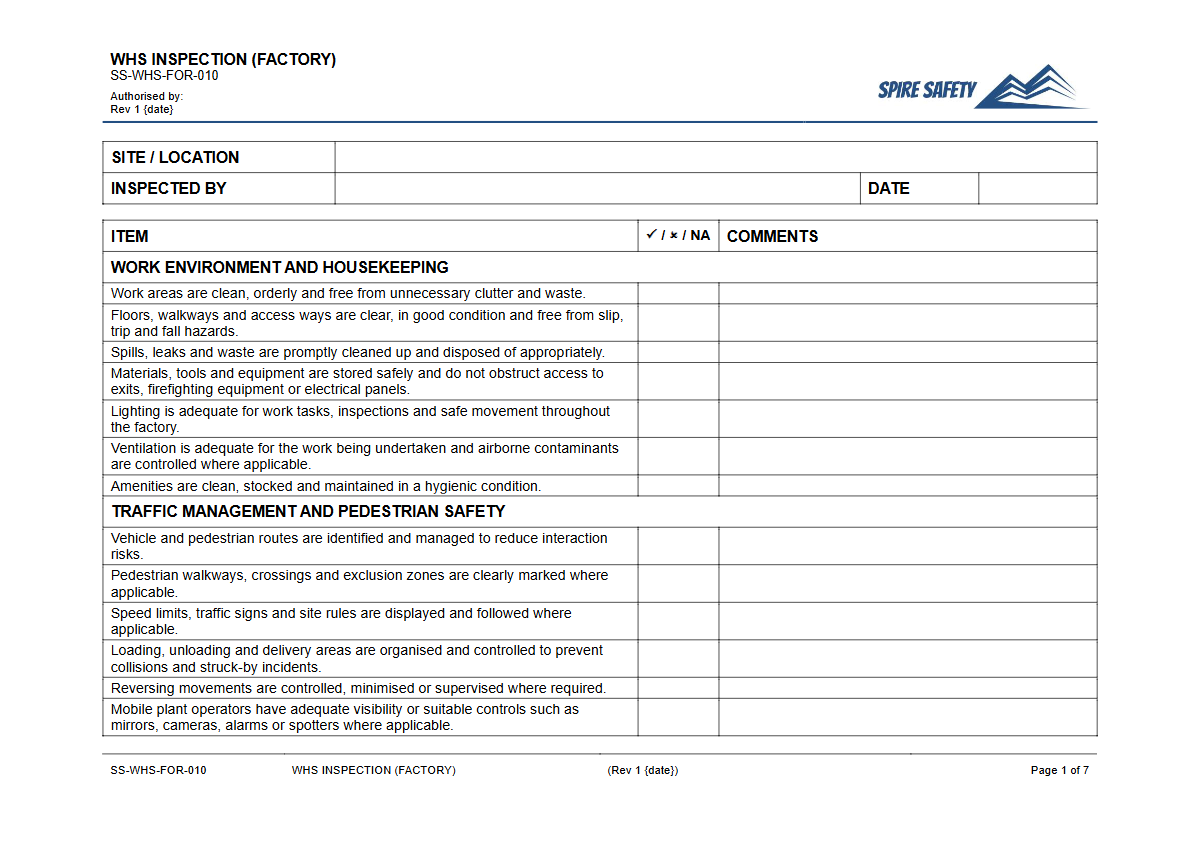
Regularly inspecting your factory environment is a cornerstone of effective workplace health and safety management. This free WHS Inspection (Factory) Template provides a structured starting point for systematically identifying hazards, assessing risks, and verifying control measures.
Using a formal checklist helps ensure consistency and thoroughness in your safety walk-throughs, creating a documented record of your organisation's due diligence. This template is designed to align with Australian WHS principles, helping you proactively manage risks associated with machinery, traffic, storage, and general work conditions.
The goal of a factory inspection is to find and fix potential issues before they cause an incident or injury. It forms a critical part of a broader safety framework, demonstrating a commitment to providing a safe workplace for all employees, contractors, and visitors.
Properly implemented, this process supports the development of robust WHS management systems and fosters a positive safety culture.
Video walkthrough
How to use the Free WHS Inspection (Factory) Template
This template is a comprehensive starting point, but it must be adapted to your specific operational context. Download the DOCX file and tailor it to reflect the unique machinery, chemical substances, work processes, and layout of your factory.
Add, remove, or modify checklist items to ensure they are relevant to your site-specific risks.
Customisation is essential
We cannot stress this enough: every factory is different. A generic checklist will miss specific hazards unique to your workplace.
You must review and customise this document to align with your machinery, environment, and operational procedures. Involve your team, including supervisors and Health and Safety Representatives (HSRs), in the customisation process to ensure it is practical and comprehensive.
For facilities with specific heavy equipment, you might supplement this general inspection with more detailed checklists. For example, if your factory uses lifting equipment, consider using a dedicated Free Pre-Start Checklist (Electric Hoist) Template for daily checks on those assets.
When to use it
The frequency of factory inspections depends on the level of risk. High-risk environments or areas with heavy machinery may require weekly or even daily checks for certain items, while a full factory inspection might be scheduled monthly or quarterly. Inspections should also be conducted:
- After an incident, injury, or near miss.
- When new machinery or equipment is introduced.
- When work processes or the factory layout changes.
- When concerns are raised by workers or HSRs.
- As part of a scheduled review of your safety management system.
Integrating these inspections into your regular operational rhythm ensures safety remains a consistent priority. For operations with controlled entry points, a Free Pre-Start Checklist (Boom Gate) Template can also be used to ensure site access controls are functioning correctly.
Who should use it
Factory inspections should be a collaborative effort. While a WHS Manager, Officer, or consultant may lead the process, valuable input comes from those on the floor. Key personnel include:
- Supervisors and Line Managers: They have direct oversight of daily operations and are well-placed to identify emerging hazards.
- WHS Managers/Coordinators: Responsible for the overall safety system and ensuring inspections are completed and documented correctly.
- Health and Safety Representatives (HSRs): As elected representatives of the workforce, their involvement is crucial for a transparent and effective safety process.
- Workers: Involving workers who perform the tasks provides invaluable insight into the practical risks and effectiveness of existing controls.
For organisations seeking external validation of their safety processes, engaging an expert for formal WHS compliance auditing can provide an independent and comprehensive assessment of your entire safety system. If you require further templates or checklists for different equipment or tasks, you can explore our complete free WHS resources library for more options.
Common mistakes
Common mistakes to avoid
- Using a generic template without customising it for site-specific risks.
- Failing to assign and track corrective actions for identified hazards.
- Not involving workers and HSRs in the inspection process.
- Focusing only on physical hazards while neglecting psychosocial risks like stress and fatigue.
Legal references
Legal considerations
The following legal requirements may be relevant to this type of work.
- Work Health and Safety Act (Harmonised) — Provides the primary duties for protecting workers and other people from work health and safety risks.
- Work Health and Safety Regulations (Harmonised) — Sets out requirements supporting the management of workplace hazards and risks.
The following codes may be relevant to this type of work.
- Managing WHS Risks Code of Practice — Provides practical guidance on identifying hazards, assessing risks and applying effective controls.
- Work Health and Safety Consultation, Cooperation and Coordination Code of Practice — Provides practical guidance on consulting workers and coordinating with other duty holders.
- Managing the Work Environment and Facilities Code of Practice — Provides practical guidance on safe work environments, workplace facilities and related controls.
Did you know
Manufacturing Sector Risks
According to Safe Work Australia, the manufacturing industry is one of the top industries for serious workers' compensation claims, with common injuries resulting from body stressing, falls, and being hit by moving objects.
FAQ
Frequently asked questions
01What is the difference between a WHS inspection and an audit?
02How often should I conduct a factory WHS inspection?
03Can this template be used for any type of factory?
04Who is legally responsible for workplace safety in a factory?
Share this resource
Free WHS Inspection (Factory) Template
Browse Categories
How To Use It
- 1Download and open in Word or PDF.
- 2Replace the placeholders with your business details.
- 3Get it reviewed by a WHS specialist before rollout.
Need it customised?
Our WHS consultants can adapt this template to your site, run a gap analysis, or audit what you already have in place.
Book a Free Consultation WHS consulting servicesor call 1300 156 382