
Free WHS Inspection (Farm Shed) Template
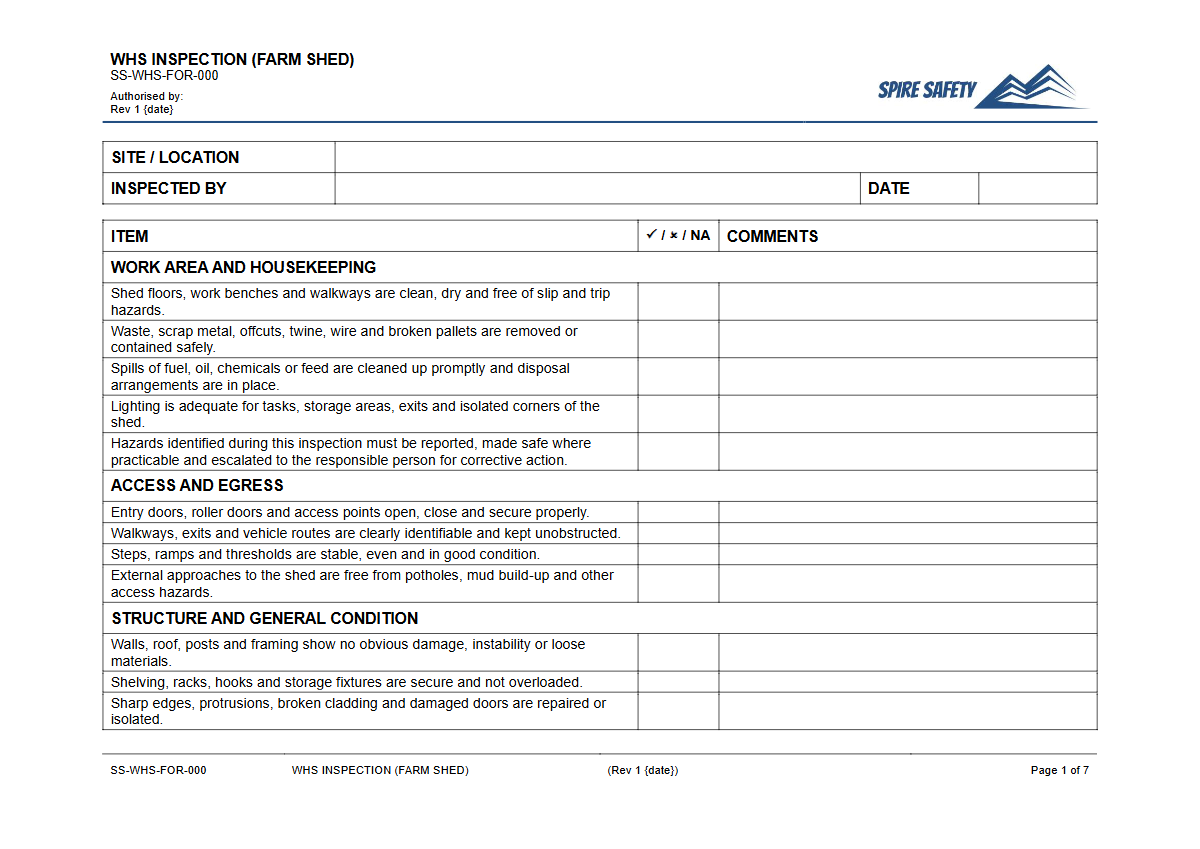
Download our Free WHS Inspection (Farm Shed) Template. This structured DOCX & PDF checklist helps you formalise safety checks for your farm sheds. Get yours.
Free WHS Inspection (Farm Shed) Template
DOCX • 128 KB + PDF
Updated Oct 2026
No signup required
Purpose of the Free WHS Inspection (Farm Shed) Template
Farm sheds are central to rural operations, but they can house significant workplace hazards if not managed correctly. This Free WHS Inspection (Farm Shed) Template provides a structured starting point for systematically identifying and controlling risks.
Regular inspections help a Person Conducting a Business or Undertaking (PCBU) meet their primary duty of care by ensuring a safe working environment. Using a formal checklist helps maintain a consistent approach to checking for common hazards such as unsafe chemical storage, faulty electrical wiring, structural issues, fire risks, and trip hazards.
By documenting inspections, you create a record of your safety management activities, which is a key part of effective WHS governance. The goal is to move beyond reactive fixes and proactively manage the safety of your structures and the plant within them. For specific machinery stored in the shed, you can supplement this general inspection with equipment-specific checks, such as our Free Pre-Start Checklist (Feed Mixer) Template.
Video walkthrough
How to use the Free WHS Inspection (Farm Shed) Template
This document is a foundational tool designed for customisation. After downloading the DOCX or PDF, you should adapt it to reflect the specific layout, contents, and activities relevant to your farm sheds.
A shed used purely for hay storage will have different risks to one used as a workshop or for housing livestock.
Key steps for implementation:
- Customise: Add, remove, or modify checklist items to match your specific farm environment. Consider the types of machinery, chemicals stored, and tasks performed in and around the shed.
- Consult: Involve your workers in the customisation process. They have hands-on experience with the shed and can provide valuable insights into potential hazards you may have overlooked.
- Inspect: Use the customised checklist to conduct a thorough walkthrough of the shed. Document any hazards, non-conformances, or areas for improvement identified.
- Act: Assign corrective actions for each identified issue, with clear responsibilities and deadlines. The inspection is only effective if it leads to action.
- Review: Store the completed inspection records and review them periodically to identify recurring issues or trends. This data provides valuable input for your overall WHS management systems.
Note: We have developed this template as a guide based on Australian WHS principles. It must be customised to your specific workplace, equipment, and operational risks.
Compliance is your responsibility.
When to conduct a Farm Shed Inspection
The frequency of inspections should be determined by your own risk assessment. As a general guide, a thorough inspection should be conducted at least quarterly. However, you should also conduct an inspection:
- After a significant weather event like a storm or flood that could affect structural integrity.
- When there is a change in the shed’s use (e.g., converting it from storage to a workshop).
- After an incident or near miss occurs in or around the shed.
- When new plant or hazardous substances are introduced.
Regular visual checks should also be encouraged as part of daily work routines. This proactive approach helps identify issues before they escalate. A similar principle applies to machinery, where daily checks are essential, as outlined in resources like our Free Pre-Start Checklist (Lawn Tractor) Template.
Who should use this Inspection Template
This template is designed for anyone with responsibility for health and safety on a farm or rural property. This typically includes:
- Farm Owners and Operators (as the PCBU)
- Farm Managers and Supervisors
- WHS Representatives or Committee Members
- Workers assigned to conduct safety checks
The inspection is most effective when conducted by someone with a good understanding of the work being done in the shed. For organisations looking to verify their processes against legislative requirements, a formal WHS compliance auditing service can provide independent assurance.
If you require expert guidance on implementing safety processes, our team offers practical WHS consulting tailored to agricultural businesses. This template is just one example from our extensive free WHS resources library designed to support Australian businesses.
Common mistakes
Common mistakes to avoid
- Failing to customise the template to suit the specific hazards of their own shed.
- Treating the inspection as a paperwork exercise without implementing corrective actions.
- Not involving workers who regularly use the shed in the inspection process.
- Poor record-keeping, making it difficult to track hazards and demonstrate due diligence.
Legal references
Legal considerations
The following legal requirements may be relevant to this type of work.
- Work Health and Safety Act (Harmonised) — Provides the primary duties for protecting workers and other people from work health and safety risks.
- Work Health and Safety Regulations (Harmonised) — Sets out requirements supporting the management of workplace hazards and risks.
The following codes may be relevant to this type of work.
- Managing WHS Risks Code of Practice — Provides practical guidance on identifying hazards, assessing risks and applying effective controls.
- Work Health and Safety Consultation, Cooperation and Coordination Code of Practice — Provides practical guidance on consulting workers and coordinating with other duty holders.
- Managing the Work Environment and Facilities Code of Practice — Provides practical guidance on safe work environments, workplace facilities and related controls.
Did you know
Rural Risks
Agriculture is one of Australia's most hazardous industries. According to Safe Work Australia, incidents involving vehicles, machinery, and falls are among the leading causes of fatalities and serious injuries on farms.
FAQ
Frequently asked questions
01What are the most common hazards in a farm shed?
02How often should I inspect my farm shed?
03Is using this template enough to be WHS-aligned?
04Who is legally responsible for farm shed safety?
Share this resource
Free WHS Inspection (Farm Shed) Template
Browse Categories
How To Use It
- 1Download and open in Word or PDF.
- 2Replace the placeholders with your business details.
- 3Get it reviewed by a WHS specialist before rollout.
Need it customised?
Our WHS consultants can adapt this template to your site, run a gap analysis, or audit what you already have in place.
Book a Free Consultation WHS consulting servicesor call 1300 156 382