
Free WHS Inspection (Farm) Template
Download our Free WHS Inspection (Farm) Template (DOCX & PDF). A structured starting point for identifying and managing agricultural WHS risks. Get yours now.
Free WHS Inspection (Farm) Template
DOCX • 128 KB + PDF
Updated Oct 2026
No signup required
Purpose of the Free WHS Inspection (Farm) Template
Conducting regular safety checks is a cornerstone of effective risk management on any agricultural property. Our Free WHS Inspection (Farm) Template provides a structured starting point for identifying and controlling hazards across your farm.
This practical template, aligned with Australian WHS principles, helps you formalise your inspection process, from sheds and workshops to paddocks and chemical stores. It is designed for farm owners and managers committed to creating a safer working environment for everyone.
A systematic inspection helps you proactively address risks before they cause an incident. This includes hazards related to machinery operation, chemical handling, animal management, electrical safety, and the general state of the working environment.
Using a template ensures consistency and provides a documented record of your safety efforts, which is a key part of demonstrating due diligence. For daily checks on specific equipment, you might also use a dedicated checklist, such as our Free Pre-Start Checklist (Feed Mixer) Template.
Video walkthrough
How to use the Free WHS Inspection (Farm) Template
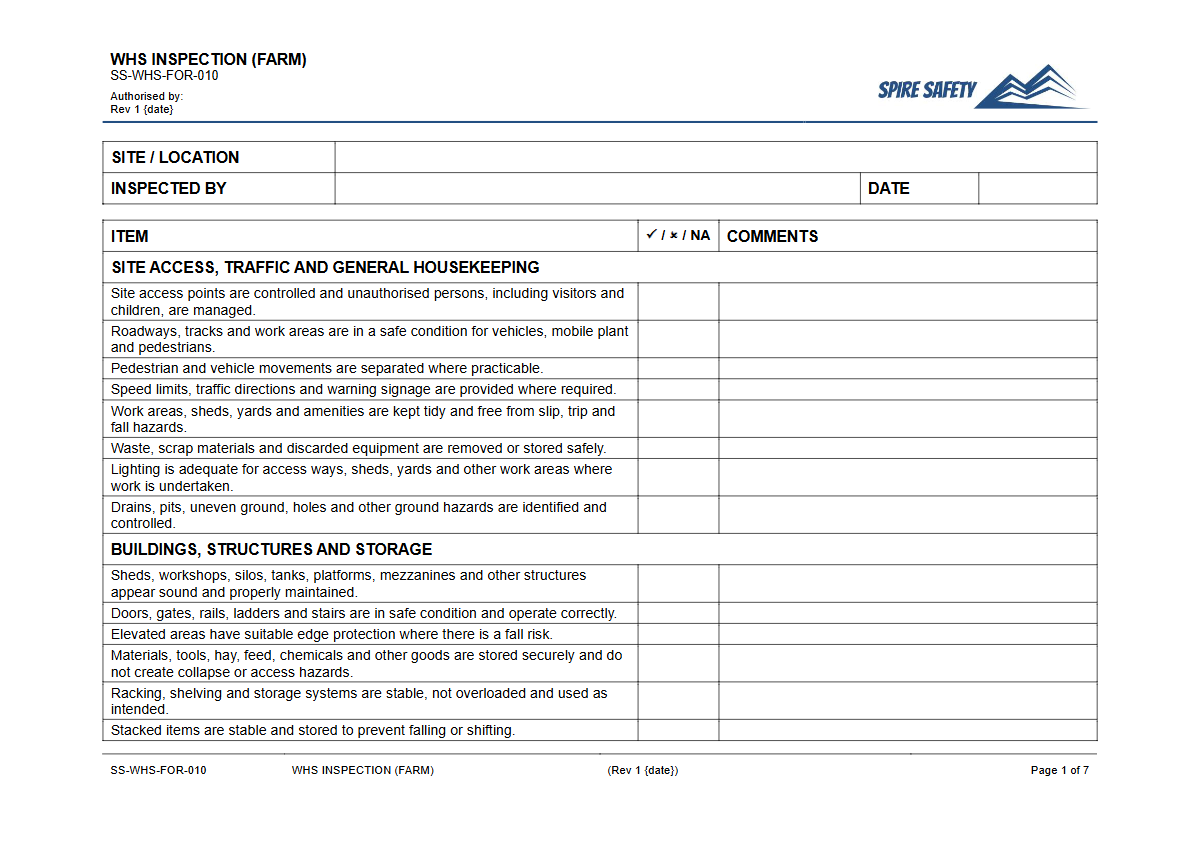
This template is available as a fully editable DOCX file and a printable PDF. The document is structured into logical sections covering common areas of a farm, with prompts for what to look for.
You can add, remove, or modify sections to suit your specific operations, whether you run a livestock, cropping, or mixed farming enterprise.
To get started:
- Download the DOCX template.
- Walk through your property and identify all key areas, equipment, and processes.
- Customise the checklist sections and items to match your farm's unique layout and risks. For example, if you have extensive turf care requirements, you might incorporate elements from a Free Pre-Start Checklist (Lawn Tractor) Template into your procedures.
- Conduct the inspection, noting any hazards or non-conformances.
- Document your findings and develop a corrective action plan with clear responsibilities and deadlines for any issues identified.
Important: This document is a template and serves as a starting point. We have created it as a guide; you must customise it to your specific workplace. A generic checklist cannot cover all the unique hazards present on your farm.
Integrating this process into your overall safety framework is essential for its effectiveness. For guidance on building a comprehensive framework, consider exploring professional services for WHS management systems.
When to use it
The frequency of farm-wide inspections depends on the size and complexity of your operation, the nature of the risks, and any changes in your work practices. As a general guide, a comprehensive workplace inspection should be conducted at least quarterly or biannually.
More frequent inspections may be required for high-risk areas or activities.
Consider conducting an inspection:
- Seasonally, as tasks and associated hazards change (e.g., pre-harvest or pre-sowing).
- After an incident, accident, or near-miss to identify contributing factors.
- When new equipment, chemicals, or work processes are introduced.
- After significant weather events that may have affected structures or terrain.
Regular inspections also provide an opportunity to review the effectiveness of existing controls. Specialised equipment used in grounds maintenance, such as those covered by our Free Pre-Start Checklist (Aerator) Template, should be subject to pre-start checks before every use.
Who should use it
This template is designed for anyone with health and safety responsibilities in an agricultural setting. This includes:
- Farm owners and operators
- Farm managers and supervisors
- Work Health and Safety (WHS) representatives
- Workers assigned to conduct safety checks
Effective inspections involve consulting with the people who do the work. Workers often have the most direct knowledge of the hazards in their daily tasks.
Involving them in the inspection process not only helps in identifying risks more effectively but also fosters a positive safety culture. For businesses looking to verify their safety processes against legislative requirements, a formal WHS compliance auditing service can provide external assurance.
You can also explore our full free WHS resources library for other useful templates and checklists.
Common mistakes
Common mistakes to avoid
- Using the template 'as is' without customising it for the specific machinery, layout, and risks of your farm.
- Failing to create and follow up on a corrective action plan for hazards identified during the inspection.
- Not involving workers who perform the day-to-day tasks in the inspection process.
- Treating the inspection as a paperwork exercise rather than a genuine opportunity to improve safety.
Legal references
Legal considerations
The following legal requirements may be relevant to this type of work.
- Work Health and Safety Act (Harmonised) — Provides the primary duties for protecting workers and other people from work health and safety risks.
- Work Health and Safety Regulations (Harmonised) — Sets out requirements supporting the management of workplace hazards and risks.
The following codes may be relevant to this type of work.
- Managing WHS Risks Code of Practice — Provides practical guidance on identifying hazards, assessing risks and applying effective controls.
- Work Health and Safety Consultation, Cooperation and Coordination Code of Practice — Provides practical guidance on consulting workers and coordinating with other duty holders.
- Managing the Work Environment and Facilities Code of Practice — Provides practical guidance on safe work environments, workplace facilities and related controls.
Did you know
High-Risk Industry
The agriculture, forestry, and fishing industry consistently has one of the highest rates of worker fatalities and serious injuries in Australia, making proactive risk management critically important.
FAQ
Frequently asked questions
01What should a farm safety inspection cover?
02How often do I need to conduct a WHS inspection on my farm?
03Is this farm inspection template compliant with WHS laws in my state?
04Who is responsible for conducting farm safety inspections?
Share this resource
Free WHS Inspection (Farm) Template
Browse Categories
How To Use It
- 1Download and open in Word or PDF.
- 2Replace the placeholders with your business details.
- 3Get it reviewed by a WHS specialist before rollout.
Need it customised?
Our WHS consultants can adapt this template to your site, run a gap analysis, or audit what you already have in place.
Book a Free Consultation WHS consulting servicesor call 1300 156 382