
Free Inspection & Test Plan (Roofing) Template
Download our free Inspection & Test Plan (Roofing) Template. This DOCX & PDF resource provides a structured framework for quality and safety checks.
Free Inspection & Test Plan (Roofing) Template
DOCX • 140 KB + PDF
Updated Oct 2026
No signup required
Purpose of the Free Inspection & Test Plan (Roofing) Template
An Inspection and Test Plan (ITP) is a critical quality assurance and safety document that outlines the planned checks for a specific process. For high-risk activities like roofing, a robust ITP is essential to supports your compliance efforts with project specifications and safety standards.
Our Free Inspection & Test Plan (Roofing) Template provides a structured framework to ensure every stage of your project, from substrate preparation to final sign-off, meets the required standards. It helps formalise your verification activities, ensuring nothing is overlooked and creating a clear audit trail for project accountability.
This template serves as a definitive guide for supervisors and workers, detailing the sequence of inspections, tests, and verifications required. By systematically documenting each checkpoint—including material compliance, installation methods, and safety controls—you can proactively manage quality and mitigate risks associated with defective work.
Using a formal ITP demonstrates a commitment to quality control and methodical project execution.
What is covered in the Inspection & Test Plan?
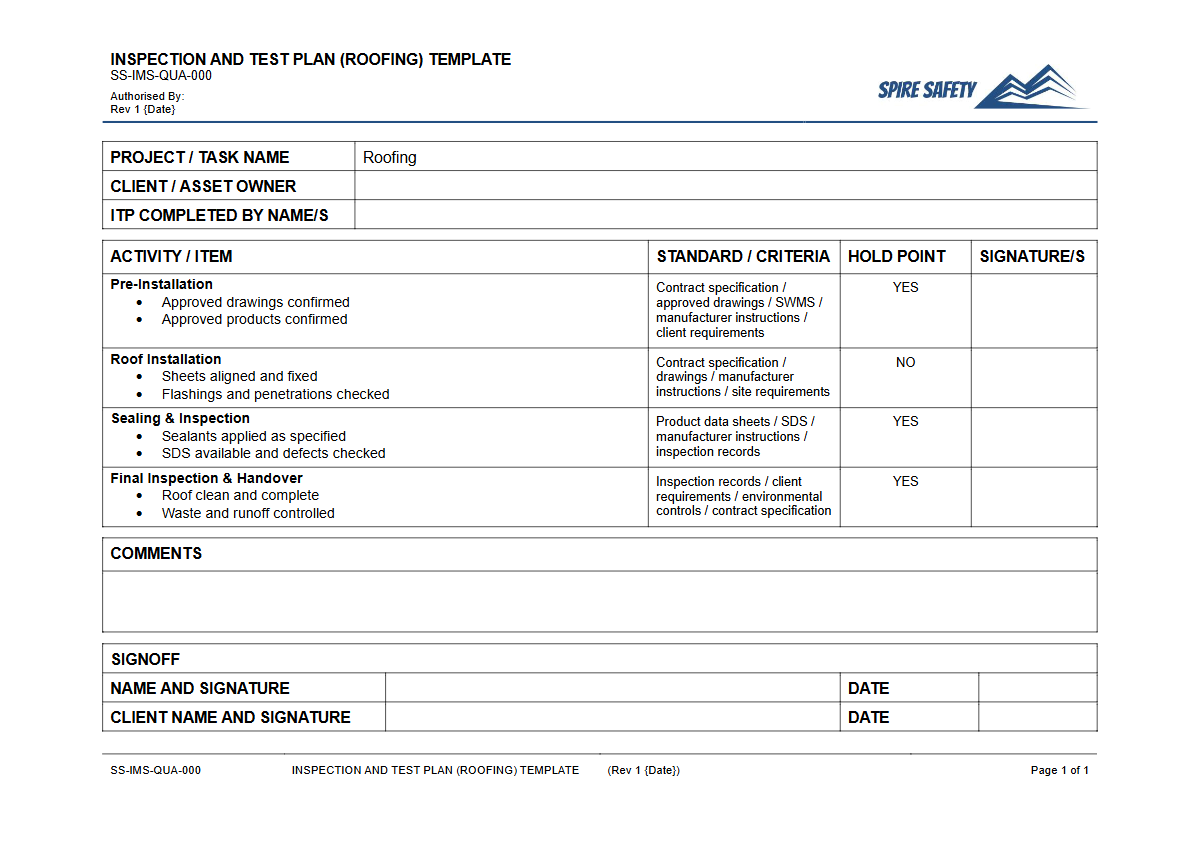
The ITP template is structured to cover the key phases of a typical roofing project. It includes columns for:
- The specific activity or task (e.g., 'Set-out of roof', 'Installation of flashings').
- The type of check required (e.g., witness, hold point, surveillance).
- The acceptance criteria based on project specifications or Australian Standards.
- The records to be generated (e.g., checklist, photo, signed form).
- The person responsible for the verification.
Video walkthrough
How to use the Free Inspection & Test Plan (Roofing) Template
To get the most out of this Free Inspection & Test Plan (Roofing) Template, start by downloading the DOCX file and adapting it to your project's unique requirements. The template is pre-filled with common roofing activities, but you should add, remove, or modify these to match your specific scope of work, materials, and methodologies.
A well-defined ITP is a core component of effective WHS management systems, demonstrating proactive risk control.
Important Note: This document is a template only. We strongly advise that you customise it to reflect the specific hazards, risks, materials, methodologies, and legal requirements of your workplace and project.
It should be reviewed and approved by a competent person before use.
When to use it
An ITP should be developed during the project planning phase, well before any physical work begins on site. It serves as a roadmap for quality and safety checks throughout the project's lifecycle.
It is used during material delivery to verify specifications, at key construction stages (e.g., substrate checks, membrane installation), and for final inspection before handover. To ensure it remains effective, the ITP should be referenced daily by supervisors and workers to guide their activities. For ongoing communication about hazards identified, consider using our Roofing Safety Toolbox Talk Template.
Who should use it
This template is designed for personnel responsible for overseeing quality and safety on construction sites. This includes Project Managers, Construction Managers, Site Supervisors, Forepersons, and dedicated Quality Assurance (QA) and WHS Officers.
It provides a clear and consistent method for all parties to understand the inspection requirements, responsibilities, and acceptance criteria for roofing works. The records generated from the ITP are crucial evidence during any formal WHS compliance auditing process, proving that due diligence was followed.
Implementing this ITP helps bridge the gap between design specifications and on-site execution, ensuring the final product is delivered as intended. If you need assistance integrating this plan into your existing systems or require expert advice on complex roofing projects, consider engaging our WHS consulting team for tailored support. For more document templates to support your safety framework, you can browse our complete free WHS resources library.
Common mistakes
Common mistakes to avoid
- Failing to customise the template to match specific project materials and site conditions.
- Treating the ITP as a 'tick-and-flick' exercise without conducting genuine inspections.
- Not providing clear instructions or training to supervisors and workers on how to use the ITP.
- Inadequate record-keeping, leaving no verifiable evidence that checks were completed correctly.
Legal references
Legal considerations
The following legal requirements may be relevant to this type of work.
- Work Health and Safety Act (Harmonised) — Provides the primary duties for protecting workers and other people from work health and safety risks.
- Work Health and Safety Regulations (Harmonised) — Sets out requirements supporting the management of workplace hazards and risks.
The following codes may be relevant to this type of work.
- Managing WHS Risks Code of Practice — Provides practical guidance on identifying hazards, assessing risks and applying effective controls.
- Work Health and Safety Consultation, Cooperation and Coordination Code of Practice — Provides practical guidance on consulting workers and coordinating with other duty holders.
- Managing the Work Environment and Facilities Code of Practice — Provides practical guidance on safe work environments, workplace facilities and related controls.
Did you know
A Leading Cause of Fatalities
According to Safe Work Australia, falls from height are a leading cause of fatalities and serious injuries in the construction industry, with roofing work being a particularly high-risk activity.
Quality Management Alignment
Inspection & Test Plans are a fundamental component of quality management systems that align with the principles of ISO 9001, providing a structured approach to verification and validation.
FAQ
Frequently asked questions
01What's the difference between an ITP and a SWMS?
02Does this template cover all types of roofing?
03What is a 'hold point' in an Inspection and Test Plan?
04How often should an ITP be reviewed?
Share this resource
Free Inspection & Test Plan (Roofing) Template
Browse Categories
How To Use It
- 1Download and open in Word or PDF.
- 2Replace the placeholders with your business details.
- 3Get it reviewed by a WHS specialist before rollout.
Need it customised?
Our WHS consultants can adapt this template to your site, run a gap analysis, or audit what you already have in place.
Book a Free Consultation WHS consulting servicesor call 1300 156 382
Related templates
- Free Inspection & Test Plan (Sanitary Fixtures Installation) Template
- Free Inspection & Test Plan (Sewer Drainage Installation) Template
- Free Inspection & Test Plan (Site Establishment and Setout) Template
- Free Inspection & Test Plan (Skirting, Architrave and Trim) Template
- Free Inspection & Test Plan (Skylights and Roof Penetrations) Template
- Free Inspection & Test Plan (Smoke Alarm Installation) Template