
Free Inspection & Test Plan (Site Establishment and Setout) Template
Download our free Inspection & Test Plan (ITP) for Site Establishment and Setout.
Free Inspection & Test Plan (Site Establishment and Setout) Template
DOCX • 138 KB + PDF
Updated Oct 2026
No signup required
Purpose of the Free Inspection & Test Plan (Site Establishment and Setout) Template
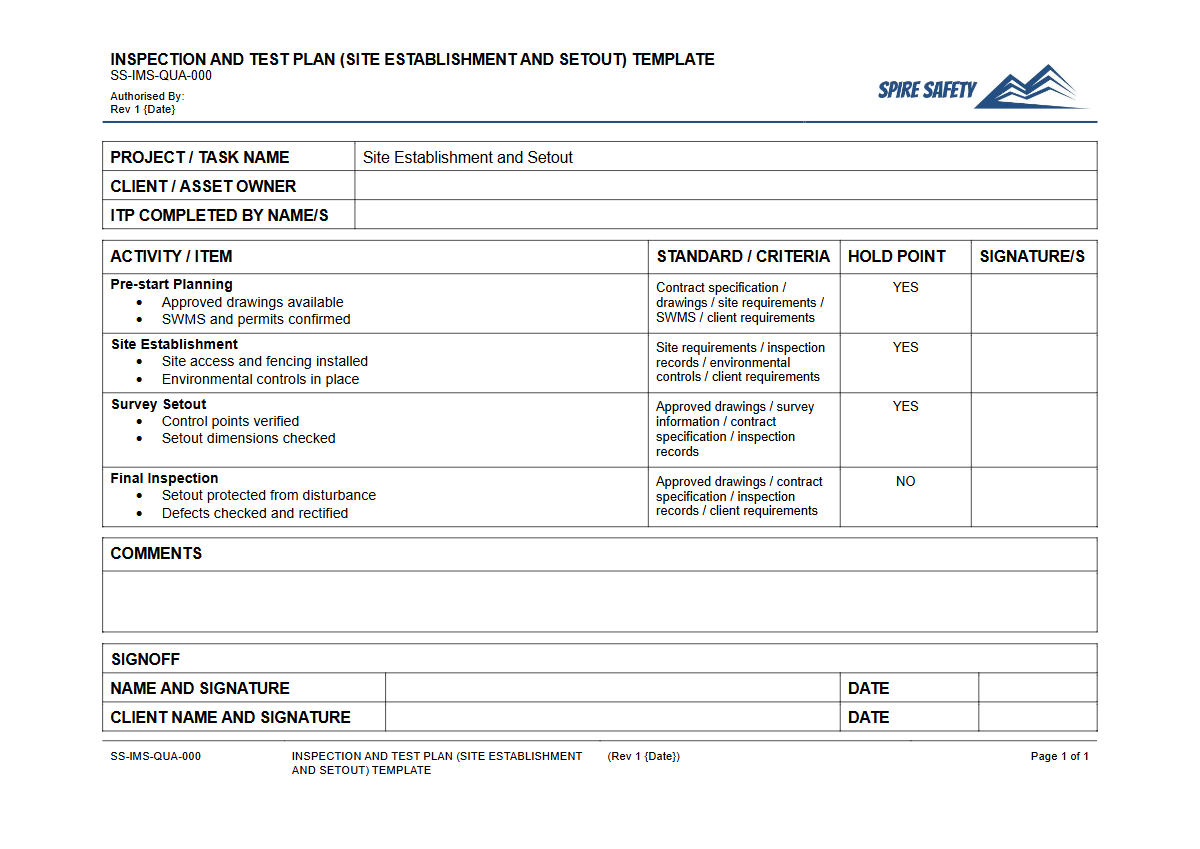
The initial phase of any construction project sets the foundation for safety and efficiency. This Free Inspection & Test Plan (Site Establishment and Setout) Template provides a structured framework to verify that critical preparatory activities are completed correctly and safely.
It helps project teams systematically manage and document the verification of controls for tasks such as site clearing, installation of temporary services and fencing, establishment of access and egress points, erosion and sediment control, and the accurate setout of survey marks.
Using a formal ITP ensures that these foundational activities are not overlooked and are executed in accordance with project specifications, environmental regulations, and work health and safety standards. It creates a clear record of quality and safety verification, which is essential for project handovers and regulatory audits.
Properly establishing a site is a core component of managing the key WHS requirements for construction site safety from day one.
Video walkthrough
How to use the Free Inspection & Test Plan (Site Establishment and Setout) Template
This template is provided as a customisable DOCX file for ease of use. To implement it effectively, your project team should review each line item and adapt it to the specific scope and conditions of your site.
This involves adding, removing, or modifying checkpoints to reflect your unique risks, environmental factors, and project requirements. Key steps include defining acceptance criteria for each inspection point, assigning responsibilities for inspection and sign-off, and identifying any 'hold points' that require formal approval before subsequent work can proceed.
Please note: This template provides a starting point. We have developed it to be customised to your specific site, plant, equipment, and operational procedures.
Integrating this ITP into your broader project framework is crucial for its success. For organisations looking to build a more robust safety framework, this plan can serve as a practical component within comprehensive WHS management systems.
What is an Inspection & Test Plan?
An Inspection and Test Plan (ITP) is a formal quality assurance document that outlines the planned sequence of inspections, tests, and verifications for a particular process or scope of work. It specifies what will be checked, who is responsible for checking it, what acceptance criteria will be used, and what records will be kept.
An ITP is a proactive tool used to ensure work is completed to the required standards from the outset, rather than relying on reactive defect rectification.
When to use an ITP for Site Establishment
This Inspection & Test Plan should be implemented at the very beginning of a project's physical works, typically after site possession is granted and before major construction commences. It is a live document used throughout the establishment phase.
It guides activities such as installing temporary site accommodation, connecting power and water, setting up laydown areas, and implementing initial environmental controls. For instance, checkpoints for silt fences and drainage control must be verified before any significant earthworks begin.
Effectively managing site runoff is a critical part of site establishment to prevent pollution of local waterways. A toolbox talk can help reinforce team responsibilities, and our Stormwater and Waterway Protection Toolbox Talk template is a great resource to support this effort.
Who should use it
This template is designed for personnel responsible for managing and overseeing the initial stages of a construction or infrastructure project. Key users include:
- Project Managers: For overall quality and safety assurance.
- Site Engineers: For technical verification and record-keeping.
- Site Supervisors and Forepersons: For directing works and conducting on-the-ground inspections.
- WHS Advisors: To ensure safety controls are integrated and verified.
- Surveyors: For confirming the accuracy of setout points.
It also serves as a valuable communication tool between contractors, clients, and superintendents, providing transparency on how quality and compliance are being managed. Regular verification of the ITP's implementation can be a key activity during a WHS compliance auditing program.
Planning for worker welfare during site establishment is just as important as the physical setup. Ensuring adequate facilities and resources are available from the start supports a positive safety culture. A simple but vital topic to cover is hydration, as outlined in our Hydration and Nutrition on Site Toolbox Talk.
This document is one of many tools available to help you build a safer workplace. You can explore a wide range of checklists, templates, and guides in our free WHS resources library to support your safety management efforts.
Common mistakes
Common mistakes to avoid
- Failing to adequately secure the site perimeter with appropriate fencing and signage.
- Neglecting to install effective erosion and sediment controls before earthworks commence, leading to environmental breaches.
- Poor planning of site traffic, leading to congestion and dangerous interactions between vehicles and pedestrians.
- Incorrectly setting out site grids or benchmarks, causing significant rework later in the project.
Legal references
Legal considerations
The following legal requirements may be relevant to this type of work.
- Work Health and Safety Act (Harmonised) — Provides the primary duties for protecting workers and other people from work health and safety risks.
- Work Health and Safety Regulations (Harmonised) — Sets out requirements supporting the management of workplace hazards and risks.
The following codes may be relevant to this type of work.
- Managing WHS Risks Code of Practice — Provides practical guidance on identifying hazards, assessing risks and applying effective controls.
- Work Health and Safety Consultation, Cooperation and Coordination Code of Practice — Provides practical guidance on consulting workers and coordinating with other duty holders.
- Managing the Work Environment and Facilities Code of Practice — Provides practical guidance on safe work environments, workplace facilities and related controls.
Did you know
The Cost of Poor Planning
Industry analysis shows that poor site planning and establishment can contribute to significant project delays and cost overruns, sometimes accounting for up to 10-15% of the total project budget through rework and inefficiencies.
Setout Accuracy is Critical
A single error in the initial site setout by a surveyor can have a cascading effect, leading to structural misalignments, costly rework, and significant project delays. This is why ITPs have specific hold points for survey verification.
FAQ
Frequently asked questions
01What is an ITP for site establishment and setout?
02Who is responsible for completing this Inspection & Test Plan?
03How does an ITP relate to a Safe Work Method Statement (SWMS)?
04Can this ITP template be used for any construction project?
Share this resource
Free Inspection & Test Plan (Site Establishment and Setout) Template
Browse Categories
How To Use It
- 1Download and open in Word or PDF.
- 2Replace the placeholders with your business details.
- 3Get it reviewed by a WHS specialist before rollout.
Need it customised?
Our WHS consultants can adapt this template to your site, run a gap analysis, or audit what you already have in place.
Book a Free Consultation WHS consulting servicesor call 1300 156 382
Related templates
- Free Inspection & Test Plan (Skirting, Architrave and Trim) Template
- Free Inspection & Test Plan (Skylights and Roof Penetrations) Template
- Free Inspection & Test Plan (Smoke Alarm Installation) Template
- Free Inspection & Test Plan (Solar Installation) Template
- Free Inspection & Test Plan (Staircase and Balustrade) Template
- Free Inspection & Test Plan (Steel Decking Composite Floor) Template