
Free Inspection & Test Plan (Solar Installation) Template
Download our free Inspection & Test Plan (Solar Installation) template. This customisable DOCX & PDF helps you formalise quality and safety checks.
Free Inspection & Test Plan (Solar Installation) Template
DOCX • 140 KB + PDF
Updated Oct 2026
No signup required
Purpose of the Free Inspection & Test Plan (Solar Installation) Template
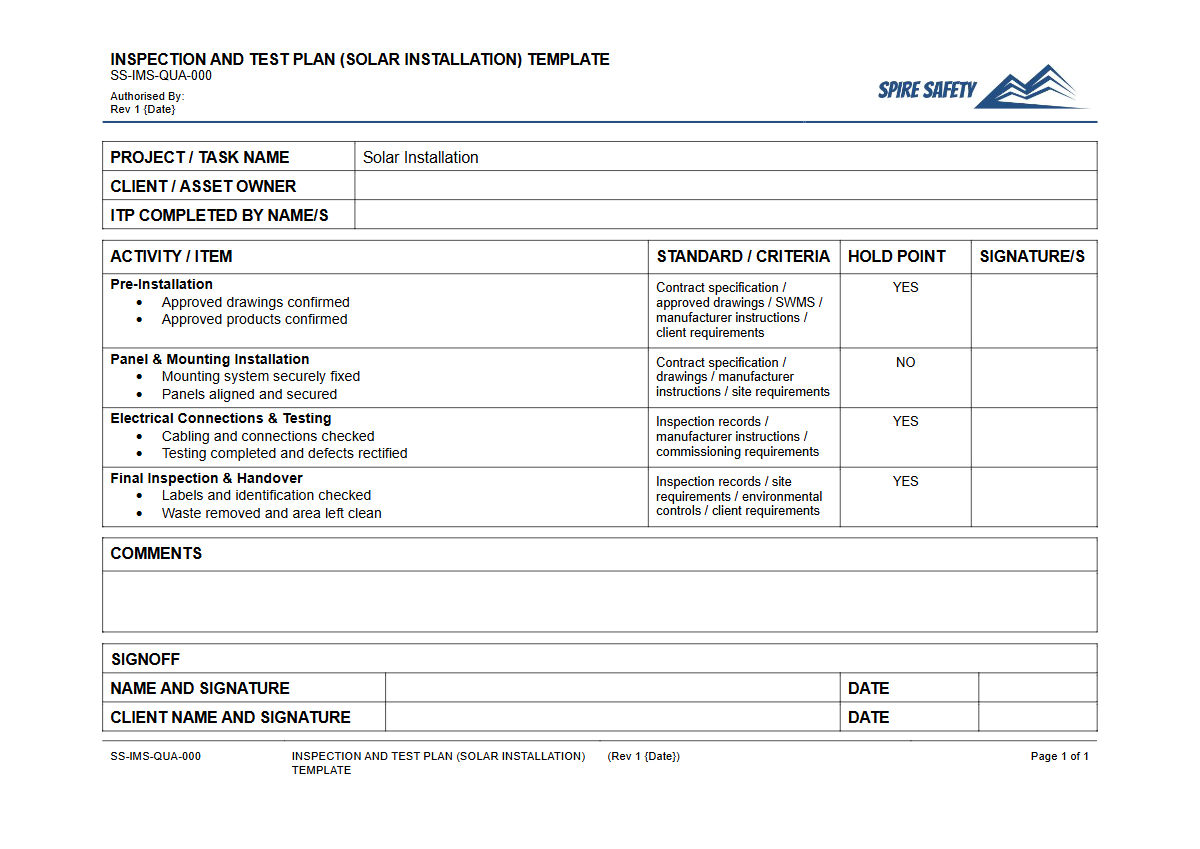
This Free Inspection & Test Plan (Solar Installation) Template provides a structured framework for documenting and verifying quality and safety checkpoints throughout a solar PV installation project. An Inspection and Test Plan (ITP) is a critical document that outlines the sequence of inspections, tests, and checks required to ensure the final installation meets all technical specifications, safety standards, and client requirements.
Using a formal ITP helps to systematically manage quality control, demonstrate due diligence, and provide clear evidence of compliance at project completion.
The template is designed to cover key stages of a solar project, from the initial site assessment and material verification through to panel installation, electrical work, and final system commissioning. It establishes clear hold points and witness points, defines acceptance criteria, and assigns responsibilities for verification.
This systematic approach helps prevent defects, reduces rework, and ensures the long-term performance and safety of the solar energy system. It also serves as a crucial handover document for the client and maintenance teams.
Video walkthrough
How to use the Free Inspection & Test Plan (Solar Installation) Template
This Inspection & Test Plan template is a comprehensive starting point designed for easy adoption. After downloading the DOCX or PDF file, the first step is to thoroughly review its contents and adapt them to the specific scope of your project.
This includes adding project-specific details, referencing relevant engineering drawings, and incorporating any unique client or site requirements. The plan should be a live document, used actively by the project team on-site.
A key part of using the template is customisation. Important: This document is a template only.
You must customise it to suit the specific hazards, risks, equipment, and operational procedures of your workplace and the specific solar installation project. We are not responsible for any incidents or compliance breaches that may arise from using this template as-is. Integrating this ITP into your broader safety framework is essential for managing high-risk activities, a principle also outlined in resources like our guide to Principal Mining Hazard Management Plans.
Key Sections to Customise:
- Project Details: Fill in the project name, location, client information, and relevant contract numbers.
- Referenced Documents: List all applicable standards (e.g., AS/NZS 5033, AS/NZS 4777), engineering drawings, and manufacturer's instructions.
- Inspection/Test Items: Review, add, or remove checkpoints to match your project's scope. This may include checks for structural integrity of the roof, correct mounting hardware, DC and AC electrical testing, and inverter configuration.
- Acceptance Criteria: Clearly define the measurable standard that must be met for each inspection point to be passed.
- Responsibilities: Assign specific roles (e.g., Site Supervisor, Licensed Electrician) responsible for performing and verifying each test.
When to use this Inspection & Test Plan
An ITP should be developed during the project planning phase and implemented from day one of on-site activity. It is used continuously throughout the project lifecycle to guide and record quality assurance activities.
Key stages for its use include pre-commencement, during the installation process, and at project completion. For example, pre-start checks on tooling and equipment can be formalised using documents like a WHS Inspection (Vehicle Workshop) Template, with the results noted in the ITP.
During installation, the ITP serves as a real-time checklist for supervisors and installers to ensure every critical step is verified before proceeding to the next. At the end of the project, the completed and signed-off ITP forms a vital part of the commissioning and handover documentation pack.
This provides an auditable record that all quality and safety requirements have been met, which is invaluable for warranty claims and future maintenance. A well-maintained ITP can be a key piece of evidence during a formal WHS compliance auditing process.
Who should use it
This template is designed for use by various personnel involved in the delivery of solar installation projects. It provides a common reference point for quality and safety expectations across the entire team.
Key users include Project Managers, who use it to oversee project quality, and Site Supervisors or Foremen, who manage the day-to-day on-site implementation and sign-offs.
Licensed Electricians and accredited Solar Installers will use the ITP to guide their work and complete specific electrical and mechanical checks. Quality Assurance (QA) and Health, Safety, and Environment (HSE) personnel also use the document to conduct audits and verify that project procedures align with the company's comprehensive WHS management systems. By ensuring all parties are working from the same plan, the ITP helps foster a consistent approach to quality and safety. You can find more examples of structured safety documents in our free WHS resources library.
For a structured approach to verifying that equipment is safe and ready for use before work begins, you can adapt sector-specific checklists, such as our WHS Inspection (Tyre Workshop) Template, to cover the tools and machinery used in your solar installation process.
Common mistakes
Common mistakes to avoid
- Failing to customise the template for the specific project site and scope.
- Skipping pre-installation checks for materials, equipment, and structural suitability.
- Poor record-keeping, resulting in an incomplete or unsigned ITP at project handover.
- Allowing personnel who are not competent or licensed for the task to perform and sign off on critical tests.
Legal references
Legal considerations
The following legal requirements may be relevant to this type of work.
- Work Health and Safety Act (Harmonised) — Provides the primary duties for protecting workers and other people from work health and safety risks.
- Work Health and Safety Regulations (Harmonised) — Sets out requirements supporting the management of workplace hazards and risks.
The following codes may be relevant to this type of work.
- Managing WHS Risks Code of Practice — Provides practical guidance on identifying hazards, assessing risks and applying effective controls.
- Work Health and Safety Consultation, Cooperation and Coordination Code of Practice — Provides practical guidance on consulting workers and coordinating with other duty holders.
- Managing the Work Environment and Facilities Code of Practice — Provides practical guidance on safe work environments, workplace facilities and related controls.
Did you know
The Guiding Standard
AS/NZS 5033 is the principal Australian Standard governing the installation and safety requirements for photovoltaic (PV) arrays. It covers everything from array design and component selection to wiring, earthing, and commissioning.
Height Safety is Key
Working at heights is one of the most significant risks in solar panel installation. A fall from even a single-storey roof can cause serious injury, making fall prevention measures a critical part of the safety planning process.
FAQ
Frequently asked questions
01What is the main purpose of an ITP for solar installation?
02Is this solar installation ITP template suitable for both residential and commercial projects?
03Who is responsible for signing off on the inspection and test points?
04How does an ITP relate to a Safe Work Method Statement (SWMS)?
Share this resource
Free Inspection & Test Plan (Solar Installation) Template
Browse Categories
How To Use It
- 1Download and open in Word or PDF.
- 2Replace the placeholders with your business details.
- 3Get it reviewed by a WHS specialist before rollout.
Need it customised?
Our WHS consultants can adapt this template to your site, run a gap analysis, or audit what you already have in place.
Book a Free Consultation WHS consulting servicesor call 1300 156 382
Related templates
- Free Inspection & Test Plan (Staircase and Balustrade) Template
- Free Inspection & Test Plan (Steel Decking Composite Floor) Template
- Free Inspection & Test Plan (Stormwater Drainage Installation) Template
- Free Inspection & Test Plan (Structural Steel Bolted Connections) Template
- Free Inspection & Test Plan (Structural Steel Erection) Template
- Free Inspection & Test Plan (Structural Steel Welding) Template