
Free Inspection & Test Plan (Stormwater Drainage Installation) Template
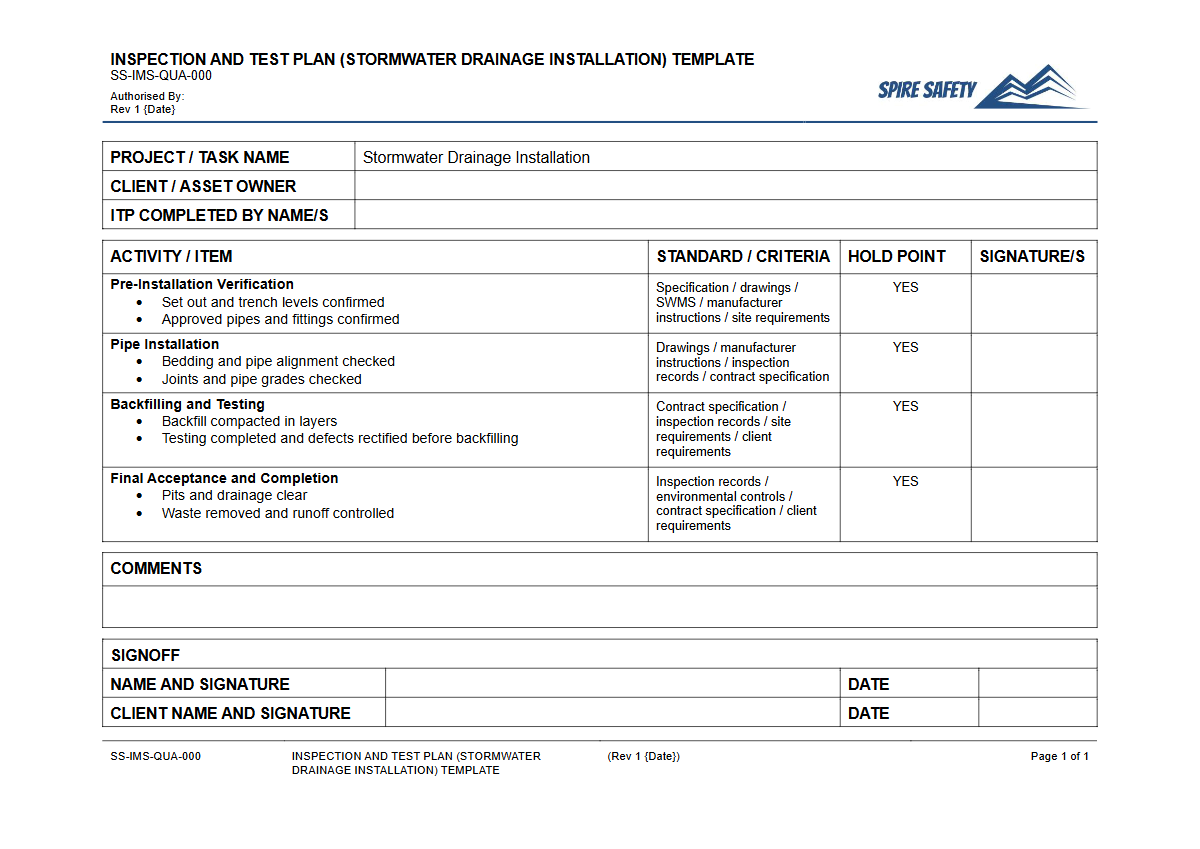
Download our free Inspection & Test Plan (Stormwater Drainage Installation) Template. This structured DOCX and PDF is aligned with Australian WHS practice.
Free Inspection & Test Plan (Stormwater Drainage Installation) Template
DOCX • 136 KB + PDF
Updated Oct 2026
No signup required
Purpose of the Free Inspection & Test Plan (Stormwater Drainage Installation) Template
This free Inspection & Test Plan (Stormwater Drainage Installation) Template provides a structured framework for verifying that stormwater systems are installed according to project specifications, design drawings, and relevant Australian Standards. It is a critical quality assurance document that outlines the sequence of inspections and tests required to supports your compliance efforts and functionality.
By methodically documenting each stage of the installation, from material delivery to final commissioning, this ITP helps prevent defects, control non-conformances, and create a comprehensive record for project handover.
Properly managing stormwater on a construction site is also a key environmental responsibility. This ITP includes checkpoints for erosion and sediment controls, helping teams minimise their environmental impact.
For more detailed guidance on this topic, a Stormwater and Waterway Protection Toolbox Talk can equip your team with practical knowledge for preventing site runoff and protecting local waterways.
Video walkthrough
How to use the Free Inspection & Test Plan (Stormwater Drainage Installation) Template
This Inspection & Test Plan template is formatted to capture all essential quality verification details for stormwater drainage works. It prompts you to detail each construction activity, the corresponding specification or standard, the type of inspection (e.g., Hold, Witness, Surveillance), the acceptance criteria for a pass, and the record to be generated.
The document is organised to follow a logical construction sequence, but it must be adapted to your specific project.
The template serves as a foundational component within broader quality and safety frameworks. Integrating documents like this into your operational procedures is a hallmark of effective WHS management systems, ensuring that processes are standardised, repeatable, and auditable.
The goal is to create a clear and undeniable record of compliance and quality at every step.
Important: Customise for Your Project
This document is a template and must be customised for your specific works. We have provided a structured starting point, but you must review and amend it to align with your project’s unique design drawings, engineering specifications, site conditions, client requirements, and local council regulations.
It is not a substitute for a detailed project quality plan.
When to use an Inspection & Test Plan
An ITP for stormwater drainage should be developed before any physical work begins and implemented throughout the project lifecycle. It is a live document used at several key stages:
- Pre-Construction: For verifying material compliance upon delivery (e.g., pipe class, pit specifications), checking survey set-outs, and confirming initial erosion control measures are in place.
- During Installation: To inspect excavation depths and grades, trench stability, pipe bedding material and compaction, pipe laying and jointing, backfilling procedures, and pit/structure installation.
- Post-Installation: For conducting post-installation testing (e.g., CCTV inspection, hydrostatic testing), verifying clean-out and flushing, and confirming the completion of as-built drawings. Managing excavated spoil and imported materials is also a key process, and procedures can be cross-referenced with those from a WHS inspection for a resource recovery facility.
Who should use this Inspection & Test Plan
This template is designed for use by personnel directly involved in managing and executing civil and construction projects. Key users include:
- Project Managers & Site Engineers: For overall quality management and ensuring the project meets its contractual and regulatory obligations.
- Quality Assurance (QA/QC) Officers: For conducting inspections, monitoring compliance, and managing all quality-related documentation.
- Site Supervisors & Forepersons: For directing works on the ground and ensuring their teams adhere to the specified sequence and quality standards.
- Auditors: During internal or external audits, the completed ITP serves as crucial evidence of a compliant process. It is a key document reviewed during formal WHS compliance auditing activities to verify that procedures were followed as planned.
By using this ITP, teams can proactively identify issues, maintain high standards of workmanship, and build a robust quality file for the project. For more tools to support your projects, you can browse our complete free WHS resources library.
Common mistakes
Common mistakes to avoid
- Failing to customise the template to match specific project drawings, specifications, and local council requirements.
- Not clearly defining objective acceptance criteria, leading to ambiguity and disputes during inspection.
- Poor record-keeping, including missing signatures or incomplete forms, which undermines the ITP's value as evidence.
- Using the ITP as a 'tick-and-flick' exercise without performing genuine, thorough inspections at each stage.
Legal references
Legal considerations
The following legal requirements may be relevant to this type of work.
- Work Health and Safety Act (Harmonised) — Provides the primary duties for protecting workers and other people from work health and safety risks.
- Work Health and Safety Regulations (Harmonised) — Sets out requirements supporting the management of workplace hazards and risks.
The following codes may be relevant to this type of work.
- Managing WHS Risks Code of Practice — Provides practical guidance on identifying hazards, assessing risks and applying effective controls.
- Work Health and Safety Consultation, Cooperation and Coordination Code of Practice — Provides practical guidance on consulting workers and coordinating with other duty holders.
- Managing the Work Environment and Facilities Code of Practice — Provides practical guidance on safe work environments, workplace facilities and related controls.
Did you know
Standardised Practice
AS/NZS 3500.3 is the primary Australian Standard for stormwater drainage systems. It provides deemed-to-satisfy solutions for compliance with the National Construction Code (NCC).
Cost of Non-Compliance
Failing to control sediment runoff from a construction site can result in significant fines from state Environmental Protection Agencies (EPAs), as it is a leading cause of pollution in urban waterways.
FAQ
Frequently asked questions
01What is the difference between a hold point and a witness point in an ITP?
02Does this ITP template cover environmental compliance?
03Who is responsible for signing off on the ITP stages?
04Can I use this template for both residential and civil construction projects?
Share this resource
Free Inspection & Test Plan (Stormwater Drainage Installation) Template
Browse Categories
How To Use It
- 1Download and open in Word or PDF.
- 2Replace the placeholders with your business details.
- 3Get it reviewed by a WHS specialist before rollout.
Need it customised?
Our WHS consultants can adapt this template to your site, run a gap analysis, or audit what you already have in place.
Book a Free Consultation WHS consulting servicesor call 1300 156 382
Related templates
- Free Inspection & Test Plan (Structural Steel Bolted Connections) Template
- Free Inspection & Test Plan (Structural Steel Erection) Template
- Free Inspection & Test Plan (Structural Steel Welding) Template
- Free Inspection & Test Plan (Subgrade Preparation) Template
- Free Inspection & Test Plan (Suspended Ceiling System) Template
- Free Inspection & Test Plan (Suspended Concrete Slab) Template