
Free Position Description (Agricultural Worker) Template
Clearly define roles, responsibilities, and safety duties for farm hands with our Position Description (Agricultural Worker) Template. Download today.
Free Position Description (Agricultural Worker) Template
DOCX • 136 KB + PDF
Updated Oct 2026
No signup required
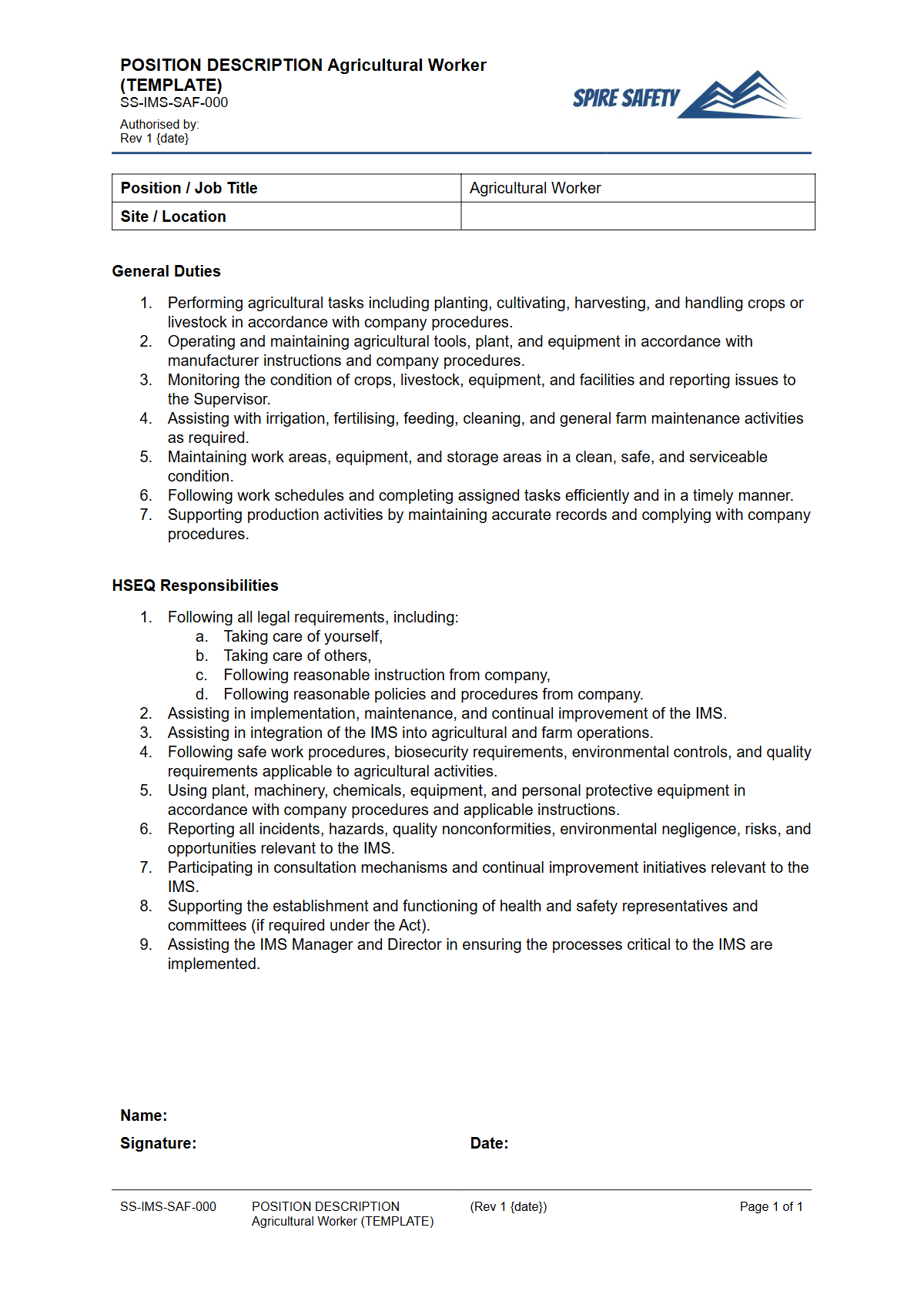
Purpose of the Free Position Description (Agricultural Worker) Template
A well-drafted position description is a critical tool for any agricultural business. Our Free Position Description (Agricultural Worker) Template provides a structured starting point for clearly defining the roles, responsibilities, and safety obligations of your farm hands and general agricultural staff.
Using a formal document helps to set clear expectations from the outset, supporting effective recruitment, onboarding, and performance management. It ensures that every worker understands their specific duties, reporting lines, and how their role contributes to the overall safety and productivity of the farm.
This template is designed to capture the diverse tasks involved in modern farming, from crop management and animal husbandry to equipment operation and general maintenance. By clearly articulating these requirements, you create a foundation for a safer and more organised work environment.
A detailed position description also serves as a reference point for both the worker and management, helping to minimise confusion about job expectations and responsibilities. It is a fundamental component of good human resources and safety management practice within the agricultural industry.
How to use the Free Position Description (Agricultural Worker) Template
This Position Description template is available for download in both DOCX for easy editing and PDF for straightforward printing and distribution. To get the most value from this resource, it must be adapted to the specific context of your operation.
Agricultural workplaces are incredibly diverse, and a generic document will not capture the unique risks and duties of your site.
Follow these steps to adapt the template:
- Review and Customise: Go through each section and replace the placeholder text with details relevant to your farm. This includes specific types of crops, livestock, machinery used, and daily tasks.
- Detail Key Responsibilities: Be specific about the primary duties. Instead of just “operate machinery,” list the specific equipment, such as tractors, harvesters, or balers.
- Specify Qualifications: List all mandatory and desirable qualifications, such as a driver's licence, chemical handling certificate (e.g., ChemCert), or first aid training.
- Integrate WHS Duties: Clearly outline the worker's safety responsibilities, such as participating in toolbox talks, reporting hazards and incidents, and using personal protective equipment (PPE).
Important Note: This template provides a structured foundation, but it is essential that you customise it to reflect the specific machinery, chemicals, and hazards present at your unique agricultural workplace. Integrating this document into broader comprehensive WHS management systems ensures consistency and reinforces your commitment to safety.
Integrating WHS into the Role
Safety on a farm is not a separate task—it's an integral part of every activity. This position description encourages that mindset by embedding WHS duties directly into the role's core responsibilities.
This includes proactive measures like performing regular WHS inspections for agricultural sites and participating in risk assessments. A worker's role should explicitly state their duty to follow all safety procedures, report hazards immediately, and contribute to a positive safety culture.
For many roles, it's also important to clarify the terminology used in your safety procedures. Ambiguity can lead to misunderstanding and risk.
Referencing a glossary of key work health and safety definitions can help ensure everyone understands terms like 'PCBU', 'hazard', and 'risk' in the same way.
Equipment and Task Competency
Agricultural work often involves operating powerful and potentially dangerous machinery. A position description should list the types of equipment the worker is expected to use, which in turn informs your training and competency requirements.
It's not enough for a worker to simply be assigned a task; the PCBU has a duty to ensure they are competent to perform it safely. This includes conducting routine pre-start checks for equipment like feed mixers to identify faults before they cause an incident.
For high-risk equipment, formal competency assessments are crucial. After providing training, you can use specific tools for verifying competency for equipment like pressure cleaners and other common farm plant.
This creates a documented record that the worker has demonstrated their ability to operate the equipment safely, fulfilling a key WHS obligation.
When to use it
A position description for an agricultural worker is a versatile document that should be used throughout the employment lifecycle. Its primary use is during the recruitment and hiring process to attract suitable candidates and provide clarity on the job's demands.
It is also an essential tool for onboarding new employees, serving as a guide during their induction. Furthermore, it should be referenced during performance reviews to assess achievement against expectations and to identify areas for professional development or further training.
In the unfortunate event of a workplace incident, a clear position description can also help in investigations by clarifying the expected duties and responsibilities of those involved.
Who should use it
This template is designed for anyone responsible for managing staff in an agricultural setting. This includes Farm Owners, Station Managers, Vineyard Managers, and HR personnel.
It provides a standardised format that helps ensure all roles are defined with the same level of detail and care. WHS advisors and managers can also use this document to ensure that safety responsibilities are formally assigned and communicated to every worker.
For businesses seeking to improve their overall safety framework, seeking specialist WHS consulting can help integrate documents like this into a robust and effective safety system.
Agricultural work is physically demanding and often performed in challenging environmental conditions. It is crucial to outline duties related to personal wellbeing, such as managing fatigue and staying hydrated.
Reinforcing these messages through regular training, such as toolbox talks on hydration and nutrition on site, supports a healthier and more resilient workforce.
Common mistakes
Common mistakes to avoid
- Using a generic template without customising it for specific farm tasks, crops, and machinery.
- Failing to clearly and specifically list the worker's WHS responsibilities and reporting duties.
- Not involving experienced workers or supervisors in the drafting process to ensure accuracy.
- Forgetting to review and update the description when the role's duties or equipment change.
Legal references
Legal considerations
The following legal requirements may be relevant to this type of work.
- Work Health and Safety Act (Harmonised) — Provides the primary duties for protecting workers and other people from work health and safety risks.
- Work Health and Safety Regulations (Harmonised) — Sets out requirements supporting the management of workplace hazards and risks.
The following codes may be relevant to this type of work.
- Managing WHS Risks Code of Practice — Provides practical guidance on identifying hazards, assessing risks and applying effective controls.
- Work Health and Safety Consultation, Cooperation and Coordination Code of Practice — Provides practical guidance on consulting workers and coordinating with other duty holders.
- Managing the Work Environment and Facilities Code of Practice — Provides practical guidance on safe work environments, workplace facilities and related controls.
Did you know
A High-Risk Industry
The agriculture, forestry, and fishing industry consistently ranks among the top industries for serious injuries and fatalities in Australia, making documented safety procedures critically important.
Tractor Safety
Tractors are the leading cause of death on Australian farms, with rollovers being the most common cause. This highlights the need for robust training, competency checks, and safe operating procedures.
FAQ
Frequently asked questions
01Why is a WHS section important in an agricultural worker's position description?
02Can I use this template for a farm supervisor or manager position?
03What other documents should accompany this position description during onboarding?
04How often should a position description for an agricultural worker be reviewed?
Share this resource
Free Position Description (Agricultural Worker) Template
Browse Categories
How To Use It
- 1Download and open in Word or PDF.
- 2Replace the placeholders with your business details.
- 3Get it reviewed by a WHS specialist before rollout.
Need it customised?
Our WHS consultants can adapt this template to your site, run a gap analysis, or audit what you already have in place.
Book a Free Consultation WHS consulting servicesor call 1300 156 382