
Free Safe Operating Procedure (Absorbent Cleanup) Template
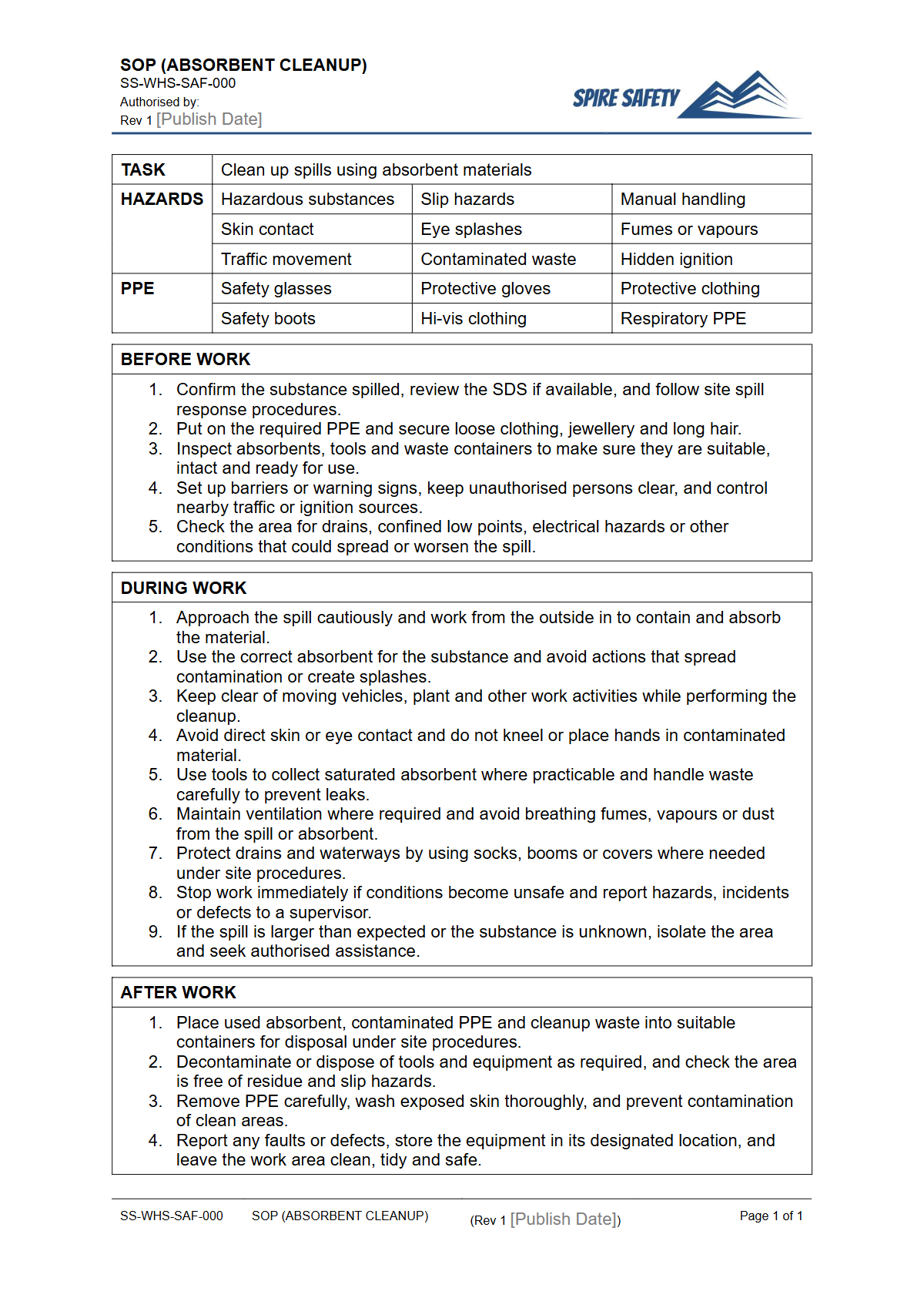
Download our free Safe Operating Procedure (SOP) for absorbent cleanup. This DOCX and PDF template helps you outline safe work systems for managing spills.
Free Safe Operating Procedure (Absorbent Cleanup) Template
DOCX • 126 KB + PDF
Updated Oct 2026
No signup required
Purpose of the Free Safe Operating Procedure (Absorbent Cleanup) Template
Managing liquid spills effectively is crucial for maintaining a safe workplace. This Free Safe Operating Procedure (Absorbent Cleanup) Template provides a structured framework for documenting the step-by-step process for cleaning up spills using absorbent materials.
A clear SOP minimises risks such as slips, trips, falls, and exposure to hazardous substances. By establishing a standardised and safe method for spill response, you can ensure workers are prepared, act consistently, and reduce the likelihood of incidents and injuries.
A well-drafted Safe Operating Procedure helps fulfil your duty of care by systematically addressing foreseeable hazards. Documenting procedures for common tasks is a fundamental part of risk management, just as it is for controlling risks associated with falls from height, as outlined in our FREE Step Ladder SOP Template.
Video walkthrough
How to use the Free Safe Operating Procedure (Absorbent Cleanup) Template
This template is provided as a fully editable DOCX file, with a PDF version also available for easy printing and distribution. To use it, simply download the file and customise it with details specific to your workplace, including the types of absorbents used, the potential liquids that could be spilt, required Personal Protective Equipment (PPE), and emergency contact information.
This procedure should be integrated into your broader safety framework and WHS management systems to ensure it is communicated, understood, and followed by all relevant personnel.
Important: This is a template only. It provides a starting point for developing your own site-specific Safe Operating Procedure.
We are not WHS consultants, and this document must be customised by a competent person to suit the unique hazards, equipment, and environment of your workplace. You must conduct your own risk assessment and ensure the final procedure is practical and effective for your team.
When to use this Safe Operating Procedure
This SOP is designed for any situation where absorbent materials are used to clean up liquid spills. This includes workshops, manufacturing facilities, warehouses, laboratories, commercial kitchens, and maintenance areas.
It is particularly relevant in environments where oils, coolants, solvents, chemicals, or even simple water spills can create a significant slip hazard or exposure risk. For instance, a spill near machinery requires a prompt and safe response, similar to how other high-risk tasks are managed with dedicated procedures like a FREE CNC Machine SOP (Safe Operating Procedure) Template.
Who should use this Safe Operating Procedure
This Safe Operating Procedure should be used by any worker tasked with cleaning up spills. This includes maintenance staff, machine operators, cleaners, laboratory technicians, and general hands.
Supervisors and managers also have a key role; they are responsible for ensuring workers are trained on the procedure, have access to the necessary spill kits and PPE, and follow the SOP correctly. Proper training ensures that all staff, whether cleaning a spill or operating equipment detailed in a FREE Body Truck SOP (Safe Operating Procedure) Template, understand and adhere to documented safety protocols.
Furthermore, WHS officers and committee members can use this template as a basis for developing and reviewing workplace safety protocols. Regular reviews and checks are vital for maintaining a safe system of work.
Undertaking periodic WHS compliance auditing helps verify that procedures like this are being implemented effectively and remain relevant to your current operations.
Spire Safety offers a wide range of templates and documents to help you build a safer workplace. You can explore our complete collection in the free WHS resources library for more tools to support your safety management system.
Common mistakes
Common mistakes to avoid
- Using the wrong type of absorbent for the chemical spilt (e.g., using a universal absorbent on hydrofluoric acid).
- Failing to wear appropriate Personal Protective Equipment (PPE) during cleanup, leading to chemical burns or respiratory exposure.
- Incorrectly disposing of used absorbent material, which may be classified as hazardous waste.
- Not cordoning off the spill area, allowing others to walk through and spread the contamination or slip.
Legal references
Legal considerations
The following legal requirements may be relevant to this type of work.
- Work Health and Safety Act (Harmonised) — Provides the primary duties for protecting workers and other people from work health and safety risks.
- Work Health and Safety Regulations (Harmonised) — Sets out requirements supporting the management of workplace hazards and risks.
The following codes may be relevant to this type of work.
- Managing WHS Risks Code of Practice — Provides practical guidance on identifying hazards, assessing risks and applying effective controls.
- Work Health and Safety Consultation, Cooperation and Coordination Code of Practice — Provides practical guidance on consulting workers and coordinating with other duty holders.
- Managing the Work Environment and Facilities Code of Practice — Provides practical guidance on safe work environments, workplace facilities and related controls.
Did you know
A Common Hazard
According to Safe Work Australia, slips, trips, and falls are the second leading cause of serious workers' compensation claims, making effective spill management a critical preventative measure.
FAQ
Frequently asked questions
01What should be included in an SOP for absorbent cleanup?
02Are spill kits a legal requirement in Australia?
03How often should workers be trained on spill cleanup procedures?
04Can I use sand instead of a commercial absorbent?
Share this resource
Free Safe Operating Procedure (Absorbent Cleanup) Template
Browse Categories
How To Use It
- 1Download and open in Word or PDF.
- 2Replace the placeholders with your business details.
- 3Get it reviewed by a WHS specialist before rollout.
Need it customised?
Our WHS consultants can adapt this template to your site, run a gap analysis, or audit what you already have in place.
Book a Free Consultation WHS consulting servicesor call 1300 156 382
Related templates
- Free Safe Operating Procedure (AC Refrigerant Recovery) Template
- Free Safe Operating Procedure (AC Vacuum Pump) Template
- Free Safe Operating Procedure (Access Control Panel) Template
- Free Safe Operating Procedure (Access Hatch Inspection) Template
- Free Safe Operating Procedure (Accessible Bus Loading) Template
- Free Safe Operating Procedure (Accessible Van Loading) Template