
Free Safe Operating Procedure (Cash Drawer Handling) Template
Download our free Safe Operating Procedure for cash drawer handling. This template helps document safe work practices for retail and hospitality.
Free Safe Operating Procedure (Cash Drawer Handling) Template
DOCX • 126 KB + PDF
Updated Oct 2026
No signup required
Purpose of the Free Safe Operating Procedure (Cash Drawer Handling) Template
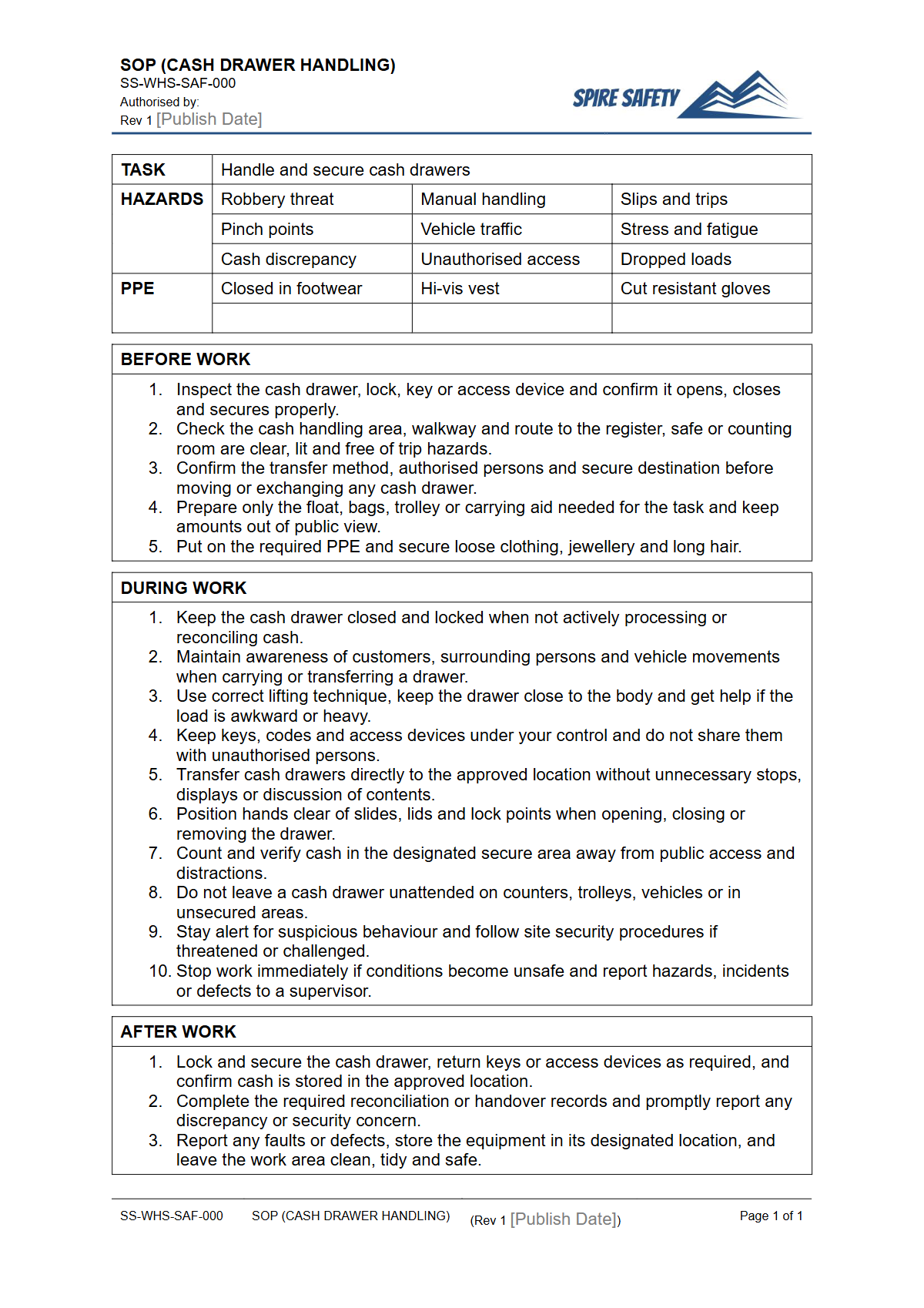
This Free Safe Operating Procedure (Cash Drawer Handling) Template provides a structured framework for businesses to document the safe methods for managing cash drawers and point-of-sale transactions. Handling cash, while a routine task in many retail and hospitality settings, carries specific risks that must be managed.
This SOP helps you formally address hazards such as armed robbery, internal theft, manual handling injuries from heavy coin trays, and ergonomic strain from repetitive movements at the till.
By implementing a clear SOP, your organisation can standardise procedures, ensure all staff members are aware of their responsibilities, and provide a consistent basis for training. This document serves as a critical component of your overall safety management framework, demonstrating a commitment to protecting your workers.
Integrating specific procedures like this one is a key step in developing comprehensive WHS management systems that are effective and easy to follow.
Video walkthrough
How to use the Free Safe Operating Procedure (Cash Drawer Handling) Template
This document is a foundational template designed to be adapted to your unique operational environment. It is not a complete, out-of-the-box solution.
You must conduct your own risk assessment and modify the content to suit your specific tills, cash management software, workplace layout, and security arrangements. It is crucial to define clear limits for cash held in the drawer, procedures for cash clearances, and steps to take during and after a security incident.
Important Note: This document is a template only. You must customise it to reflect the specific equipment, processes, and risks in your workplace.
We strongly recommend you consult with your workers and other relevant stakeholders during this process.
To use the template effectively:
- Download the DOCX file and add your company name and logo.
- Review each section and add, remove, or modify steps to align with your site's procedures.
- Clearly specify the make and model of the cash drawer or POS system if applicable.
- Incorporate details from your site-specific risk assessment, including control measures for identified hazards.
- Train all relevant workers on the final, approved version of the SOP and record their acknowledgement.
If you require expert assistance to ensure your procedures are robust and effectively address your specific risks, engaging professional WHS consulting services can provide valuable guidance and peace of mind.
When to use it
This Safe Operating Procedure should be the primary reference document for all activities involving the cash drawer. It is a live document that should be used for:
- Daily Operations: Guiding staff during opening procedures, float setup, processing sales, and end-of-shift cash balancing.
- Cash Security: Defining the process and frequency for clearing excess cash from the till to a secure location like a safe or back office.
- Incident Response: Providing clear, step-by-step instructions for workers to follow in the event of a robbery or other security threat.
- Training and Induction: Forming a core part of the onboarding process for new employees and serving as a basis for regular refresher training for all staff.
Who should use it
This SOP is intended for all personnel who interact with or have responsibility for cash handling operations. This includes, but is not limited to:
- Cashiers and retail staff
- Customer service representatives
- Hospitality workers (bar and counter staff)
- Supervisors and team leaders
- Venue and store managers
- Loss prevention officers
- WHS representatives and committee members
Management should ensure that the procedure is readily accessible to all relevant workers during their shifts. The effectiveness of its implementation is often a key point of focus during a WHS compliance auditing process, where an auditor will verify that workers are not only trained but also following the documented steps.
A robust safety system often involves multiple documented procedures for common tasks. For example, alongside cash handling, retail environments frequently require staff to access items on high shelves, which should be covered by a separate procedure like our FREE Step Ladder SOP Template.
By documenting all key processes, you create a comprehensive library of safe work methods that support your safety culture. You can explore more templates and checklists in our free WHS resources library to build out your documentation.
Common mistakes
Common mistakes to avoid
- Using the generic template without customising it for the specific workplace layout and security needs.
- Failing to adequately train all new and existing staff on the finalised SOP.
- Allowing large sums of cash to build up in the till, increasing the potential loss from theft or robbery.
- Neglecting to review and update the procedure after an incident or when processes change.
Legal references
Legal considerations
The following legal requirements may be relevant to this type of work.
- Work Health and Safety Act (Harmonised) — Provides the primary duties for protecting workers and other people from work health and safety risks.
- Work Health and Safety Regulations (Harmonised) — Sets out requirements supporting the management of workplace hazards and risks.
The following codes may be relevant to this type of work.
- Managing WHS Risks Code of Practice — Provides practical guidance on identifying hazards, assessing risks and applying effective controls.
- Work Health and Safety Consultation, Cooperation and Coordination Code of Practice — Provides practical guidance on consulting workers and coordinating with other duty holders.
- Managing the Work Environment and Facilities Code of Practice — Provides practical guidance on safe work environments, workplace facilities and related controls.
Did you know
Ergonomic Impact
Poorly positioned cash drawers and scanners can contribute to musculoskeletal disorders. Designing the point-of-sale area to minimise awkward reaching, twisting, and repetitive motions is a key control measure.
Cash in Decline
While still important, the use of cash for transactions in Australia is declining. In 2022, cash was used for only 13% of payments, down from 69% in 2007, shifting some workplace risks from cash security to digital security.
FAQ
Frequently asked questions
01What risks does a cash drawer handling SOP address?
02Is a cash drawer handling SOP a legal requirement in Australia?
03How often should we review our cash handling procedures?
04Who needs to be trained on this Safe Operating Procedure?
Share this resource
Free Safe Operating Procedure (Cash Drawer Handling) Template
Browse Categories
How To Use It
- 1Download and open in Word or PDF.
- 2Replace the placeholders with your business details.
- 3Get it reviewed by a WHS specialist before rollout.
Need it customised?
Our WHS consultants can adapt this template to your site, run a gap analysis, or audit what you already have in place.
Book a Free Consultation WHS consulting servicesor call 1300 156 382
Related templates
- Free Safe Operating Procedure (Cash Safe Access) Template
- Free Safe Operating Procedure (Cash Transit Handover) Template
- Free Safe Operating Procedure (Cask Handling) Template
- Free Safe Operating Procedure (Casket Handling) Template
- Free Safe Operating Procedure (Catch Basin Cleaning) Template
- Free Safe Operating Procedure (Catch Basin Inspection) Template