
Free Safe Operating Procedure (Casket Handling) Template
Formalise your casket handling procedures with our free SOP template. Manage manual handling risks and ensure consistent, safe work practices. Download today.
Free Safe Operating Procedure (Casket Handling) Template
DOCX • 126 KB + PDF
Updated Oct 2026
No signup required
Purpose of the Free Safe Operating Procedure (Casket Handling) Template
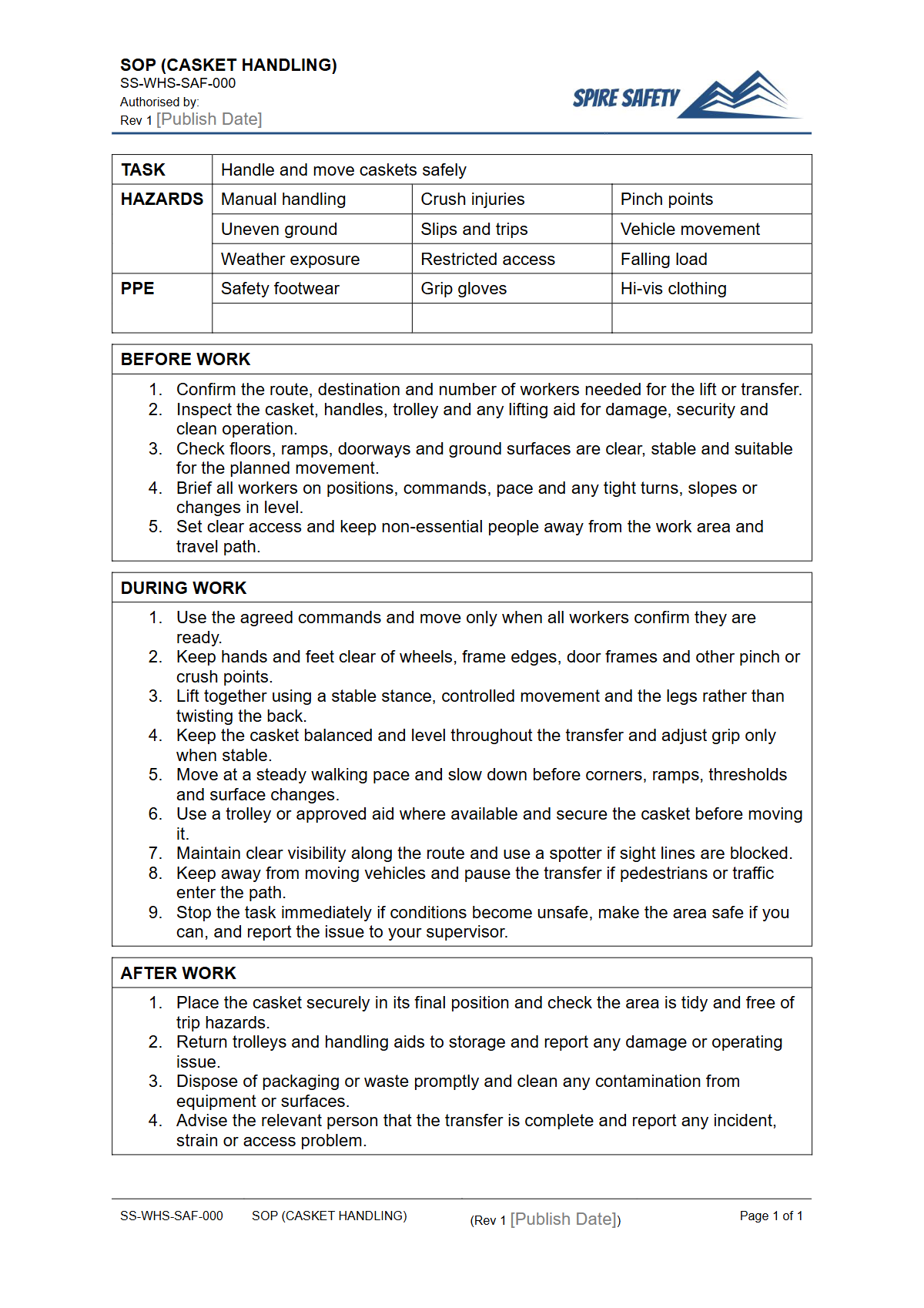
Handling caskets presents significant manual handling risks due to their weight, awkward shape, and the sensitive nature of the task. This Free Safe Operating Procedure (Casket Handling) Template provides a structured framework for funeral homes, crematoriums, and related service providers to document and standardise the process.
Its purpose is to control hazards and reduce the risk of musculoskeletal injuries to workers. By implementing a clear SOP, your organisation can ensure all team members follow a consistent, safe method for lifting, carrying, and transporting caskets, aligning with Australian WHS best practices.
A well-defined SOP is a cornerstone of an effective safety system. It serves as a vital training tool for new employees and a reference for experienced staff, promoting a proactive safety culture.
This template helps you outline step-by-step instructions, identify required personal protective equipment (PPE), and specify the control measures needed to manage identified risks. Integrating this procedure into your broader WHS management systems demonstrates a commitment to worker health and safety.
Video walkthrough
How to use the Free Safe Operating Procedure (Casket Handling) Template
Our Free Safe Operating Procedure (Casket handling) Template is provided in both DOCX and PDF formats for your convenience. The DOCX file is fully editable, allowing you to tailor the content to the specific environment, equipment, and tasks at your workplace.
To use it effectively, download the document and work through each section, consulting with workers who perform the task to ensure the procedure reflects real-world practices. You should detail the specific types of caskets handled, the lifting equipment available (e.g., hoists, trolleys, transfer devices), and the typical environments where handling occurs (e.g., chapels, mortuaries, gravesides).
It is critical to adapt this template to your unique operational context. We have created this document as a comprehensive starting point, but it is not a complete, out-of-the-box solution.
You must conduct your own risk assessment and customise the SOP to address the specific hazards present in your workplace. This includes adding site-specific details, vehicle information, and emergency procedures.
For tasks involving vehicles, you may also find our free Body Truck SOP template a useful supplementary resource.
When to use it
A casket handling SOP should be used whenever a worker is required to lift, carry, lower, push, pull, or otherwise move a casket. This applies across all stages of the funeral service process, from receiving a casket at the facility to final placement.
Specific scenarios include transferring a casket from a vehicle, moving it into or out of a cool room, placing it in a chapel for a service, or positioning it for burial or cremation. It should also be referenced during employee training, induction, and regular safety briefings.
Regular reviews are essential. The SOP should be consulted and potentially updated after any incident or near miss, when new equipment is introduced, if the work environment changes, or as part of a scheduled document review cycle.
Periodic WHS compliance auditing can help identify gaps in your procedures and ensure they remain effective and relevant to your operations.
Who should use it
This SOP is designed for any Person Conducting a Business or Undertaking (PCBU) in the funeral industry, including funeral directors, mortuary managers, and crematorium operators. Managers and supervisors are responsible for implementing the SOP, providing adequate training, and ensuring it is followed correctly.
The procedure is a direct resource for the workers who perform the handling tasks, such as funeral attendants, mortuary technicians, and grounds crew. By providing clear, accessible instructions, it empowers them to work safely and consistently.
WHS managers and safety officers can use this template to formalise risk management processes related to hazardous manual tasks. It serves as documented evidence of risk controls and safe work systems.
Even for tasks like accessing caskets stored at height, procedural discipline is key, which might involve referencing other specific procedures like our FREE Step Ladder SOP Template. For businesses seeking to improve their overall safety framework, our expert WHS consulting services can provide tailored support.
This document is one of many professionally developed templates available to download from our free WHS resources library, designed to help Australian businesses build safer workplaces.
Common mistakes
Common mistakes to avoid
- Using the template without customising it for specific workplace equipment and environments.
- Failing to provide practical, hands-on training to workers on the documented procedure.
- Neglecting to mandate and provide appropriate mechanical lifting aids where reasonably practicable.
- Not reviewing and updating the SOP after a near miss, incident, or change in work practices.
Legal references
Legal considerations
The following legal requirements may be relevant to this type of work.
- Work Health and Safety Act (Harmonised) — Provides the primary duties for protecting workers and other people from work health and safety risks.
- Work Health and Safety Regulations (Harmonised) — Sets out requirements supporting the management of workplace hazards and risks.
The following codes may be relevant to this type of work.
- Managing WHS Risks Code of Practice — Provides practical guidance on identifying hazards, assessing risks and applying effective controls.
- Work Health and Safety Consultation, Cooperation and Coordination Code of Practice — Provides practical guidance on consulting workers and coordinating with other duty holders.
- Managing the Work Environment and Facilities Code of Practice — Provides practical guidance on safe work environments, workplace facilities and related controls.
Did you know
Manual Handling Injuries
According to Safe Work Australia, serious claims for injuries resulting from manual handling have accounted for around 30% of all serious claims over the last decade, highlighting the importance of proper procedures for tasks like casket handling.
Mechanical Aids
Using mechanical aids such as casket lifters, hoists, and specialised trolleys can eliminate or significantly reduce the manual effort required, dramatically lowering the risk of injury for funeral service workers.
FAQ
Frequently asked questions
01What should be included in a casket handling SOP?
02Are there specific WHS regulations for handling caskets in Australia?
03How often should we review our casket handling SOP?
04What are the main manual handling risks with caskets?
Share this resource
Free Safe Operating Procedure (Casket Handling) Template
Browse Categories
How To Use It
- 1Download and open in Word or PDF.
- 2Replace the placeholders with your business details.
- 3Get it reviewed by a WHS specialist before rollout.
Need it customised?
Our WHS consultants can adapt this template to your site, run a gap analysis, or audit what you already have in place.
Book a Free Consultation WHS consulting servicesor call 1300 156 382
Related templates
- Free Safe Operating Procedure (Catch Basin Cleaning) Template
- Free Safe Operating Procedure (Catch Basin Inspection) Template
- Free Safe Operating Procedure (Catering Cart Handling) Template
- Free Safe Operating Procedure (Cattle Drafting) Template
- Free Safe Operating Procedure (Cattle Feeding) Template
- Free Safe Operating Procedure (Cattle Footbath) Template