
Free Safe Operating Procedure (Catch Basin Inspection) Template
Download our free Safe Operating Procedure for catch basin inspections. This customisable DOCX & PDF resource helps formalise stormwater management safety.
Free Safe Operating Procedure (Catch Basin Inspection) Template
DOCX • 126 KB + PDF
Updated Oct 2026
No signup required
Purpose of the Free Safe Operating Procedure (Catch Basin Inspection) Template
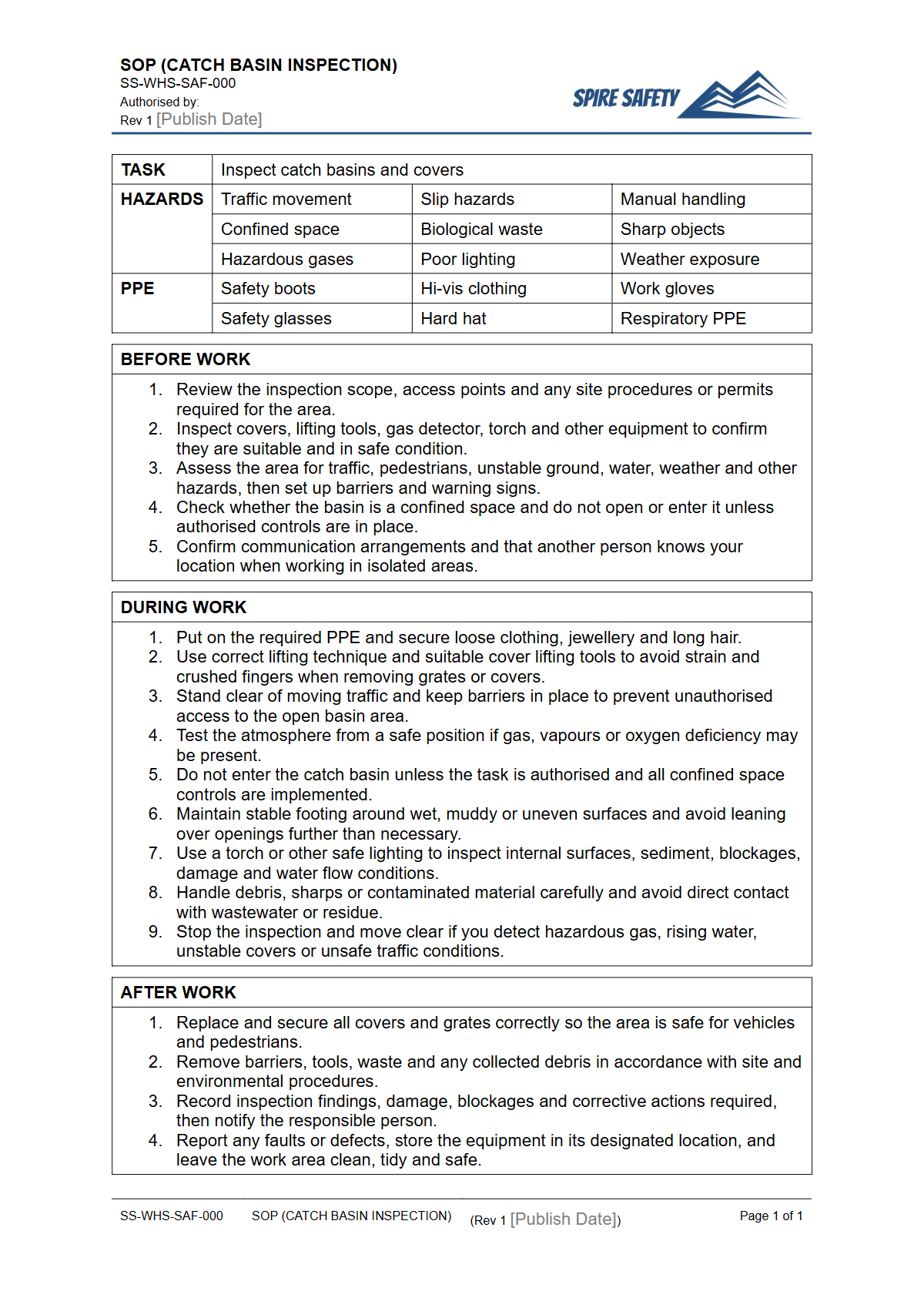
This Free Safe Operating Procedure (Catch Basin Inspection) Template provides a structured framework for businesses to document a safe and repeatable process for inspecting and cleaning stormwater catch basins. Regularly inspecting these assets is crucial for property maintenance, environmental compliance, and flood prevention.
However, the task involves significant hazards, including manual handling of heavy grates, exposure to traffic, slips and falls, and potential contact with hazardous substances or atmospheres within the basin.
Using this SOP helps formalise safety protocols, ensuring workers are aware of the risks and the control measures required to perform the job safely. It acts as a vital tool for training, supervision, and demonstrating a commitment to proactive WHS management.
By outlining clear, step-by-step instructions, this document helps any organisation reduce the risk of injury and ensure operational consistency.
Video walkthrough
How to use the Free Safe Operating Procedure (Catch Basin Inspection) Template
Our Safe Operating Procedure for catch basin inspection is available as a fully editable DOCX file and a print-ready PDF. To use it, simply download the file and integrate it into your existing safety documentation.
The key to its effectiveness is thorough customisation to reflect the specific realities of your workplace.
IMPORTANT: This is a template only. We are not familiar with your specific site, equipment, personnel, or local environmental regulations.
You MUST customise this document by conducting your own site-specific risk assessment. This involves identifying unique hazards at your location—such as specific traffic patterns, grate types, or contaminants—and incorporating the relevant control measures into the final SOP. Effective integration is a core component of well-designed WHS management systems.
When to Use It
A catch basin inspection SOP should be used every time the task is performed. It is particularly important in several key scenarios:
- Routine Maintenance: As part of a scheduled preventative maintenance program to ensure basins are clear and functional before the wet season.
- Post-Storm Inspections: After significant rainfall events to check for blockages, debris accumulation, and structural damage.
- Reactive Cleaning: When a blockage is reported or identified, the SOP guides the immediate response to clear it safely.
- Compliance Checks: During environmental or site safety audits to demonstrate that formal procedures are in place for stormwater management. Regular procedural reviews are a key part of any WHS compliance auditing program.
Who Should Use It
This SOP is designed for use by any personnel tasked with inspecting or maintaining stormwater drainage systems. This includes:
- Maintenance and Facilities Management Teams
- Groundskeeping Staff
- Civil Construction Workers and Site Labourers
- Environmental Officers and Technicians
- Site Supervisors and Managers responsible for overseeing work
All workers using this procedure must be trained on its contents and deemed competent to perform the task safely. This includes training on manual handling techniques, traffic management, PPE use, and emergency response. For related groundworks, ensure you also have procedures like our free Trencher SOP template.
What's Included in the Template
This comprehensive template provides a solid foundation for building your site-specific procedure. It includes clearly defined sections for:
- Required PPE: Lists personal protective equipment such as high-visibility clothing, safety glasses, gloves, and steel-capped boots.
- Risk Assessment: A pre-filled risk matrix identifying common hazards and suggesting control measures, which must be reviewed and amended.
- Pre-operational Checks: Steps to take before starting, including inspecting tools, setting up exclusion zones, and assessing the immediate environment.
- Step-by-Step Procedure: A logical sequence covering traffic control, safe grate lifting techniques, inspection methods, and cleaning processes. If waste or debris needs to be transported off-site, a separate procedure such as our Body Truck SOP may be required.
- Emergency Procedures: Guidance on responding to incidents like injuries, spills, or discovery of hazardous materials.
Integrating with Your Overall Safety System
A Safe Operating Procedure is most effective when it functions as part of a broader safety framework. This document should support, and be supported by, other WHS documents like a Safe Work Method Statement (SWMS) if the task is deemed high-risk construction work.
Sometimes access may require working at a minor height, making it important to consult documents like our Step Ladder SOP template. For expert guidance on integrating this SOP into a comprehensive safety system, consider engaging professional WHS consulting services.
By establishing and following a clear SOP, you empower your team to work safely and efficiently. This proactive approach to safety not only protects your workers but also enhances your operational resilience and compliance posture.
You can explore our complete free WHS resources library for more templates to support your business.
Common mistakes
Common mistakes to avoid
- Neglecting to check for hazardous atmospheres (like hydrogen sulphide) before and after lifting the grate.
- Using the template without customising it for specific site conditions, traffic, and grate types.
- Failing to implement proper traffic management or exclusion zones around the work area.
- Assuming the task is 'simple' and not providing adequate worker training, supervision, or mechanical lifting aids.
Legal references
Legal considerations
The following legal requirements may be relevant to this type of work.
- Work Health and Safety Act (Harmonised) — Provides the primary duties for protecting workers and other people from work health and safety risks.
- Work Health and Safety Regulations (Harmonised) — Sets out requirements supporting the management of workplace hazards and risks.
The following codes may be relevant to this type of work.
- Managing WHS Risks Code of Practice — Provides practical guidance on identifying hazards, assessing risks and applying effective controls.
- Work Health and Safety Consultation, Cooperation and Coordination Code of Practice — Provides practical guidance on consulting workers and coordinating with other duty holders.
- Managing the Work Environment and Facilities Code of Practice — Provides practical guidance on safe work environments, workplace facilities and related controls.
Did you know
Stormwater Pollution
Blocked or poorly maintained catch basins are a major contributor to pollution in Australia's waterways, releasing litter, chemicals, and sediment during rainfall.
Manual Handling Risks
Maintenance tasks frequently involve lifting heavy grates, a leading cause of musculoskeletal injuries if not managed with correct procedures and mechanical aids.
FAQ
Frequently asked questions
01What key hazards are involved in catch basin inspection?
02Is a Safe Operating Procedure legally required for catch basin inspection in Australia?
03How often should a catch basin inspection SOP be reviewed?
04Can this template be used for confined space entry?
Share this resource
Free Safe Operating Procedure (Catch Basin Inspection) Template
Browse Categories
How To Use It
- 1Download and open in Word or PDF.
- 2Replace the placeholders with your business details.
- 3Get it reviewed by a WHS specialist before rollout.
Need it customised?
Our WHS consultants can adapt this template to your site, run a gap analysis, or audit what you already have in place.
Book a Free Consultation WHS consulting servicesor call 1300 156 382
Related templates
- Free Safe Operating Procedure (Catering Cart Handling) Template
- Free Safe Operating Procedure (Cattle Drafting) Template
- Free Safe Operating Procedure (Cattle Feeding) Template
- Free Safe Operating Procedure (Cattle Footbath) Template
- Free Safe Operating Procedure (Cattle Loading Ramp) Template
- Free Safe Operating Procedure (Cattle Loading) Template