
Free Safe Operating Procedure (Cattle Footbath) Template
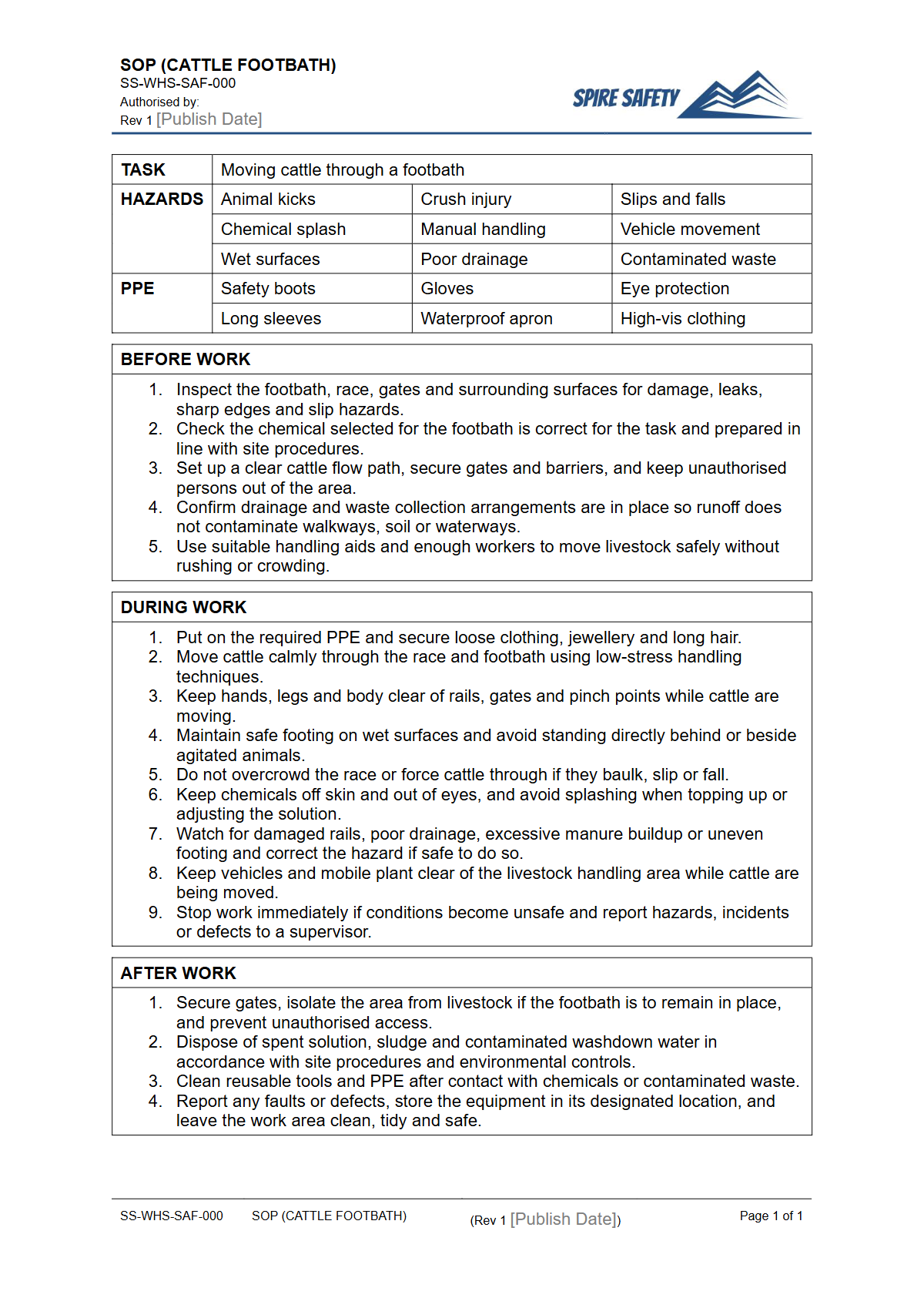
Download our free Safe Operating Procedure (Cattle Footbath) Template to document safe work practices for cattle hoof care. Customise our DOCX or use the PDF.
Free Safe Operating Procedure (Cattle Footbath) Template
DOCX • 126 KB + PDF
Updated Oct 2026
No signup required
Purpose of the Free Safe Operating Procedure (Cattle Footbath) Template
Managing cattle health effectively requires safe and consistent processes, especially for routine tasks like footbaths. This Free Safe Operating Procedure (Cattle Footbath) Template provides a structured starting point for documenting the approved method for preparing, using, and cleaning a cattle footbath on your property.
Using an SOP helps control significant risks, including exposure to hazardous chemicals, manual handling injuries from lifting chemical containers, and unpredictable animal behaviour. It forms a critical part of a farm's overall safety framework.
By clearly outlining the steps, required personal protective equipment (PPE), and emergency procedures, this SOP serves as a vital training and reference tool. It ensures all workers, from new hands to experienced station managers, understand and follow the same safe work method every time.
Documenting these processes is a fundamental component of effective WHS management systems, helping to meet your duty of care obligations under Australian WHS legislation.
Video walkthrough
How to use the Free Safe Operating Procedure (Cattle Footbath) Template
This resource is available as a fully editable DOCX file and a ready-to-print PDF. The primary goal is for you to adapt the document to your specific operational context.
This involves detailing the exact type of footbath, the specific chemicals used (e.g., copper sulphate, formalin), the layout of your yards, and the procedures for moving cattle through the bath safely.
IMPORTANT: This document is a template and must be customised to suit the specific equipment, chemicals, and processes used in your workplace. We recommend a person with appropriate knowledge of the task and WHS principles consults with workers to review and approve the final document.
For assistance with complex tasks or customisation, consider engaging specialist WHS consulting services.
When to use this Safe Operating Procedure
A Safe Operating Procedure for a cattle footbath should be used as a primary reference document for several key activities. It is essential for inducting new workers and for providing refresher training to existing staff to ensure competency is maintained.
The SOP should be reviewed before starting the task, especially if it is performed infrequently. It also serves as a benchmark for supervisors conducting safety observations or performance reviews.
The finalised SOP should be kept in a location where it is easily accessible to all workers who will be performing the task. This might be in the chemical storage shed, the site office, or a protected folder near the cattle yards. Having documented procedures is just as important for agricultural tasks as it is for operating heavy equipment, and a similar level of detail should be applied as you would find in an SOP for operating a dozer.
Who should use it
This SOP is intended for all persons conducting a business or undertaking (PCBUs), farm managers, supervisors, and agricultural workers involved in the cattle footbath process. It helps PCBUs demonstrate that they have established a safe system of work.
For workers, it provides clear, step-by-step instructions that empower them to perform their duties safely and without ambiguity. It is a critical tool for anyone responsible for handling livestock or farm chemicals.
Documenting procedures for all high-risk tasks, from animal husbandry to machinery operation, is best practice. Your farm may also use equipment like telehandlers for moving chemical IBCs or other materials, which also require documented procedures; our free Telehandler SOP template can assist with this.
Consistency across all operational documents creates a stronger safety culture. While this SOP focuses on footbaths, the same principles apply to other rural activities, as seen in a Safe Operating Procedure for a grain drill. You can find more templates like this in our complete free WHS resources library.
Common mistakes
Common mistakes to avoid
- Using incorrect chemical concentrations, which can be ineffective or harm the animals.
- Failing to clean the footbath frequently, leading to a build-up of manure that deactivates the chemicals.
- Poor stock handling techniques that cause stress to cattle and create risks for handlers.
- Not wearing the correct Personal Protective Equipment (PPE) when mixing and handling concentrated chemicals.
Legal references
Legal considerations
The following legal requirements may be relevant to this type of work.
- Work Health and Safety Act (Harmonised) — Provides the primary duties for protecting workers and other people from work health and safety risks.
- Work Health and Safety Regulations (Harmonised) — Sets out requirements supporting the management of workplace hazards and risks.
The following codes may be relevant to this type of work.
- Managing WHS Risks Code of Practice — Provides practical guidance on identifying hazards, assessing risks and applying effective controls.
- Work Health and Safety Consultation, Cooperation and Coordination Code of Practice — Provides practical guidance on consulting workers and coordinating with other duty holders.
- Managing the Work Environment and Facilities Code of Practice — Provides practical guidance on safe work environments, workplace facilities and related controls.
Did you know
Hoof Health Impact
Lameness in cattle, often preventable with regular footbaths, can reduce milk production by up to 25% and significantly impact weight gain and fertility, making hoof health a major economic factor in livestock management.
FAQ
Frequently asked questions
01What chemicals are used in cattle footbaths and what are the risks?
02How often should a cattle footbath SOP be reviewed?
03Is an SOP legally required for using a cattle footbath in Australia?
04What personal protective equipment (PPE) is needed for managing a cattle footbath?
Share this resource
Free Safe Operating Procedure (Cattle Footbath) Template
Browse Categories
How To Use It
- 1Download and open in Word or PDF.
- 2Replace the placeholders with your business details.
- 3Get it reviewed by a WHS specialist before rollout.
Need it customised?
Our WHS consultants can adapt this template to your site, run a gap analysis, or audit what you already have in place.
Book a Free Consultation WHS consulting servicesor call 1300 156 382
Related templates
- Free Safe Operating Procedure (Cattle Loading Ramp) Template
- Free Safe Operating Procedure (Cattle Loading) Template
- Free Safe Operating Procedure (Cattle Race) Template
- Free Safe Operating Procedure (Cattle Weighing) Template
- Free Safe Operating Procedure (Caustic Soda Handling) Template
- Free Safe Operating Procedure (CCTV Drain Camera) Template